
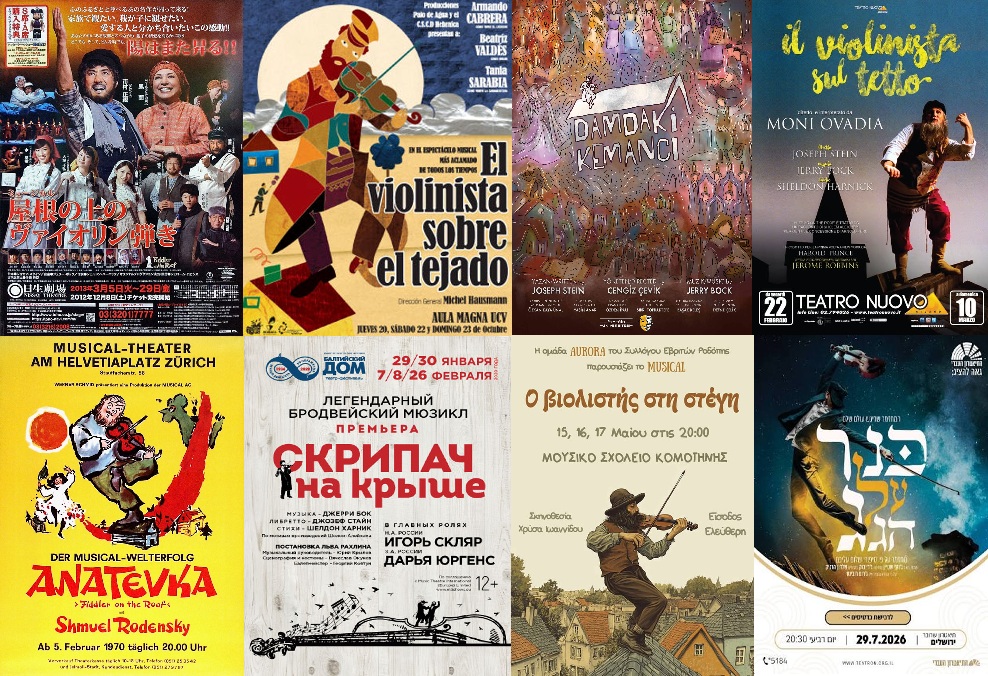
When Fiddler on the Roof premiered on Broadway on September 22, 1964, it told a story rooted in a particular place and time: a Jewish village in Tsarist Russia, on the brink of upheaval. Yet the musical’s afterlife has been anything but local. More than sixty years later, and with the 1971 film adaptation turning 55 in 2026, Fiddler on the Roof continues to circulate across stages, screens, languages, and cultures, remaining unexpectedly contemporary in its concerns with tradition, family, identity, and change.
As the documentary Fiddler: A Miracle of Miracles observed in 2019, Fiddler on the Roof has been performed “every day somewhere around the world.” While this is best understood as a testament to the musical’s extraordinary global reach rather than a literal performance record, it captures an essential truth: Fiddler has become a living work, continually remade in new contexts while remaining anchored in its origins.
This exhibit, TO LIFE: Tradition, Change, and the World of Fiddler on the Roof, brings together books, scores, films, and scholarship that explore how the musical was created, how it reimagines the past, and why it continues to resonate.
From Page to Stage: Sholem Aleichem and Tevye
At the heart of Fiddler on the Roof stands Tevye the Dairyman, created by Yiddish writer Sholem Aleichem. Collections such as Tevye the Dairyman and The Best of Sholem Aleichem allow readers to encounter Tevye first on the page, where humor and moral reflection coexist with anxiety about modernity and survival.Several works in the exhibit trace Tevye’s transformation into a global cultural figure. Century in the Life of Sholem Aleichem’s Tevye follows the character across languages and eras, while The Worlds of Sholem Aleichem situates Tevye within the author’s broader literary legacy. Works on translation such as Translating Sholem Aleichem and Writing in Tongues show how adaptation reshaped Tevye’s voice for new audiences.
Humor is equally central to the story’s enduring appeal. Tevye’s wit allows him to navigate uncertainty, hardship, and social change without surrendering his humanity. Through works on Jewish humor, storytelling, and Sholem Aleichem’s literary legacy, the exhibit explores how laughter functions not merely as entertainment but as a means of resilience and cultural expression.Beyond Sholem Aleichem’s writings, the exhibit highlights the vibrant worlds of Yiddish theatre and cinema that helped shape modern Jewish performance culture. These traditions provided important artistic foundations for the musical’s blend of comedy, music, and storytelling.
Reimagining the Shtetl
Fiddler on the Roof presents a vision of the Eastern European Jewish shtetl that has become one of the most influential representations of Jewish life before mass migration and twentieth-century upheaval. Historical and cultural studies in the exhibit provide insight into the communities that inspired Sholem Aleichem’s stories, while photographic and literary works help illuminate everyday life, religious practice, family relationships, and social change in the world from which Tevye emerged. The exhibit also invites visitors to consider how memories of the shtetl have been preserved, reimagined, and sometimes idealized. Scholarship on Eastern European Jewish history and collective memory demonstrates how later generations have looked back to this world, finding in it both a record of a vanished past and a source of cultural identity.
Creating a Musical: Broadway Craft and Risk
The journey from Yiddish short stories to a Broadway musical was complex and uncertain. The Making of a Musical: Fiddler on the Roof documents the creative risks and debates that shaped the show, while Tradition! chronicles its improbable success. To Broadway, to Life! places Fiddler within the larger body of work created by Jerry Bock and Sheldon Harnick. The exhibit also situates Fiddler within the broader history of the American musical, exploring how writers, composers, producers, directors, and designers collaborated to transform a series of Yiddish stories into one of Broadway’s most enduring works.
Performing Identity on Stage and Screen
As Fiddler reached wider audiences, it became central to conversations about Jewish representation. Acting Jewish and Authentically Jewish explore how ethnicity and belief are negotiated through performance, while studies such as The Jew in American Cinema and Hollywood’s Chosen People situate Fiddler within a broader history of Jewish visibility on screen. The exhibit also explores the landmark 1971 film adaptation directed by Norman Jewison, whose cinematic interpretation introduced Fiddler to new audiences around the world. Film scholarship, memoirs, and documentary works reveal how the story moved from Broadway to Hollywood while retaining its emotional and cultural power.
Music, Meaning, and Celebration
Music gives Fiddler its emotional force. Scores and recordings allow direct engagement with the musical, while critical works such as Music of the Night and The Secret Life of the American Musical reveal how songs like “Tradition” and “To Life” hold celebration and tension in balance. Throughout the musical, music becomes a vehicle for expressing continuity and change, enabling characters to voice hopes, fears, and conflicts that transcend the specific historical setting of the story.
A Musical That Travels
Although rooted in Jewish history, Fiddler on the Roof has traveled widely. The musical has been staged across Europe, the Americas, and Asia, including extensively in Japan, where a producer once told Sheldon Harnick that the story felt “so Japanese.” Works such as Wonder of Wonders and Yiddish Cinema trace this global afterlife. Fiddler’s journey from Yiddish fiction to Broadway musical, Hollywood film, and international phenomenon is also a story of translation. As stories cross languages and cultures, they inevitably change. Yet the exhibit’s works on adaptation, translation, and cultural transmission demonstrate how Tevye’s story has continued to resonate with audiences far removed from Anatevka while remaining connected to its origins.
Taken together, the materials in this exhibit present Fiddler on the Roof not as a fixed classic but as a continuously evolving cultural text. As the film approaches its 55th anniversary in 2026, Fiddler endures as a powerful reflection on how traditions are carried forward forward through time, space, and change. A complete list of the materials in this exhibit can be found at https://libraryguides.mcgill.ca/redpathbookdisplay/To-Life.