
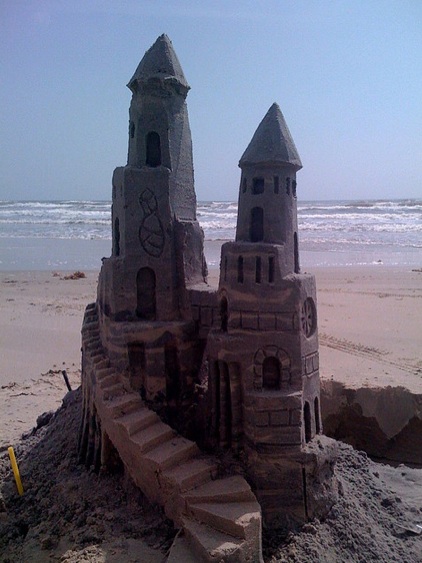
Formula for constructing perfect sandcastles

Researchers from France, Iran, and the Netherlands have published a journal article on “How to construct the perfect sandcastle” in Nature Publishing Group’s Scientific Reports.  They present a mathematical formula for building stable sandcastles, which can be used on land or below water.

According to the authors, the study’s “results are of practical interest for civil engineering and soil mechanics… In addition, it explains the maximum height of, and provides us with a recipe to construct, the perfect sandcastle.”

In ScienceNordic, one of the authors also explains in layman’s terms how it can be applied to building sandcastles on the beach.

Image from Sandyfeet

Olympic fever continues

Anette Hosio, an associate professor in MIT’s Department of Mechanical Engineering recently talked to MIT news about the mechanics of sports. From her points of view, what helped Usain Bolt give the record-breaking performance in 2008 is “his unique combination of both strength and the long stride.” In the following video, Hosio also explained the mystery of the “fast pool” from the perspective of fluid mechanics.

Read more at 3 Questions: Anette Hosoi on engineering and the Olympics

A trip to an ASCE monument of the millennium

During a trip to Chicago last week, I had occasion to see one of the American Society of Civil Engineers’ (ASCE) monuments of the millennium, the Chicago Wastewater System.  By the end of the 19th century, Chicagoans had heavily polluted the Chicago River by dumping all of their garbage in the water, which flowed into Lake Michigan, the source of the city’s drinking supply.  This caused deadly diseases such as cholera and typhus.  To solve the problem, the flow of the Chicago River was reversed, sending it in the opposite direction from Lake Michigan.

Here’s a brief documentary on the reversal of the Chicago River: