These engineering students at Northwestern University are learning to think on their feet. Anyone up for dance classes?
Category Archives: Blog
21st century engineering challenges
The National Academy of Engineering (U.S.) identified 14 challenges in this century that need engineering solutions. These challenges are:
- Make solar energy economical
- Provide energy from fusion
- Develop carbon sequestration methods
- Manage the nitrogen cycle
- Provide access to clean water
- Restore and improve urban infrastructure
- Advance health informatics
- Engineer better medicines
- Reverse-engineer the brain
- Prevent nuclear terror
- Secure cyberspace
- Enhance virtual reality
- Advance personalized learning
- Engineer the tools of scientific discovery
Three minutes to explain yourself
Can you explain your research activities or thesis in 3 minutes to someone outside your field? Jinna Kim in University Affairs reports that many universities are holding prize-winning competitions that require graduate student participants to communicate their work to judges and an audience in just 3 minutes. The idea is to teach students how to promote themselves and their research.
McGill University has an annual event called, “3 Minutes to Change the World” that provides a non-competitive opportunity for graduate students to present their research to a general audience. Below is an example of a presentation from this event:
Star Trek and science
I liked watching “Star Trek: The Next Generation” when I was a teenager. I liked the character of Captain Jean-Luc Picard, who was a scientist, diplomat, and Shakespeare-lover all rolled into one.
The film, “Star Trek into Darkness,” started playing in cinemas this past weekend. As a homage to the movie, Phil Plait provides an amusing look at the science errors in the Star Trek franchise in his blog post, “The Top 6 Star Trek Science Mistakes.”
FracFocus Chemical Disclosure Registry
Both Canada and the U.S. maintain a national registry for the disclosure of chemicals used in hydraulic fracturing:
FracFocus.ca, built by the BC Oil and Gas Commission and conceived based on the American site, is an up-to-date resource for students and professionals in environmental sciences, earth sciences, and engineering, as well as members of the general public. Visitors to the Canadian site can discover the location of oil and gas wells and the chemicals used at each site in British Columbia and Alberta. From the FracFocus.ca Welcome Page: [FracFocus.ca] is a collaboration between provinces, territories, regulators and industry to provide Canadians with objective information on hydraulic fracturing, what legislation and regulations are in place to protect the environment including groundwater, and transparency on the ingredients that make up hydraulic fracturing fluids. Visit the site(s) to learn more.
Particle physics videos from TEDxCERN
Two guys walk into a bar – they just happen to be CERN scientists and they can help explain Higgs boson excitation of the Higgs field. This particle physics video is one of a series of five videos from TEDxCERN. Waltch all five on the TED blog for a little on the birth of the universe, the history of the web and big data, dark matter, and antimatter.
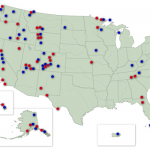
America’s 100 Best Adventures
Have you finished your exams and are you planning your summer trips? If so, you will probably find this article useful. National Geographic recently created a list of 100 most appealing adventure places in the States where you might be able to enjoy your favorite activities in pure nature.
If you decide to visit several places on one trip, you may draw your itinerary using this interactive map.
If you cannot go to any of these sites this summer, you can at least play fun puzzles by creating one of these famous natural beauties.
Read more on National Geographic.
Image: America’s Best Adventures Maps from National Geographic
Google Scholar Metrics
We have blogged in the past about metrics for measuring impact, such as the well known Journal Impact Factor, and more recently Altmetric, so I thought that I would bring your attention to Google’s lists of top publications. As part of the Google Scholar Metrics offerings they have rankings of the top 100 publications in several languages.
Google has added categories and subcategories for the English language rankings, so now you can look up the top publications in, for example, Geophysics in the Physics & Mathematics category, or Robotics in the Engineering & Computer Science Category.
The usual suspects are there in the list, like Science, Cell, Nature, Physical Review Letters, but you may find some interesting results. How amazing is it that arXiv (open access e-prints in physics, mathematics, computer science) is frequently listed by the separate subject areas?
Happy Monday!

Altmetric for Scopus
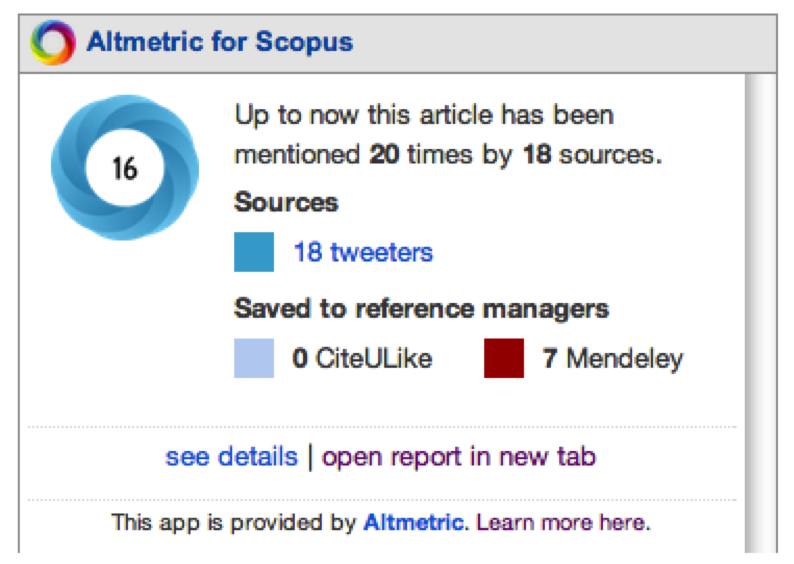
The next time that you find an article of interest in the Scopus database, click on the title and look for this Altmetric for Scopus box. The article will get a score, based on how much attention or buzz it is getting online. For example, this article was mentioned by 18 tweeters and was saved by seven individuals to their Mendeley references. You can read the tweets and see how many of them are coming from the general public, versus scientists, practitioners, or journalists and bloggers. The app will also tell you how the article ranks and if the Altmetric score is good compared to other articles that came out around the same time and from the same journal. Alternative metrics like these are great for going beyond the standard citation count, h-index, or journal impact factor, and can provide some realtime feedback.
The Montreal Planetarium
The Montreal Planetarium, part of a larger consortium called Space for Life Montreal (Biodome, Insectarium, Botanical Gardens), is doing some great outreach on their website with simple and easy ways to get your astronomy fix. They have a feature called “Monthly Sky” – read it to discover what you can see in the sky this month. There’s also “Questions about astronomy” with some common FAQs. Don’t miss the section on “Astronomical events” with a list of major events in astronomy, past or future. And finally “Ephemerides” which has information on the phases of the moon, solstices or equinoxes. There’s also a seasonal bulletin called “The Pocket Planetarium”.
And if you want to get offline, maybe you’ll have visitors this summer to Montreal, and if that’s the case, Space for Life sounds like a great place to start the tour.
Image is a logo from the Space for Life website