Seeds and Patents

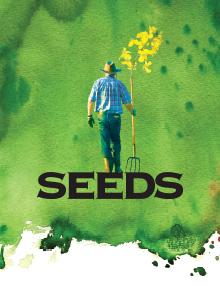
Seeds_220“Who owns life?”  This is the tag line of the play, Seeds, which I saw last weekend at the Centaur.  It is documentary theatre that tells the real story of the patent infringement law suit that Monsanto, a chemical and agricultural corporation, brought against Percy Schmeiser, a farmer from Saskatchewan.  Monsanto accused Mr. Schmeiser of  illegally growing its genetically engineered canola seeds on his farm, while Mr. Schmeiser maintained that the wind blew these seeds from neighbouring farms onto his land.

One of the scenes of the play that I found most interesting is when the farmer’s lawyer argues in court that you cannot patent a plant in Canada, while the company’s lawyer counter-argues that Monsanto only patented the genetically modified canola seed that produced the plant.

In Canada, you can apply for a patent (i.e., a legal right that the government gives you “to stop others from making, using, or selling your invention from the day the patent is granted to a maximum of 20 years after the day on which you filed your patent application”) on the following inventions:

–       “a product (for example, a door lock),
–       a composition (for example, a chemical composition used in lubricants for door locks),
–       an apparatus (for example, a machine for making door locks),
–       a process (for example, a method for making door locks),
–       or an improvement on any of these” (from A Guide to Patents by the Canadian Intellectual Property Office).

In order to be patented, your invention must demonstrate novelty (be unique in the world), utility (be in working condition and serve a useful purpose), and inventive ingenuity (not be apparent).

A reminder that the library subscribes to Derwent Innovations Index, a primary resource in searching for patents on a topic.  You may want to check whether anyone has already patented a specific invention that is of interest to you.

Image from the Centaur Theatre Company

Thinking of taking the MCAT? Try the Khan Academy resources

The Khan Academy is a not-for-profit seeking to provide free education to “anyone, anywhere.” It sounds a lot like a MOOC site, but it doesn’t seem to call itself that, which is fine by me. Their health content is categorized under science, which is also fine by me: The library staff (including librarians and yours truly) and the collections of the Life Sciences Library recently moved, in large part, to the Schulich Library of Science and Engineering, so this comparable categorization makes me feel even more at ease in our new Schulich home.

But let’s get back to the subject line. One of their collections, MCAT, is being developed as a study aid for the revised release of the MCAT (Medical College Admission Test) due out in 2015; this is being done in collaboration with the Association of American Medical Colleges (AAMC) and the Robert Wood Johnson Foundation. The MCAT is not a required examination for all categories of prospective medical students at McGill (depending on the type of applicant) but is commonly required in Canada and in most of the US medical schools.

This is poised to be an excellent resource for students of any age seeking new knowledge, refreshers or tutorials on specific topics. The Khan Academy covers other subjects as well, such as calculus, inferential statistics, and organic chemistry. There are also plans to put together a collection for the NCLEX-RN licensing examination for nursing, which is, according to Dr. Rishi Desai (Program Lead – Medical Partnerships, Khan Academy) quite similar to the USMLE (United States Medical Licensing Examination).

McGill plug: One of their team members is a McGill grad!

I just logged in with my Gmail account (super easy) and was faced with a math test. Despite the badge I got for completing what is probably quite a basic test, I did really, really badly. Perhaps I should get my basic math concepts down before looking at MCAT content…

Lecture on evolution of high speed rail around the world

Dear all
Montreal Student Chapter of Canadian Transportation Research Forum (MSC-CTRF) is organizing a seminar on Nov 22 (Friday) from 12.00 -2.00 pm.
Location: Room No. 2.184, EV Building, Concordia University,
1515 St Catherine West, Montreal
Guest speaker – Mr. Daniel L. Roth, Senior Vice President, Infrastructure Advisory, Transaction Advisory Services, Ernst & Young Orenda Corporate Finance Inc. He will lecture on evolution of high speed rail around the world.
You are invited to this event. FREE LUNCH AND COFFEE!!!!!!!!!!
Please fill out the registration form to reserve your space.
https://docs.google.com/forms/d/1j7uzrKdONOTp_kRc-MSk-1hZo_ZQXVrQpsuaJXbpSpc/viewform
Thanks
VP Research
MSC-CTRF

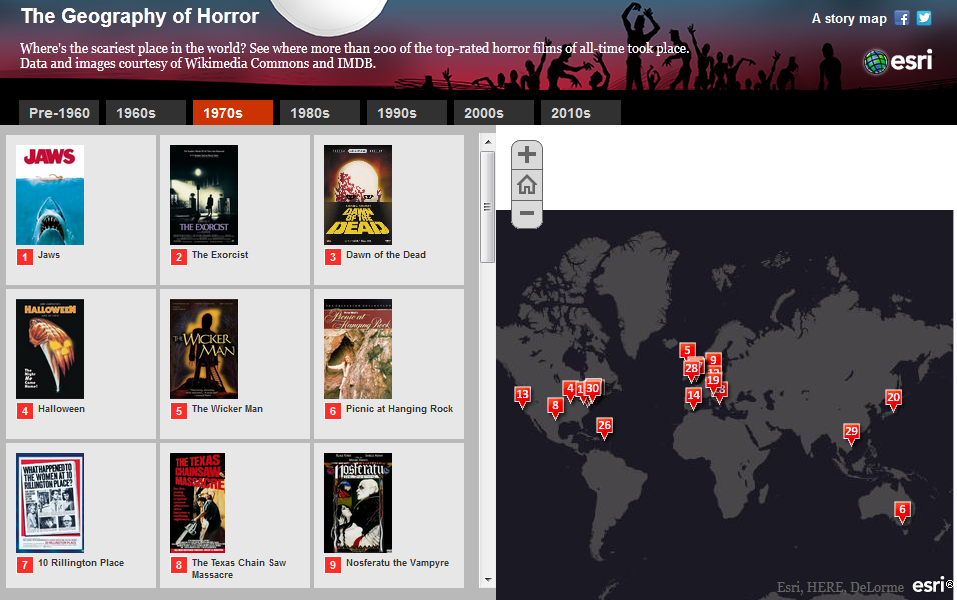
ESRI’s Story Maps Gallery and its Geography of Horror Exhibition

Are you a fun of scary filHalloweenms? Visit ESRI’s Geography of Horror map exhibition and find out the scariest places in the world where popular horror movies in the past half century took place.

Actually this exhibition is just one example of the ESRI’s story maps gallery which collects stories worldwide on a variety of topics using maps, text and other media.

Image courtesy to ESRI


Geography Awareness Week and GIS Day

This week (November 17-23) is the Geography Awareness Week, also called GeoWeek. National Geographic’s Education Section created a website to celebrate this event. The theme of this year is “how geography enables us all to be intrepid explorers in our own way”.  The resources created for the previous Geography Awareness Week events are archived online.  You may explore this rich educational collection by a search or use a combination of filters provided on the webpage.

Wednesday, Nov.20 is the GIS Day. Worldwide GIS day events can be found at this map. At McGill University, Geographic Information Center (GIC) will also have a series of celebration events, including presentations and a poster competition.

Helpouts by Google

Google has started this site, Helpouts, connecting people who need one-on-one help with people who can offer it. Some of them cost money but many are free. Here are the broad categories: Art & Music, Computers & Electronics, Cooking, Education & Careers, Fashion & Beauty, Fitness & Nutrition, Health, Home & Garden. You can even sign up and offer your own face-to-face Helpouts and schedule appointments to teach others what you know. Of course, if you’d like to schedule an online appointment with a science and engineering librarian at Schulich Library we’d be happy to set up a date and time.

Mining at the Deutsches Museum

I recently had the opportunity to travel to Germany and visited the Deutsches museum in Munich.  The Deutsches museum has exhibitions on science and technology.  One of my favourites is the Mining exhibit.  It contains life-size models of miners in different situations, such as manually drilling blast holes, transporting ore by barges, surveying, hole mining, etc.  One interesting fact I learned is that horses, called “pit ponies,” were lowered underground and used in coal mines to haul materials in the past.  Below are some of my photos from my visit to the “mines.”Mining exhibit

Potential, possible, or probable predatory publishers

There is a lot to keep in mind when deciding where to publish and it takes time to investigate individual journals and explore their websites. Not everyone considers the same things as important to them. For some it is about a journal’s prestige while for others it is about the audience that they can reach or about ensuring that their work is open access and available freely to all.

Unfortunately, there are publishers out there that are less than honest and provide false or misleading information about who they are and the impact that they have on a field. There are also publishers with hidden fees that send out invoices to authors after publishing their papers. These are commonly referred to as predatory publishers and they have fooled many a researcher.

One site that can help is Beall’s List of potential, possible, or probable predatory scholarly open access publishers. Jeffrey Beall uses a set of criteria to create this list that makes a lot of sense. I urge you to take a close look at these publishers before deciding to send them your work.