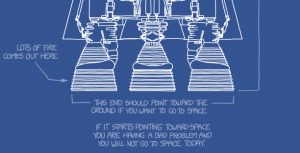
The Up-Goer Five Text Editor: using only the ten hundred most used words

Detail from Up Goer Five http://xkcd.com/1133/ from xkcd.com by Randall MunroeThis past weekend I came across the Up-Goer Five Text Editor, created by Theo Sanderson, that was inspired by the Up Goer Five XKCD comic. The editor checks a block of text and indicates if any of the words you have used are not included in the one thousand – or ten hundred because “thousand” is not one of them – most frequently used words in English (contemporary fiction).

People seem to be embracing the challenge posed by the ten-hundred piece vocabulary. There is now a Ten Hundred Words of Science Tumblr for scientific explanations that satisfy the ten-hundred words rule (though “science” is also not one of the top ten hundred) and the #UpGoerFive hashtag on Twitter, which provide some pretty interesting reading. And Jason B. Jones suggests using the editor can offer new perspective for your writing over at Prof Hacker.

What does your research sound like using only the most common words? Why not give it a try? Let us know if you do!

The Up-Goer Five – a thing you can find on a computer

Image: Detail from Up Goer Five (from xkcd.com) by Randall Munroe

BiblioTech: An audio podcast series about emerging technologies for academics

I came across an interesting monthly series by Rochelle Mazar, an Emerging Technologies Librarian at the University of Toronto Mississauga, about new technologies for faculty, instructors, and researchers.  Topics covered include: information overload, productivity tools, digital natives, wikipedia, plagiarism, etc.  Check out her latest podcast and previous episodes on the University Affairs website.

Image from Daniel Johnson Jr. (Flickr)


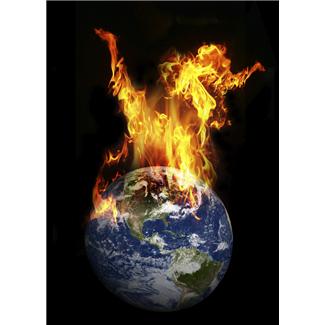
The World Afire: A Lunch and Learn Session with Professor Nigel Roulet

Earth in flames“Media reports are full of doom and gloom about the increasing frequency of strange or extreme weather events and their effects: lack of food security, pollution, invasive species, economic recession, rising incidences of tropical diseases and superbugs, cancer and other catastrophes.

Instead of feeling overwhelmed or helpless by all this bad news, we should be asking: How can we clean up the mess we are leaving for future generations? Can my help really make a difference to leave planet Earth a better place? Is it my problem?”

Environmental expert Professor Nigel Roulet will give a lunch and learn session to address these issues and answer your questions.

Date/Time:  Friday, February 1, 2013 12:30 PM to 1:30 PM

Location(s):  Room 232, Robert Vogel Council Room, Leacock Building, McGill University

RSVP/Pre-Register: required

Contact:  Event Registrar at campuscommunity@mcgill.ca

Image: Earth in flames from Microsoft Images

Google a day science challenges

The Google Search Education site has info for teachers who would like to impart Google search skills, especially useful for finding factual information and contributing to lifelong learning. For example, there are lesson plans with classroom challenges, such as A Google A Day Challenges in different categories.

I like this science challenge: While quietly standing at sea level, you are suddenly whacked on the ankle with a guitar. Did you hear it or feel it first? (view challenge)

The site isn’t just for teachers, however. You could also learn how to become a power searcher, which couldn’t hurt. Take a look at this handy printable Power Searching Quick Guide.

Happy searching!

Women as academic authors over the years, 1665-2010

Infographics are visually appealing and effective ways of representing statistics, knowledge, and data, both qualitative and quantitative. Some are static and others are interactive, like this infographic showing the percentage of academic papers published by women over the last five centuries.You can interact with the infographic by selecting which time period you would like to see represented and you can also sort the information in a few different ways. Be sure to read more about the data and how it was gathered, examined, and ultimately represented. This infographic comes from The Chronicle of Higher Education and the data was drawn from JSTOR, a digital archive of scholarly papers, by researchers at the University of Washington.

Image courtesy of www.bestcollegesonline.com

Top 10 technology predictions for Canada

In today’s newspaper, The Gazette, I read an article about the top 10 technology predictions made by Deloitte, a company that offers audit, tax, consulting, and financial advisory services.  The prediction that surprised me the most is that over 90% of passwords can be hacked in a few seconds.  Visit Deloitte’s website to read the top 10 predictions and get more information.

Image from Microsoft Office Clipart

Climate change and its impacts on human lives

For those who are interested in exploring how much people’s lives have been affected by global warming, I would recommend  this source where you could find Dr. Mauro and his team’s research findings over the past few years.

Dr. Mauro was also the filmmaker of Qapirangajuq: Inuit Knowledge and Climate Change, the first Inuktitut-language film on people’ experience of adapting into global warming.

Image from Microsoft Images

Science of NHL Hockey

Hockey is back at long last so I thought I’d post a little hockey science.

The U.S. National Science Foundation has a series of videos in their multimedia gallery called the Science of NHL Hockey. For example, learn about Goals Against Average and other goaltending Statistics and Averages, or goalie Reflexes & Reaction Time, or watch one of the other videos:

Go Habs Go!

Watch the growth of Walmart and Sam’s Club, 1962-2010

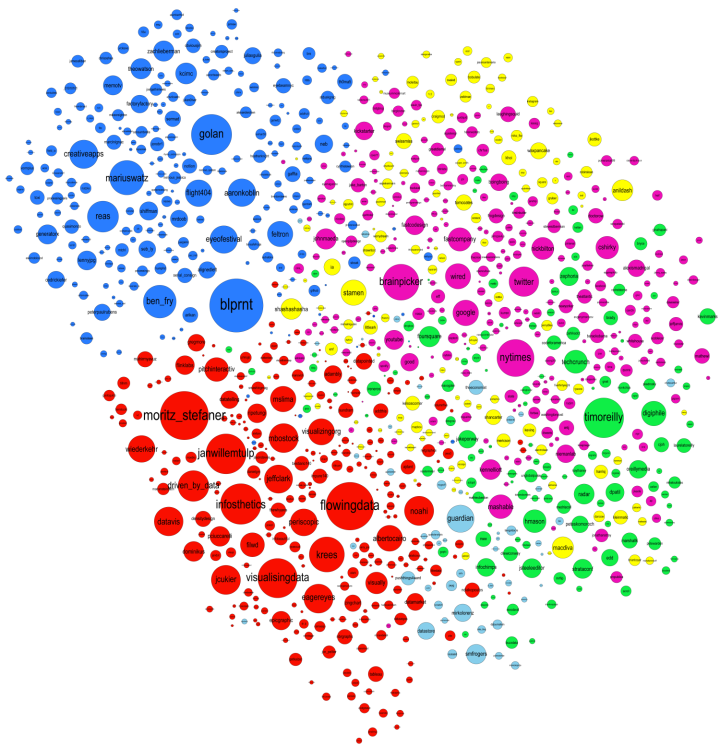
Sometimes you just have to “see” the numbers to believe them. Walmart has to be one of the most ubiquitous big-box stores in North America. When it comes to how many retail outlets there are, there’s really no number that would surprise me. But if you translate that statistic into a cool data visualization map, I’m blown away. Check out this video from FlowingData where you can watch Walmart “spread like wild fire” across the US.

Image from www.neoformix.com