An electronic copy of your textbook

Now you know that you can find your textbook by searching the Course Reserves Catalogue. Many students who attended the library orientation or dropped by at the library service desk asked a same question – “Is there an e-copy available for my textbook?” The answer is “it depends”. There are a few steps that you could take to find it out by yourselves:

1. Look at your course syllabus to see if there is an indication of an e-copy.

2. Search the Course Reserves Catalogue by your course number, course name, instructor etc.

3. Check the Library E-books Catalogue by your book title or author.

4. For a book published recently by Springer or Wiley, it is worthwhile to go to SpringerLink Books or Wiley InterScience Online Books to check the availability of an e-copy.

5. The library service desk staff and your liaison librarians are always willing to help you out.

Shopping for a laptop


Do you need to purchase a new laptop?  Are you debating whether to buy a Windows PC or a Mac?  For advice from technology experts, see “PC or Mac? The experts weigh in.”

If you would like a test drive, you can borrow Windows or Mac laptops for 48 hours at the loans desk of almost all of the McGill Library’s branches.  A number of iPads are available to borrow for a one-week period.

Image from HippolyteBayard

Another piece on stratospheric albedo modification

Carnegie Mellon University’s geoengineering expert, Jay Apt, and his group have recently put up with a price on the plan of spraying aerosol into stratosphere in order to reflect more solar radiation back into space. In fact, this proposal has been controversial for a long while. Other than the issue of expense, the environmental and political risks that will be produced by this plan remain unsolved. The following documentary entails the story.

Read more at Cost analysis of stratospheric albedo modification delivery systems

Welcome / Welcome Back!

For those new to McGill, welcome, and for those returning for another year, welcome back!

It’s a busy time of the year, as students scramble to find their classrooms, course reserves, student service centres, etc. You can take solace in the fact that McGill Library has organized fun and informative orientation activities that demystify library loans and research and help you get the most out of the library. You will learn about all the collections and services and how to find everything you need.

Schulich Library is leading tours and giving workshops everyday for the next couple of weeks and they are all on a drop-in basis. To see a schedule and to read more about Library Orientation at Schulich as well as at other library branches, click here.

Image from www.allneonandled.com

Course reserves now on 2 day loan

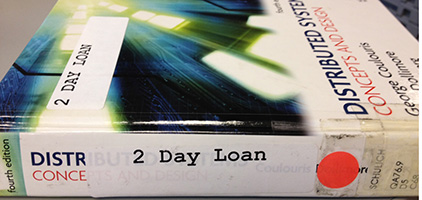
Reserve book on 2 day Reserve loanCourse textbooks that were once shelved behind the Loans desk at the entrance to Schulich Library have now moved to the regular collection of books on the different floors. Search the Course Reserves Catalogue for your course number, course name, instructor, etc., to see if a reserve book is available. Once you find the book on the shelf you can borrow it at one of the auto-loan machines located across from the elevators on the main floor.

Rather than having course reserves for 3 hours at a time, they now have a 2 day loan period, indicated by stickers on the spine and the cover (see image), with no renewals and no holds. Extra copies of textbooks can be found on Level 5 in room 513 for in-library use only, shelved alphabetically by author.

Don’t forget that Schulich Library is open for study 24 hours a day, 5 days a week, and until midnight on Friday and Saturday. You can check out reserve books all hours of the day and night. Just be sure to have your McGill ID card on hand.

We look forward to hearing your feedback on the course reserves move – let us know how we are doing!

Image by Rebecca Nicholson

It’s a bird… It’s a plane… It’s a paper plane!

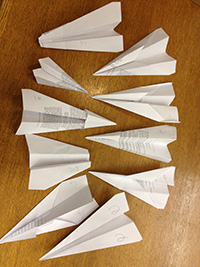
Paper planes that crossed the distance line

Some of the planes that made it across the line

Last weekend, while at the Montreal Mini Maker Faire, I received some advice on constructing paper airplanes, including why one might want to add ailerons (straight flying) or an airfoil (slower, longer glide) to improve the performance of their folded-paper gliding machine. And I recently found this conference paper, “On the aerodynamics of paper airplanes,” when we heard that we were going to have something of a paper airplane distance contest happening in Schulich Library of Science and Engineering. Finally on Thursday, I was on hand – now well equipped – to referee the Schulich Library leg of the Amazing Library Race.

As part of Library Orientation (on now!) over 40 students  took part in the Amazing Library Race last Thursday afternoon, which involved participants racing between various branch libraries and completing tasks before moving on to the next location and task. At Schulich Library the new students’ challenge was to build and “fly” a paper airplane a prescribed distance – the distance was kind of arbitrary, but I would estimate it at about 5 meters – before receiving their next clue. Whether or not the planes had ailerons, most of the successful models were similar to the classic dart-style plane discussed in the paper above. Regardless, all of the groups were eventually able to get their plane to cross the distance line with their paper-plane-engineering savvy!

Orientation activities at Schulich Library and across the Library system continue this week and into the school year. Come check it out now and save time later on!

Previously: Ready! Set! Get Oriented!

Image by Rebecca Nicholson

More free reads

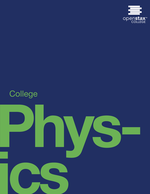
College PhysicsIf you are curious about the physical universe this free introductory College Physics textbook from OpenStax College may be just the thing you need.  It is peer-reviewed by educators and has the look and feel of a classic illustrated textbook but with a Creative Commons Attribution 3.0 license.  It can be downloaded, edited, customized, and reused, or you can just go ahead and dedicate some time to expanding your mind with conceptual questions, problems and exercises online.

You may also be interested in Introduction to Sociology, and there are more titles to come.

Happy learning!

Image from OpenStax College 

Mathematical theory and the Rubik’s Cube

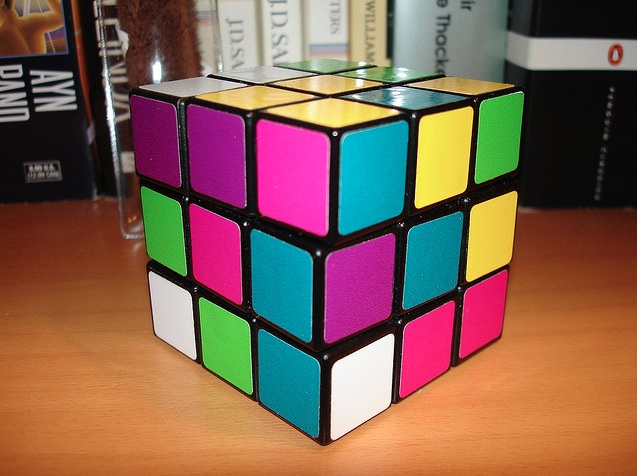
The 2012 World Cube Association’s U.S. National Championship was held at the beginning of August in Las Vegas.  A California teenager, Deven Nadudvari, set a record by using one hand to solve 5 different 3-by-3 Rubik’s Cubes in an average of 14.86 seconds each.

“You can use Rubik’s Cube to teach engineering, you can use it to teach mathematics, and you can use it to talk about the interplay between design and engineering and mathematics and creativity,“ according to Paul Hoffman, president of the Liberty Science Center in Jersey City, who is organizing an international exhibition in 2014 that will celebrate the cube’s 40th anniversary. (Montreal Gazette, 8/11/2012, Quenqua)

The Rubik’s Cube has been used to teach Group Theory in mathematics.  For more information about group theory and the cube, check out any of these books.

Photo from allie

Man-made jellyfish

Harvard bioengineers have made an artificial jellyfish by growing a single layer of rat heart muscle on a patterned sheet of polydimethylsiloxane.  As you can see from the following video, when placed between two electrodes in water, this synthetic structure can swim exactly like its living counterpart. The rat muscle contacts when an electric field is applied across the structure, and then the elastic silicone pulls the jellyfish back to its original shape.

“Morphologically, we’ve built a jellyfish. Functionally, we’ve built a jellyfish. Genetically, this thing is a rat,” said Kit Parker, the researcher who led this project.

You can read more in Nature Biotechnology.

Ready, Set, Get Oriented!

It’s that time of year again! Dust off your book belts and make sure your alarm clock is in good working order because it’s Back to School! McGill Library is ready to ease you into the new academic year with a lot of fun and informative Library Orientation activities. Attend all three, on a drop-in basis: Library Tour, Getting Started and Finding the Right Stuff, at Schulich Library or any other McGill Library branch and receive a free USB bracelet! Here’s how you win:

  1. Pick up your Orientation Passport at any library branch, during Discover McGill Street Fest or at the Discover McGill Service Fair. We will also distribute these at the Tours and Workshops if you don’t already have one.
  2. Get your passport sticker after each session you attend.
  3. Once you’ve collected all three stickers, drop your passport off at any Library Information Desk to receive your free McGill Library USB memory bracelet!

After each Workshop you attend at Schulich Library, your name is entered in a draw and you could win a nifty McGill mug. For a schedule of Schulich Library’s Tours and Workshops click here.

Don’t forget about The Amazing Library Race being held on Thursday August 30, from 3-5 pm.  For more information or to register click here. Please note that if you participate in the Amazing Library Race, you can earn a sticker for your Orientation Passport in lieu of a Tour. Sound good? See you at the finish line!

Image by Nikki Tummon