Close your eyes and picture an engineer. What do you see? A man in a suit? A young lad in a hoodie? A train driver?
Or do you picture a woman?
When a female such as myself enrols in college and selects a major such as engineering, the reactions she hears range from “Really? I would never have thought so” to “Wow, you must be REALLY smart!”
Indeed, the persistent bias towards women in male dominated fields can be damaging to one’s self-confidence, and self-confidence is something that one needs in order to tackle the growing responsibility as we advance in our careers. Maintaining confidence is crucial to success. However, finding this inner strength becomes a challenge when anatomy determines whether you are taken seriously. Because I am female, I know that I automatically have to prove my worth in such a field. And this is the core of the problem that we face today.
There is no easy way to explain why more women are not encouraged to follow these career paths. I took physics on a whim in high school out of simple curiosity, but had the sheer luck of falling in love with the subject. The difficulty but ability of physics to explain so many things around me – yet with so much left to discover – left me thirsty for more. However, I was perplexed as to why I had never even considered a career in engineering until then; was it because I had never heard of a female engineer on the news? Was it because there was a total of around 7 girls out of 30 in my physics class?
This feeling of perplexity never left me, but I brushed it off. It was not until an exchange I had during a college interview that this nagging feeling came back in full-force. The alumna (who was a successful businesswoman) hit me with the hardest question I’ve ever had to answer in my entire life: “Why do you suppose there are more men than women in the domains of economics, engineering, and math?” I was left speechless.
So I did some research and I began self-reflecting. I read up on the (lack of) women who had received Nobel Prizes throughout history – how in 2012, apart from the European Union, all of the Nobel laureates were men. How, to date, only 43 women have been awarded a Nobel Prize out of 862 people and organisations who have been named laureates. Why? Because three of the prizes are for science. Women faced endless barriers to entering higher education, with no access to labs, no connections, and few opportunities. That was my first clue – opportunity. So my quest to answering my interviewer’s question continued. Books such as “Who Succeeds In Science? The Gender Dimension” by Gerhard Sonnert have furthered my research, categorising the answer to such a question into two models: the deficit model (women are treated differently in science), and the difference model (women act differently in science).
It wasn’t until I saw this advertisement that I began to connect the dots:
The concept of selling engineering/building toys to girls (with the purpose of increasing their confidence in problem-solving and introducing them to engineering) made it so clear to me that the problem lay in social norms and in a culture that has been created over time. And one way to progress is to educate our daughters differently. When one walks through a girls’ toy aisle, it is pink and full of barbies, princesses and dolls. The legos sold to girls are a feminized spin-off, featuring pink and purple blocks, and characters that do things like sit at home or run a bakery. We are taught implicitly from a very young age that our goal is to become princesses and/or mothers. I myself loved playing with barbies and other typically girly toys, but I equally loved playing with my brother’s train tracks and legos. It was thanks to him that I was exposed to such toys (that were not gifted to me because I was a girl). And the contrary holds true too – he often came to play barbies with me. With the nature vs. nurture debate aside, there is no doubt that advertisers have capitalised on gender preferences, steering each gender to their specified section and ultimately broadcasting a more general message regarding gender roles and expectations in society. Identity becomes ideology.
So maybe there are millions of girls out there who are engineers. They just might not know it yet. Is it time to “disrupt the pink aisle”?
Progress is being made and times are changing – as my grandmother says, “you don’t give us enough credit, we couldn’t even vote a few years ago!” I therefore try to avoid thinking negatively about the male-female ratio, because ultimately, I believe that it’s all about doing what you love.
So if finding what you love depends on the opportunities presented to you, would you buy your daughter legos?

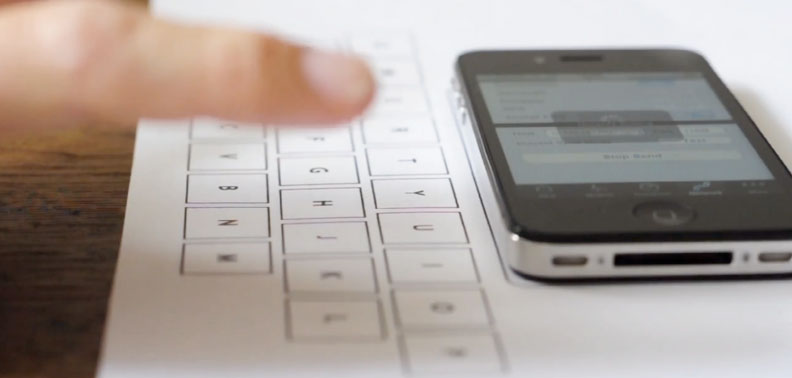 We all know there are apps for everything. But now there is an app that can create something out of nothing. Imagine typing up the next great novel by simply tapping your fingers on a desk. Florian Kräutli is an industrial designer living in the Netherlands who has designed an app that can allow you to do just that. His invention can literally turn any surface into a keyboard for your iphone. For his master’s degree in cognitive computing from the University of London, he created the Vibrative Virtual Keyboard, an invention that is less like transmitting Morse code and more like playing air guitar. Unlike similar designs that allow users to type onto a laser-projected keyboard, his app requires no additional hardware other than your nearest flat surface. The app works by taking readings from the iphone’s internal accelerometer which measures vibrations near the iphone. The user spends some time teaching the iphone what certain taps mean, and the software figures out the rest. The app is in its early stages and the readings from the iphone’s internal accelerometer are not always spot on. However, Kräutli claims that “if you made the accelerometer more sensitive you could improve the accuracy quite easily” (The Telegraph). In the meantime, the app relies on a spell checker to get words right. Here is the app in action.