Conference on April 7, 2014

The MSC-CTRF is organizing a conference on the broader aspects of Sustainable Transportation at Concordia University on April 7, 2014. Transportation companies e.g. Via Rail, IBI groups, AECOM, CPCS, CN, Robert Trucking, Gaz Metro etc. will participate in the MSC-CTRF conference 2014. For the details of the conference, follow the link
http://www.ctrf.ca/StudentChapter/student_chapter_FutureEvents.html

You are invited to submit the abstract. Abstract Submission deadline February 24, 2014.

Examples of point-of-care tools your doctor is using: UpToDate vs. DynaMed

Health information is often difficult to navigate. Try a quick PubMed search and you’ll instantly get a sense of the number of published articles that are out there, and that’s not even everything (Tip: Filter your results using the article type “systematic reviews”–not “reviews”–to narrow down your results, and favour Cochrane reviews for their rigor; alternatively, use PubMed Clinical Queries).

Where am I going with this? Well, clinicians are busy people and it is obviously really important for them to stay on top of things. How are some ways they do this using McGill-licensed resources? These resources just happen to be available to the entire McGill community, so they are worth a look even if you are not a busy clinician.

Many clinicians are huge fans of UpToDate. It’s a really expensive resource and one we have great trouble affording, but it is definitely worth a look. It’s easy to use (designed for free text searching; look for your terms within articles using CTRL-F on a PC or CMD-F on a Mac if they’re not in the article title). Evidence is not always graded, although they are improving this.

An alternative to UpToDate and a nice option if you’re an avid mobile device user is DynaMed. We began licensing it this past spring, and one key advantage of it over UpToDate is that you can download all the content onto a mobile device, which means you don’t need an internet connection to view it. The app is a bit clunky but the content is there. Levels of Evidence are pretty consistently applied.

Health is important to just about all of us, so why not give these point-of-care tools a try?

Have Your Personal Library on Google Scholar

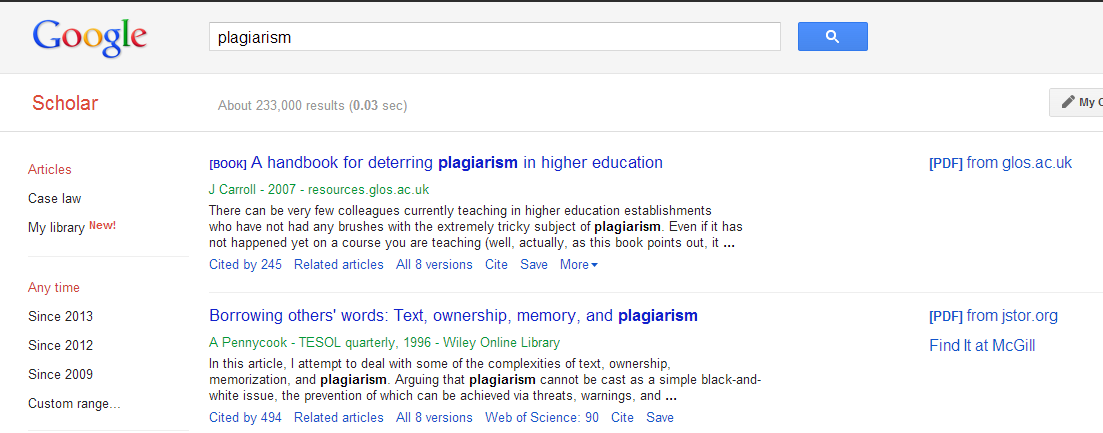
Scholar_libraryGoogle Scholar recently released a new goody – your personal online library at Google Scholar. On the result page, click “Save” below a search result to save it to your library. Click “My library” on the left to open your library. Of course, you can find the full text at any of these two stages when it is available either freely online or from your local library’s collection. To organize your articles in the library, you may click on a result in your library and add a label to it.

The Power of the Mind

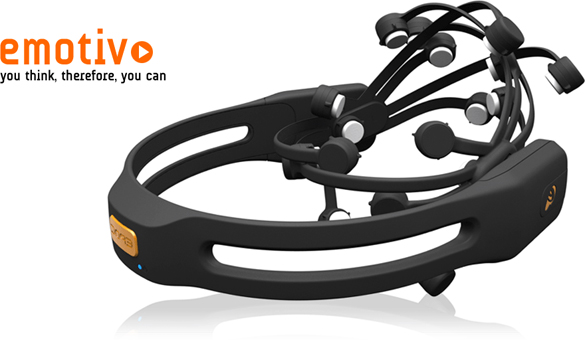
EEG headset

Just how far are we away from the mind-powered car? These were my thoughts when I read an article in Prism about Japanese researchers at Toyota who were developing a headset device for wheelchair users that would allow them to control their wheelchairs by simply thinking about where they wanted to go. Toyota’s “Brain Machine Interface” technology uses electroencephalography (EEG) data to enable people with physical disabilities to drive, steer and stop their wheelchairs using the power of the mind. The technology takes some training in order to coordinate the user’s thought patterns and the system’s responses. Researchers claim that the system can “adapt to a particular user’s thought patterns to improve accuracy to as high as 95%… Training on the system for 3 hours a day for a week is enough to have it tuned in to a user’s motor-control thought patterns” (PC World). The applications of such a revolutionary technology seem boundless! Imagine you could just think up what you wanted to have for dinner, mentally going through the various tasks while a robot actually went about preparing the meal. You might not even have to lift a finger in order to sit down to a four-course meal! Even though Japanese researchers are working on applications of this technology for use in controlling robots, we’re not quite there yet.

But now an electronics company called Emotiv has partnered with Hyundai in Australia to market a brain-powered car which uses similar EEG technology to control a vehicle via the mind and researchers in Germany are testing similar technology called BrainDriver that can actually drive a car. At this point, the only technology that has been commercialized is limited to making sure that drivers stay alert as inattentiveness on the road accounts for nearly 50% of fatal vehicle accidents in Australia (Drive.com). The Attention Powered Car will slow down and come to a stop if the driver becomes fatigued. Here it is in action. In terms of implications for road safety, Australians are already headed in the right direction!

This brings me back to my initial question: just how far are we away from a vehicle that not only stops when a driver is fatigued but is actually controlled by the impulses of the brain rather than the touch of the hand? If the work that researchers in Germany, Australia and Japan are doing is any indication, we’ll soon be driving into the future!

Image from Physiological Computing.net

Seeds and Patents

Seeds_220“Who owns life?”  This is the tag line of the play, Seeds, which I saw last weekend at the Centaur.  It is documentary theatre that tells the real story of the patent infringement law suit that Monsanto, a chemical and agricultural corporation, brought against Percy Schmeiser, a farmer from Saskatchewan.  Monsanto accused Mr. Schmeiser of  illegally growing its genetically engineered canola seeds on his farm, while Mr. Schmeiser maintained that the wind blew these seeds from neighbouring farms onto his land.

One of the scenes of the play that I found most interesting is when the farmer’s lawyer argues in court that you cannot patent a plant in Canada, while the company’s lawyer counter-argues that Monsanto only patented the genetically modified canola seed that produced the plant.

In Canada, you can apply for a patent (i.e., a legal right that the government gives you “to stop others from making, using, or selling your invention from the day the patent is granted to a maximum of 20 years after the day on which you filed your patent application”) on the following inventions:

–       “a product (for example, a door lock),
–       a composition (for example, a chemical composition used in lubricants for door locks),
–       an apparatus (for example, a machine for making door locks),
–       a process (for example, a method for making door locks),
–       or an improvement on any of these” (from A Guide to Patents by the Canadian Intellectual Property Office).

In order to be patented, your invention must demonstrate novelty (be unique in the world), utility (be in working condition and serve a useful purpose), and inventive ingenuity (not be apparent).

A reminder that the library subscribes to Derwent Innovations Index, a primary resource in searching for patents on a topic.  You may want to check whether anyone has already patented a specific invention that is of interest to you.

Image from the Centaur Theatre Company

Thinking of taking the MCAT? Try the Khan Academy resources

The Khan Academy is a not-for-profit seeking to provide free education to “anyone, anywhere.” It sounds a lot like a MOOC site, but it doesn’t seem to call itself that, which is fine by me. Their health content is categorized under science, which is also fine by me: The library staff (including librarians and yours truly) and the collections of the Life Sciences Library recently moved, in large part, to the Schulich Library of Science and Engineering, so this comparable categorization makes me feel even more at ease in our new Schulich home.

But let’s get back to the subject line. One of their collections, MCAT, is being developed as a study aid for the revised release of the MCAT (Medical College Admission Test) due out in 2015; this is being done in collaboration with the Association of American Medical Colleges (AAMC) and the Robert Wood Johnson Foundation. The MCAT is not a required examination for all categories of prospective medical students at McGill (depending on the type of applicant) but is commonly required in Canada and in most of the US medical schools.

This is poised to be an excellent resource for students of any age seeking new knowledge, refreshers or tutorials on specific topics. The Khan Academy covers other subjects as well, such as calculus, inferential statistics, and organic chemistry. There are also plans to put together a collection for the NCLEX-RN licensing examination for nursing, which is, according to Dr. Rishi Desai (Program Lead – Medical Partnerships, Khan Academy) quite similar to the USMLE (United States Medical Licensing Examination).

McGill plug: One of their team members is a McGill grad!

I just logged in with my Gmail account (super easy) and was faced with a math test. Despite the badge I got for completing what is probably quite a basic test, I did really, really badly. Perhaps I should get my basic math concepts down before looking at MCAT content…

Lecture on evolution of high speed rail around the world

Dear all
Montreal Student Chapter of Canadian Transportation Research Forum (MSC-CTRF) is organizing a seminar on Nov 22 (Friday) from 12.00 -2.00 pm.
Location: Room No. 2.184, EV Building, Concordia University,
1515 St Catherine West, Montreal
Guest speaker – Mr. Daniel L. Roth, Senior Vice President, Infrastructure Advisory, Transaction Advisory Services, Ernst & Young Orenda Corporate Finance Inc. He will lecture on evolution of high speed rail around the world.
You are invited to this event. FREE LUNCH AND COFFEE!!!!!!!!!!
Please fill out the registration form to reserve your space.
https://docs.google.com/forms/d/1j7uzrKdONOTp_kRc-MSk-1hZo_ZQXVrQpsuaJXbpSpc/viewform
Thanks
VP Research
MSC-CTRF

ESRI’s Story Maps Gallery and its Geography of Horror Exhibition

Are you a fun of scary filHalloweenms? Visit ESRI’s Geography of Horror map exhibition and find out the scariest places in the world where popular horror movies in the past half century took place.

Actually this exhibition is just one example of the ESRI’s story maps gallery which collects stories worldwide on a variety of topics using maps, text and other media.

Image courtesy to ESRI


Geography Awareness Week and GIS Day

This week (November 17-23) is the Geography Awareness Week, also called GeoWeek. National Geographic’s Education Section created a website to celebrate this event. The theme of this year is “how geography enables us all to be intrepid explorers in our own way”.  The resources created for the previous Geography Awareness Week events are archived online.  You may explore this rich educational collection by a search or use a combination of filters provided on the webpage.

Wednesday, Nov.20 is the GIS Day. Worldwide GIS day events can be found at this map. At McGill University, Geographic Information Center (GIC) will also have a series of celebration events, including presentations and a poster competition.