Particle physics videos from TEDxCERN

Two guys walk into a bar – they just happen to be CERN scientists and they can help explain Higgs boson excitation of the Higgs field.  This particle physics video is one of a series of five videos from TEDxCERN. Waltch all five on the TED blog for a little on the birth of the universe, the history of the web and big data, dark matter, and antimatter.

America’s 100 Best Adventures

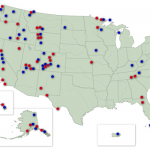
americanadvanturesHave you finished your exams and are you planning your summer trips? If so, you will probably find this article useful. National Geographic recently created a list of 100 most appealing adventure places in the States where you might be able to enjoy your favorite activities in pure nature.

If you decide to visit several places on one trip, you may draw your itinerary using this interactive map.

If you cannot go to any of these sites this summer,  you can at least play fun puzzles by creating one of these famous natural beauties.

Read more on National Geographic.

Image: America’s Best Adventures Maps from National Geographic

Google Scholar Metrics

We have blogged in the past about metrics for measuring impact, such as the well known Journal Impact Factor, and more recently Altmetric, so I thought that I would bring your attention to Google’s lists of top publications. As part of the Google Scholar Metrics offerings they have rankings of the top 100 publications in several languages.

Google has added categories and subcategories for the English language rankings, so now you can look up the top publications in, for example, Geophysics in the Physics & Mathematics category, or Robotics in the Engineering & Computer Science Category.

The usual suspects are there in the list, like Science, Cell, Nature, Physical Review Letters, but you may find some interesting results. How amazing is it that arXiv (open access e-prints in physics, mathematics, computer science) is frequently listed by the separate subject areas?

Happy Monday!

Altmetric for Scopus

AltmetricForScopus

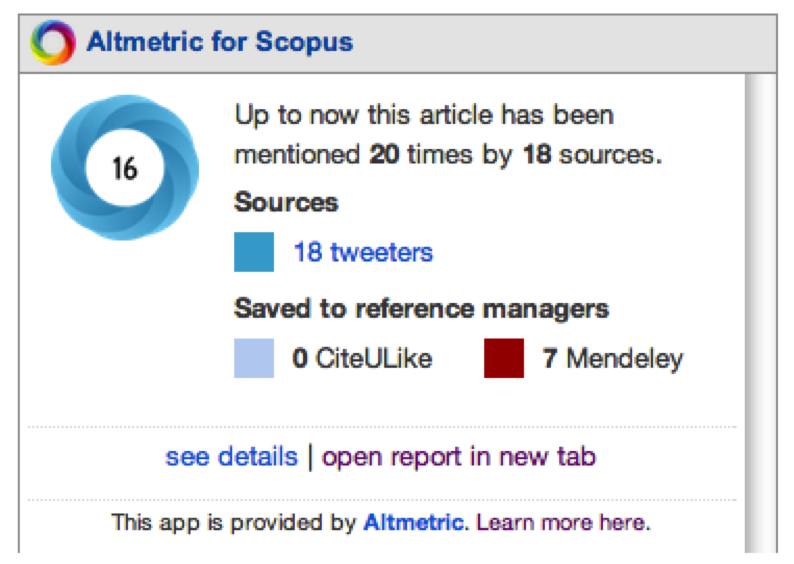
The next time that you find an article of interest in the Scopus database, click on the title and look for this Altmetric for Scopus box. The article will get a score, based on how much attention or buzz it is getting online. For example, this article was mentioned by 18 tweeters and was saved by seven individuals to their Mendeley references. You can read the tweets and see how many of them are coming from the general public, versus scientists, practitioners, or journalists and bloggers. The app will also tell you how the article ranks and if the Altmetric score is good compared to other articles that came out around the same time and from the same journal. Alternative metrics like these are great for going beyond the standard citation count, h-index, or journal impact factor, and can provide some realtime feedback.

The Montreal Planetarium

logo-pla_140_0The Montreal Planetarium, part of a larger consortium called Space for Life Montreal (Biodome, Insectarium, Botanical Gardens), is doing some great outreach on their website with simple and easy ways to get your astronomy fix. They have a feature called “Monthly Sky” – read it to discover what you can see in the sky this month. There’s also “Questions about astronomy” with some common FAQs. Don’t miss the section on “Astronomical events” with a list of major events in astronomy, past or future. And finally “Ephemerides” which has information on the phases of the moon, solstices or equinoxes. There’s also a seasonal bulletin called “The Pocket Planetarium”.

And if you want to get offline, maybe you’ll have visitors this summer to Montreal, and if that’s the case, Space for Life sounds like a great place to start the tour.

Image is a logo from the Space for Life website

Webometrics

There is no shortage of university rankings to be found on the Internet but I’d be hard pressed to find one as inclusive as the Webometrics Ranking, or as dedicated to self-improvement. The ranking, produced by Cybermetrics Lab (a research group of the Spanish National Research Council), covers more than 20 000 universities worldwide. They designed indicators of impact (links in to the university domain from third parties), presence (university pages found in Google), openness (files found in Google Scholar, including PDFs and other files from a university’s repository), and excellence (highly cited papers in scientific fields). It is quite an interesting methodology.

The raising of our roof

Look up to your right when you enter the Frank Dawson Adams Building from the campus side (or from the Roddick Gates side).  There’s a shiny new cupola that was placed on the roof of the Macdonald Stewart Library Building this week.  Read more about the raising of our roof, and see a brief video of the installation, in the McGill Reporter.

DOAJ – Directory of Open Access Journals

doajYou probably have heard of the open access movement or open access journals. Do you know of a source that exclusively lists open access scholarly journals? The Directory of Open Access Journals (DOAJ) is such a list, where you could search for peer-reviewed journal articles and browse them by subject. For example, Geography has 123 journal titles right now. Since this source is freely available, it may become one of your essential sources for academic content once you graduate.

Dutch National Library makes progress with copyrighted material

Copyright has been an issue which sustains authors’ ability to produce, on the one hand, and, on the other hand, limits readers’ use to a certain extent. As guardians of copyrighted material, libraries make every effort to help maximize the use of its materials.

The Dutch National Library recently took this a step further by digitizing its copyrighted material and giving full access to the public. Instead of resolving the copyright issue with authors one by one, it took an “opt-out model” and asked copyright owners to contact the library if they didn’t agree to making their material available online.

Read more at Dutch National Library gives full access to in copyright material.