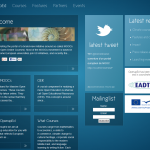
A European portal of MOOCs (Massive Open Online Courses) was recently launched at www.openuped.eu. It offers online courses, free of charge, in different languages from partner universities in Europe. The subjects cover from learning skills, management, climate change to mathematics. If you are interested in how a topic is taught in Europe or something outside of your curriculum , take a course at this website. Other major MOOCs providers include Coursera, Udacity, edX.
Friday fun: Which great genius was most like you?
Take this fun short quiz from the Discovery Channel website to find out which artistic or scientific genius was the most like you. Apparently, I resemble Pablo Picasso 🙂
Photo of Pablo Picasso’s “Young Woman” from jmussuto (Flickr)
Apps Showcase at Data.gov
I recently came across Developer Apps Showcase at Data.gov, where I was surprised to see how those apps made the Data.gov‘s open datasets more accessible and perhaps comprehensible for the public. Yes, data can be presented in a way that is interactive, innovative, and inspiring! Find more at here.
Image from http://images.apple.com/
1000000000000000 bytes
Who doesn’t love Internet Archive? I am a big user of the Wayback Machine, where they are capturing and archiving websites back to 1996. Take some time to explore thier site and you will certainly find something in the audio, video, or text archive (they recently hit 10 petabytes). For example, I have been listening to a radio mystery series called Mr. and Mrs. North that aired on CBS from 1942 to 1954. What I didn’t realize about Internet Archive is that they are collecting print books with the goal of archiving one copy of every book ever printed – watch this video – it will blow your mind.
Internet Archive from Deepspeed media on Vimeo.
Our bad habits using technology
Do you leave your laptop unattended, forget to take breaks, fail to backup your data, reuse old passwords, print everything, or text at the table? If the answer is yes, then reading the article, “The 21 worst tech habits—and how to break them,” published in PCWorld, might help.
Let’s dance!
These engineering students at Northwestern University are learning to think on their feet. Anyone up for dance classes?
21st century engineering challenges
The National Academy of Engineering (U.S.) identified 14 challenges in this century that need engineering solutions. These challenges are:
- Make solar energy economical
- Provide energy from fusion
- Develop carbon sequestration methods
- Manage the nitrogen cycle
- Provide access to clean water
- Restore and improve urban infrastructure
- Advance health informatics
- Engineer better medicines
- Reverse-engineer the brain
- Prevent nuclear terror
- Secure cyberspace
- Enhance virtual reality
- Advance personalized learning
- Engineer the tools of scientific discovery
Three minutes to explain yourself
Can you explain your research activities or thesis in 3 minutes to someone outside your field? Jinna Kim in University Affairs reports that many universities are holding prize-winning competitions that require graduate student participants to communicate their work to judges and an audience in just 3 minutes. The idea is to teach students how to promote themselves and their research.
McGill University has an annual event called, “3 Minutes to Change the World” that provides a non-competitive opportunity for graduate students to present their research to a general audience. Below is an example of a presentation from this event:
Star Trek and science
I liked watching “Star Trek: The Next Generation” when I was a teenager. I liked the character of Captain Jean-Luc Picard, who was a scientist, diplomat, and Shakespeare-lover all rolled into one.
The film, “Star Trek into Darkness,” started playing in cinemas this past weekend. As a homage to the movie, Phil Plait provides an amusing look at the science errors in the Star Trek franchise in his blog post, “The Top 6 Star Trek Science Mistakes.”
FracFocus Chemical Disclosure Registry
Both Canada and the U.S. maintain a national registry for the disclosure of chemicals used in hydraulic fracturing:
FracFocus.ca, built by the BC Oil and Gas Commission and conceived based on the American site, is an up-to-date resource for students and professionals in environmental sciences, earth sciences, and engineering, as well as members of the general public. Visitors to the Canadian site can discover the location of oil and gas wells and the chemicals used at each site in British Columbia and Alberta. From the FracFocus.ca Welcome Page: [FracFocus.ca] is a collaboration between provinces, territories, regulators and industry to provide Canadians with objective information on hydraulic fracturing, what legislation and regulations are in place to protect the environment including groundwater, and transparency on the ingredients that make up hydraulic fracturing fluids. Visit the site(s) to learn more.