Europeana opens data for 20 million cultural items

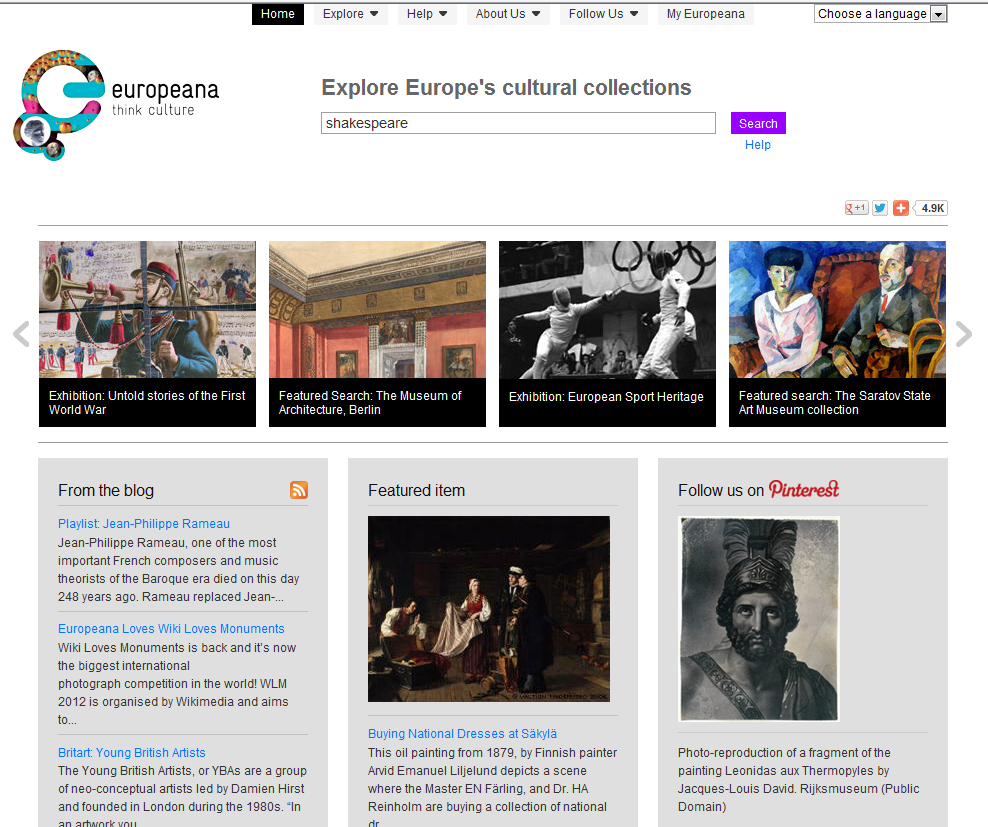
Europe’s digital library – Europeana has become a significant web site for its huge and open collection of digitized books, paintings, photographs, recordings, and films from more than 2,200 contributing cultural heritage organizations across Europe, such as the British Library, the Louvre, and the Rijksmuseum.

So far, Europeana has opened up data on 20 million items under the Creative Commons rights waiver, which means that “anyone can reuse the data for any purpose – whether using it to build applications to bring cultural content to new audiences in new ways, or analyzing it to improve our understanding of Europe’s cultural and intellectual history.”

Europeana described this release as “by far the largest one-time dedication of cultural data to the public domain”. “Hopefully this will help to establish a precedent for other galleries, libraries, archives, and museums to follow… [and to build up] digital commons of cultural content that everyone is free to use and enjoy.”

Read more at Europeana opens up data on 20 million cultural items

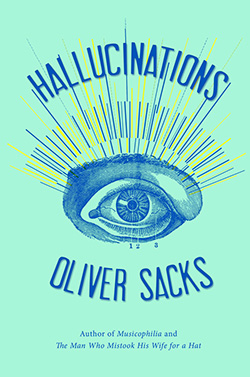
Oliver Sacks – Hallucinations

I gave several workshops in the past two weeks, as did many of my fellow librarians. One of the topics we cover in our workshops is the importance of making the distinction between popular and scholarly literature, namely the difference between scientific articles that are written for the general public and those that are meant to communicate ideas and results of scientific studies among academic researchers. Today’s post is about a scientist who most certainly writes for the general public but is no less fascinating or important for it. Just don’t cite one of his popular publications if you’ve been asked to find scholarly and peer-reviewed articles :-/

Oliver Sacks is a physician, best-selling author, and professor of neurology at the NYU School of Medicine. He writes primarily about people with neurological disorders, but it doesn’t stop there. His latest book, Hallucinations, comes out in November and the title is pretty self-explanatory. If you’d like a taste, read an excerpt called Altered States from The New Yorker (Vol. 88 Issue 25, p40-47) published this summer. Just search for The New Yorker from the Journals tab on the Library homepage and then, from within the journal, search for this volume/issue and read it online. Easy! Oh, and here’s a video from The New Yorker of Sacks, in anticipation of his new book, discussing the hallucinogenic mind…

Check out some other classic titles in the McGill Library catalogue including: The Man Who Mistook His Wife for a Hat: and Other Clinical Tales and of course Awakenings, the book that the 1990 film of the same name is based on. Happy reading…

Image courtesy of www.oliversacks.com

Climate change permits sailing through the Arctic

Three international sailors made history by being the first crew to successfully cross the M’Clure Strait in Canada’s Arctic Ocean after 90 days at sea.  The M’Clure Strait has always been entirely covered by ice.  This small crew departed from Newfoundland and is crossing the Arctic to record the melting of polar ice and increase awareness of climate change.

Visit “A Passage through Ice” for more information about this expedition.

Image from NASA Goddard Space Flight Center

Uncommon chemistry

I talked about ChemSpider in a previous post but if you are serious about finding information on substances there is a chemistry database like no other: SciFinder.

Just last year Chemical Abstracts Service (CAS), a division of the American Chemical Society, announced that the database was moving from the software version to the web. Since then there have been a number of changes to SciFinder, along with a newly redesigned CAS website. For example, there are great interactive SciFinder training videos for all aspects of substance and reaction searches that point out new features.

What sets Scifinder apart is not just the chemical literature, with articles, patents, dissertations, etc., going back over 100 years, it is how they bring together a wealth of information on reactions, structures, properties, and commercial sources, and link it all to substances with unique identifiers, called CAS Registry Numbers. That means that if you come across the name of a compound in an article that you do not recognize you can use the Explore Substances search in SciFinder and find out just what it is.

McGill students, faculty, and staff can now benefit from unlimited access to SciFinder (registration is required) so let me know it works for you.

CAS does have a free search engine for substances of general interest if Common Chemistry is more your thing.

Validating scientific research

The New York Times reported earlier this year that the number of published scientific articles that were retracted by journals has increased over the years.  The articles were withdrawn due to false claims or errors in research data.

The Reproducibility Initiative was recently launched to improve the quality of preclinical biological research.  According to its website, “the Reproducibility Initiative is a new program to help scientists validate studies for publication or commercialization. Simply submit your study, and we’ll match you to one of our 1000+ expert providers for validation. Validations are conducted blind, on a fee-for-service basis.”

Image from Microsoft Office Clipart

An electronic copy of your textbook

Now you know that you can find your textbook by searching the Course Reserves Catalogue. Many students who attended the library orientation or dropped by at the library service desk asked a same question – “Is there an e-copy available for my textbook?” The answer is “it depends”. There are a few steps that you could take to find it out by yourselves:

1. Look at your course syllabus to see if there is an indication of an e-copy.

2. Search the Course Reserves Catalogue by your course number, course name, instructor etc.

3. Check the Library E-books Catalogue by your book title or author.

4. For a book published recently by Springer or Wiley, it is worthwhile to go to SpringerLink Books or Wiley InterScience Online Books to check the availability of an e-copy.

5. The library service desk staff and your liaison librarians are always willing to help you out.

Shopping for a laptop


Do you need to purchase a new laptop?  Are you debating whether to buy a Windows PC or a Mac?  For advice from technology experts, see “PC or Mac? The experts weigh in.”

If you would like a test drive, you can borrow Windows or Mac laptops for 48 hours at the loans desk of almost all of the McGill Library’s branches.  A number of iPads are available to borrow for a one-week period.

Image from HippolyteBayard

Another piece on stratospheric albedo modification

Carnegie Mellon University’s geoengineering expert, Jay Apt, and his group have recently put up with a price on the plan of spraying aerosol into stratosphere in order to reflect more solar radiation back into space. In fact, this proposal has been controversial for a long while. Other than the issue of expense, the environmental and political risks that will be produced by this plan remain unsolved. The following documentary entails the story.

Read more at Cost analysis of stratospheric albedo modification delivery systems

Welcome / Welcome Back!

For those new to McGill, welcome, and for those returning for another year, welcome back!

It’s a busy time of the year, as students scramble to find their classrooms, course reserves, student service centres, etc. You can take solace in the fact that McGill Library has organized fun and informative orientation activities that demystify library loans and research and help you get the most out of the library. You will learn about all the collections and services and how to find everything you need.

Schulich Library is leading tours and giving workshops everyday for the next couple of weeks and they are all on a drop-in basis. To see a schedule and to read more about Library Orientation at Schulich as well as at other library branches, click here.

Image from www.allneonandled.com

Course reserves now on 2 day loan

Reserve book on 2 day Reserve loanCourse textbooks that were once shelved behind the Loans desk at the entrance to Schulich Library have now moved to the regular collection of books on the different floors. Search the Course Reserves Catalogue for your course number, course name, instructor, etc., to see if a reserve book is available. Once you find the book on the shelf you can borrow it at one of the auto-loan machines located across from the elevators on the main floor.

Rather than having course reserves for 3 hours at a time, they now have a 2 day loan period, indicated by stickers on the spine and the cover (see image), with no renewals and no holds. Extra copies of textbooks can be found on Level 5 in room 513 for in-library use only, shelved alphabetically by author.

Don’t forget that Schulich Library is open for study 24 hours a day, 5 days a week, and until midnight on Friday and Saturday. You can check out reserve books all hours of the day and night. Just be sure to have your McGill ID card on hand.

We look forward to hearing your feedback on the course reserves move – let us know how we are doing!

Image by Rebecca Nicholson