It’s a bird… It’s a plane… It’s a paper plane!

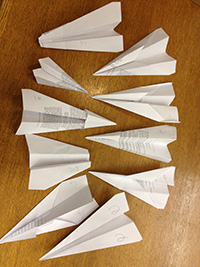
Paper planes that crossed the distance line

Some of the planes that made it across the line

Last weekend, while at the Montreal Mini Maker Faire, I received some advice on constructing paper airplanes, including why one might want to add ailerons (straight flying) or an airfoil (slower, longer glide) to improve the performance of their folded-paper gliding machine. And I recently found this conference paper, “On the aerodynamics of paper airplanes,” when we heard that we were going to have something of a paper airplane distance contest happening in Schulich Library of Science and Engineering. Finally on Thursday, I was on hand – now well equipped – to referee the Schulich Library leg of the Amazing Library Race.

As part of Library Orientation (on now!) over 40 students  took part in the Amazing Library Race last Thursday afternoon, which involved participants racing between various branch libraries and completing tasks before moving on to the next location and task. At Schulich Library the new students’ challenge was to build and “fly” a paper airplane a prescribed distance – the distance was kind of arbitrary, but I would estimate it at about 5 meters – before receiving their next clue. Whether or not the planes had ailerons, most of the successful models were similar to the classic dart-style plane discussed in the paper above. Regardless, all of the groups were eventually able to get their plane to cross the distance line with their paper-plane-engineering savvy!

Orientation activities at Schulich Library and across the Library system continue this week and into the school year. Come check it out now and save time later on!

Previously: Ready! Set! Get Oriented!

Image by Rebecca Nicholson

More free reads

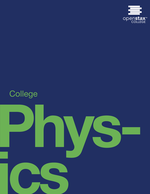
College PhysicsIf you are curious about the physical universe this free introductory College Physics textbook from OpenStax College may be just the thing you need.  It is peer-reviewed by educators and has the look and feel of a classic illustrated textbook but with a Creative Commons Attribution 3.0 license.  It can be downloaded, edited, customized, and reused, or you can just go ahead and dedicate some time to expanding your mind with conceptual questions, problems and exercises online.

You may also be interested in Introduction to Sociology, and there are more titles to come.

Happy learning!

Image from OpenStax College 

Mathematical theory and the Rubik’s Cube

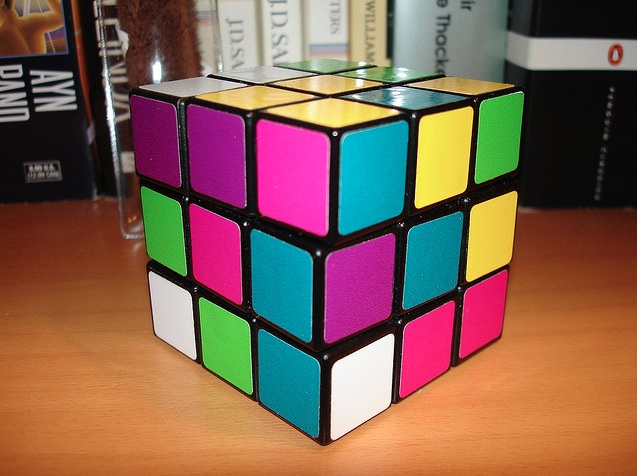
The 2012 World Cube Association’s U.S. National Championship was held at the beginning of August in Las Vegas.  A California teenager, Deven Nadudvari, set a record by using one hand to solve 5 different 3-by-3 Rubik’s Cubes in an average of 14.86 seconds each.

“You can use Rubik’s Cube to teach engineering, you can use it to teach mathematics, and you can use it to talk about the interplay between design and engineering and mathematics and creativity,“ according to Paul Hoffman, president of the Liberty Science Center in Jersey City, who is organizing an international exhibition in 2014 that will celebrate the cube’s 40th anniversary. (Montreal Gazette, 8/11/2012, Quenqua)

The Rubik’s Cube has been used to teach Group Theory in mathematics.  For more information about group theory and the cube, check out any of these books.

Photo from allie

Man-made jellyfish

Harvard bioengineers have made an artificial jellyfish by growing a single layer of rat heart muscle on a patterned sheet of polydimethylsiloxane.  As you can see from the following video, when placed between two electrodes in water, this synthetic structure can swim exactly like its living counterpart. The rat muscle contacts when an electric field is applied across the structure, and then the elastic silicone pulls the jellyfish back to its original shape.

“Morphologically, we’ve built a jellyfish. Functionally, we’ve built a jellyfish. Genetically, this thing is a rat,” said Kit Parker, the researcher who led this project.

You can read more in Nature Biotechnology.

Ready, Set, Get Oriented!

It’s that time of year again! Dust off your book belts and make sure your alarm clock is in good working order because it’s Back to School! McGill Library is ready to ease you into the new academic year with a lot of fun and informative Library Orientation activities. Attend all three, on a drop-in basis: Library Tour, Getting Started and Finding the Right Stuff, at Schulich Library or any other McGill Library branch and receive a free USB bracelet! Here’s how you win:

  1. Pick up your Orientation Passport at any library branch, during Discover McGill Street Fest or at the Discover McGill Service Fair. We will also distribute these at the Tours and Workshops if you don’t already have one.
  2. Get your passport sticker after each session you attend.
  3. Once you’ve collected all three stickers, drop your passport off at any Library Information Desk to receive your free McGill Library USB memory bracelet!

After each Workshop you attend at Schulich Library, your name is entered in a draw and you could win a nifty McGill mug. For a schedule of Schulich Library’s Tours and Workshops click here.

Don’t forget about The Amazing Library Race being held on Thursday August 30, from 3-5 pm.  For more information or to register click here. Please note that if you participate in the Amazing Library Race, you can earn a sticker for your Orientation Passport in lieu of a Tour. Sound good? See you at the finish line!

Image by Nikki Tummon

Have you Wordled yet?

Wordle is useful in helping you quickly find themes in any text that you need to read.  For example, you can use it to find themes in:

  • reports,
  • Web pages,
  • books,
  • dissertations,
  • journal articles,
  • database search results, etc.

You just copy your text and paste it in Wordle to generate a word cloud that shows you, by default, the 150 most frequently mentioned words in your text.  The bigger the word, the more often it has been mentioned.

You can also use Wordle to visually summarize anything that you have written.  Visit Wordle and give it a try!

Image of a Wordle created from the text of this blog

Melting in the Arctic

Throughout the year, the U.S. National Snow & Ice Data Center in Colorado provides scientific analysis and daily image updates of sea ice in the Arctic Ocean.  This research center has recently been in the news due to their reporting that the Arctic sea ice has been melting more quickly this summer, which has resulted in flooding and damage to structures.  Their website provides interesting FAQs about sea ice and our climate, such as “What is causing Arctic sea ice decline?

Photo courtesy of: Patrick Kelley (U.S. Coast Guard) and the National Snow and Ice Data Center, University of Colorado, Boulder.

Water catchment in Bermuda

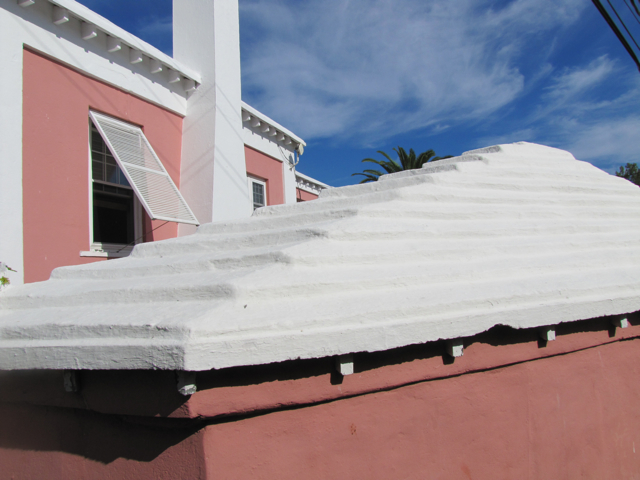
I learned something interesting about Bermuda on a recent trip there. They have beautiful pink sand beaches but no fresh water on the islands. To supply their homes with safe water for drinking and washing they make good use of their roofs.

In the photo here you can see a pyramid-like shape to the roof, used to catch rainwater and direct it to a pipe running alongside the building. Instead of basements they build their homes on top of huge water tanks. Bermuda is relatively free of pollution but the roofs are treated with a limestone wash that purifies the water.

Note also in this photo that the shutters open upwards to allow the fresh air in while providing protection from the sun.

Image by April Colosimo

Interact with computers without a mouse

You may still remember the scene from the movie “Minority Report” where Tom Cruise controlled the computer by wearing a pair of special gloves and performing gestures in the air. A new software, called “g-speak”, came into being at Oblong Industries which might change the way we interact with computers in the future, since a mouse will never be useful in a g-speak operating environment. The following video demonstrates how the g-speak system works.

Read more at ‘Minority Report’ software becomes a reality

Keeping safe during a thunderstorm

We have had a few thunderstorms over the spring and summer.  Are you acting safely during these storms?  Test your safety knowledge by identifying the following statements as true or false:

1-    Lightning never strikes in the same place twice.

2-    Lightning only strikes under a storm cloud.

3-    Trees are safe places under which to duck for cover during lighting.

Environment Canada provides the answers to the statements above and presents thunderstorm safety tips in this 3-minute video: