“Once an industry gets disrupted, it can disappear in a moment” – Markham Hislop
There is so much work going on on our campuses related to sustainability and climate change research these days and our university is being recognized for all these important projects. For example, in the June 25 What’s New, McGill was lauded as Canada’s top university in the QS World University Rankings. Of all the things that make McGill world famous, did you know our highest score was in sustainability? Though much of the work is being driven by our award-winning McGill Office of Sustainability, they are not the only game in town!
One of the most exciting things currently happening on campus is the number of free sustainability and climate-related events, open to the general public. I am grateful for having attended two such events in the past couple of months, organized by two different units on the downtown campus. As the liaison librarian for the Trottier Institute for Sustainability in Engineering and Design (TISED), several engineering departments and Atmospheric and Oceanic Sciences, I get to learn about sustainability in order to better support the research needs of students and faculty in these departments. Both events were fantastic at making the science of sustainability and the transition to healthier and zero-emission energy sources (called the energy transition) understandable to ordinary people.
Sometimes the hard part about climate change and sustainability is how dreadful it can all seem, and yet what’s so exciting is that solutions are all around us. Both events succeeded in instilling that hope in their audiences. The first event was the Transportation Research Roundtable, a day-long symposium organized by the Sustainable Growth Initiative, a cross-faculty partnership anchored in McGill’s Faculty of Management and “dedicated to building practical, constructive, and applied solutions for key issues challenging sustainable growth.” To be notified about their future events, you can subscribe to their mailing list. Sponsored by Alstom and organized by professors in McGill’s Department of Geography and École Polytechnique’s Department of Civil Engineering, the event brings together students, faculty, members of the public, municipal workers, industry and others to discuss all things transport and sustainability. This was the third annual roundtable and it didn’t disappoint.
I was so excited to hear the keynote by Sarah Goodyear and Doug Gordon, authors of the 2025 book “Life After Cars: Freeing Ourselves from the Tyranny of the Automobile” (available at McGill Libraries) and creators of the podcast the War on Cars. As a huge fan of their book, I was thrilled to hear them discuss the book’s main thesis: our reliance on cars causes air pollution and other negative health impacts, makes us lonely, limits childrens’ autonomy and results in many other social and planetary ills. There were detailed questions from the audience on if progressive policies are contagious (yes, they are), what differences there might be implementing non-car alternatives in rural versus city settings (for rural places, consider re-investing in historic city centres) and what the authors thought about Montreal’s famous alleyways (they were jealous but emphasized that our alleyways shouldn’t be an excuse not to invest in bike lane infrastructure). The authors gave practical examples of cities embracing active mobility and limiting cars such as the Beltline in Atlanta, the Bike Bus movement – where groups of citizens organize bringing kids and families to school by bike along a designated route, road pricing in Norway, the spread of Citi Bikes in New York city and, of course, our own Bixi system here at home. You can read about the day and watch the full keynote at: https://www.mcgill.ca/desautels/article/sustainable-growth-initiative-sgi/war-cars-sgis-3rd-annual-transportation-roundtable
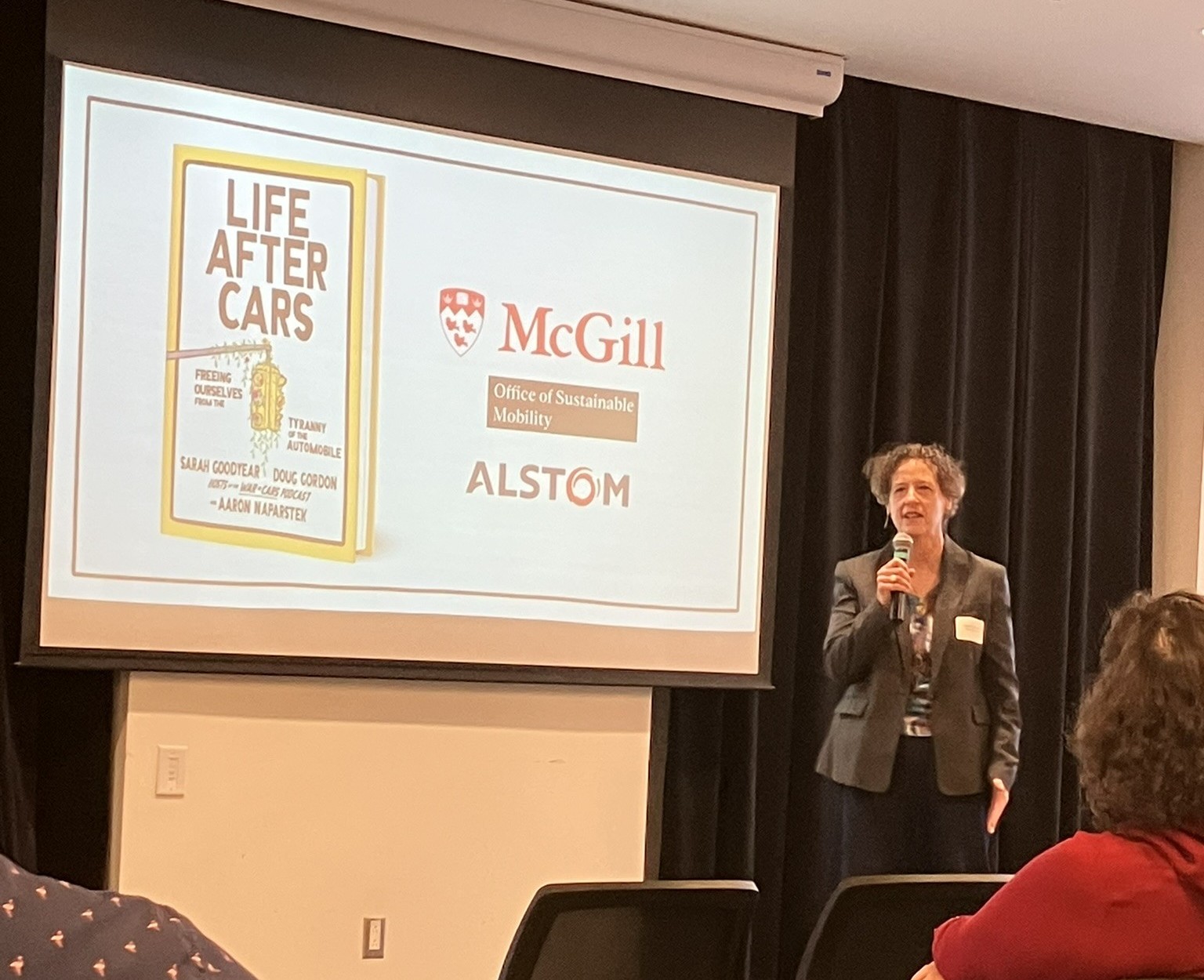
Image: Taken by Tara Mawhinney
The second sustainability-related event Disruptive Innovation, the Energy Transition, and Canada, hosted by the Trottier Institute for Sustainability in Engineering and Design was a fantastic primer by energy expert and journalist Markham Hislop on the energy transition landscape in Canada. Essentially, fossil fuels are old technology and bound to go the way that the use of horses and mules did in agriculture once tractors were invented. His main point was that Canada is getting left behind by focussing on polluting old technologies like fossil fuel extraction and pipelines instead of investing in new, green technologies. He showed a graph of the decline of horses and mules on US farms between 1900 and 1950 , which illustrated just how quickly new technology can displace older ones. We know what side of history we want to be on and it’s not the one going the way of the dinosaur. Hislop’s superpower is what is interestingly called “vulgarisation” in French and for which English doesn’t have a great equivalent. What might be called being a ‘popularizer’ or a little dryly: scientific communication for the layperson.
I love those moments in the classroom when you can actually see students absorbing new information. As an information literacy instructor, I could see several instances of that throughout Hislop’s talk. There were so many questions from the audience that you could tell everyone wished the question period could be longer. The talk ended on an inspiring note when a young female undergraduate engineering student asked Hislop for tips for young engineers graduating today. He responded that we are at a point where it is not about the cost of new green technology anymore as it’s become much more affordable. Rather, we are at the point where we need to figure out how to use the technology to solve real world problems. He commented, “Maybe our secret weapon [in Canada where we have a strong innovation ecosystem and research supports] is to take the technology and figure out how to do things better [and in a way that’s] better suited to our needs.”
You can watch the whole talk here: https://www.youtube.com/watch?v=XxfS0dSosWw , follow Hislop on his Thoughtful Journalism blog and subscribe to the TISED newsletter to keep up to date about upcoming McGill talks. With so much state of the art sustainability research happening at McGill, I hope these talks inspire you to keep learning more on this topic. The future depends on it.