Survival Guide to the Cite Guide :)

Last two or three weeks (as usual on this time of year), there was number of students looking for help on how to cite the sources for their first memo. For their benefit, I decided to reiterate my last year’s not-totally-unsolicited advice on the matter.

  1. Ask a librarian for a help. We will not do or check your footnotes, but we will walk you through the maze of the Red Book (no offence meant) to make sure that the next time you will be comfortable to use it by yourself.  Do not be shy to come several times if you need more help, and please, please do not come 5 minutes before your paper is due – in this case, we can only commiserate with you.
  2. When your TL gives you a piece of paper, a pdf, or a photocopy of something, ask what this is, and from where it is coming from (book, website, encyclopaedia, etc.). You will save some precious minutes (or hours) later when you are pressed for time and have to finish your work by a deadline. It is quite unpleasant to discover suddenly that the TL’s piece of paper is a book chapter, and you have no slightest idea about the book title and/ or author.
  3. Do not wait until the last minute to make your footnotes. If you ‘cite while you write’, you will have your paper AND your footnotes ready, except for the final proofing, when you finish writing the last paragraph. If you leave all your footnotes to be done after you finish the paper, you will end up frantically trying to figure out where this or that quotation is coming from, or what all the supra(s) and idem(s) mean. Everybody works differently, but try at least once…
  4. Add some common sense and reasoning to the Red Book. Do not expect it to contain a correct form of footnote for every possible source. Red Book will not necessarily have an answer to your particular question. When you have something to cite, think about what rule fits the best the type of source that you have in hand.
    Read carefully the section to apply the rule, do not scan and skim the text.
  5. In short, to cite a source, proceed as follows:
  • READ General Rules section (optional after you know it by heart)
  • determine what it is that you have to cite
  • find the chapter corresponding to the type of your source (Jurisprudence for cases, Secondary Sources for books and journal articles, etc.)
  • find the section corresponding to the particular source that you have
  • READ this section
  • apply the rule to cite the source making analogies if necessary
  • repeat as needed:)

Dot or no dot (while citing codes) that is the question

According to the questions that we received at the reference desk recently, there seems to be quite a confusion if a period (full stop/ dot) should be used at the end of the footnote when you are referring to a code. I contacted the editor of the Cite Guide, Alexander Max Jarvie, who kindly provided this clarification that I am sharing with you:

“The period that appears at the end of examples provided elsewhere in the Legislation section is intended as an indication of the terminal period for the entire citation. Although we have removed most periods from citation forms in the 7th edition, a citation footnote is still a sentence and as such punctuation is used in normal fashion. Hence, if the citation to a codal article is the last (or the only) source to be referenced within a particular footnote, a period would follow. To illustrate these rules in practice, I have provided examples below:
2 Art 1214 CCQ.
Canada Act 1982 (UK), 1982, c 11.
35 See Canada Act 1982 (UK), 1982, c 11; see also art 1214 CCQ.”

Centraide Campaign in the Library

centraideFinal_lowres_email_internet

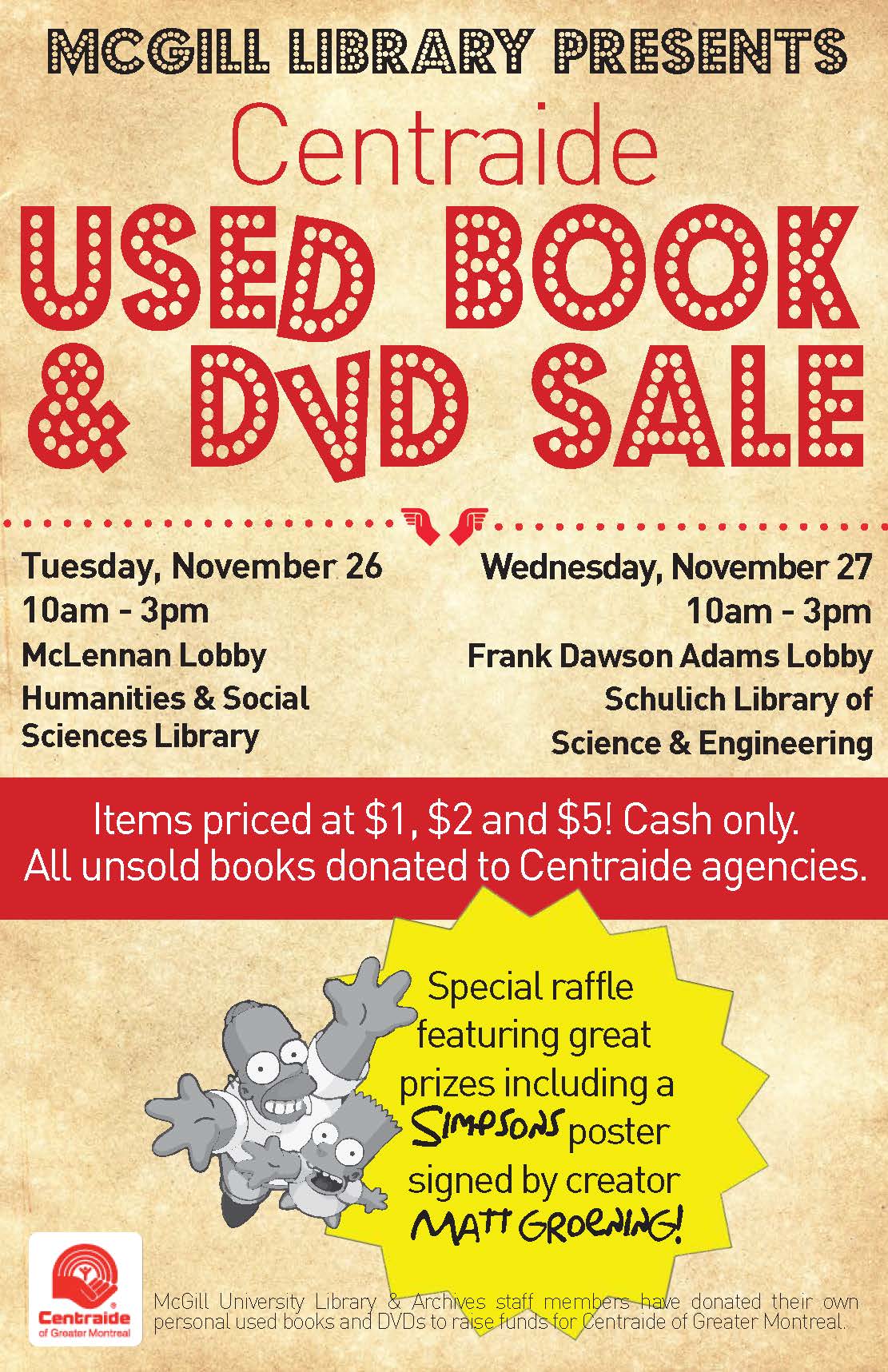
The McGill Library is holding a Book/DVD Sales on November the 26th at the McLennan Library and November the 27th at the Schulich Library! All proceeds will go to Centraide. Everything will be priced to sell at $1, $2 and $5.

Donate your used Books and DVDs to our sale for Centraide! FUN fiction, history, biography, autobiography, travel and children’s books and DVDs are accepted. Drop your donations in the grey bin at the entrance of the Law Library.

P.S.: Casebooks are not considered fun by most of the population, so please do not donate them 🙂

Legal Databases Training for Law Students

The Nahum Gelber Law Library is pleased to offer database training by legal publishers to the McGill Law School students. The sessions will take place in the Law Library Computer Classroom (main floor of the library) :

  • CAIJ (Centre d’accès à l’information juridique)
    Wednesday, October 30th, 2013 from 12h30-14h
    Me Munja Maksimcev
  • QuickLaw (LexiNexis)
    Friday, November 1st,  2013 from 12h30-14h
    Mr. Ron Jones
  • Azimut-Juris.doc (SOQUIJ)
    Wednesday, November 6th, 2013 from 12h30-14h
    Me Véronique Abad
  • Westlaw Canada (Carswell)
    Friday, November 8th, 2013 from 12h30-14h
    Me Michel Tremblay

Sign-up sheets are available in the Law Library Computer Classroom.

“Seeds” at the Centaur Theater: Legal Case Turned into Play

Based on interviews and court trial transcripts from Monsanto Canada Inc. v. Schmeiser, 2004 SCC 34, [2004] 1 SCR 902, “Seeds” brings us into a maze of patent wars, opinionated scientists and clashes between farmers and the biotechnology industry.
When Schmeiser famously asked the question, “who owns life?” before the Supreme Court of Canada, his words galvanized the anti-GMO movement around the world.

You can see the play from October 29 to November 24, 2013.

ICLR Online, UK Case Law Database

The Law Library is happy to offer to our users an access to a newly purchased UK case law database, ICLR Online.

The Incorporated Council of Law Reporting for England and Wales was established in 1865 by members of the legal profession with the object of “preparation and publication, in a convenient form, at a moderate price, and under gratuitous professional control, of Reports of Judicial Decisions of the Superior and Appellate Courts in England and Wales” (Memorandum and Articles of Association, 1870). As well as the official Law Reports, ICLR publishes the Weekly Law Reports, the Industrial Cases Reports, the Business Law Reports, the Public and Third Sector Law Reports and the Statutes and Public and General Acts.

In October 2011, ICLR launched an online database,  ICLR Online. ICLR Online is the hub of legal authorities dating back to 1865. A dedicated case law platform presents  the cases in a comprehensive and readable format. The law reports are combined with the Citator+ to present all the relevant case information in one screen, making legal research easier.

ICLR online can be accessed at Subject guides / Law  / Legislation and cases- foreign jurisdictions

Itinéraire(s) d’un historien du droit : Jacques Poumarède, regards croisés sur la naissance de nos institutions

Cet ouvrage rassemble les contributions majeures données depuis trente ans par Jacques Poumarède, le professeur émérite d’histoire du droit à l’Université de Toulouse-Capitole, un spécialiste des coutumes successorales du Sud-ouest. On trouvera dans ce volume des chapitres consacrés à l’histoire des droits familiaux et patrimoniaux tant pyrénéens que français et les réflexions sur les diverses approches d’écrire l’histoire du droit ainsi que sur les origines épistémologiques de la discipline.

New Exhibit at the Law Library: Ancienne collection de François Olivier–Martin : Histoire du droit français des origines à la Révolution

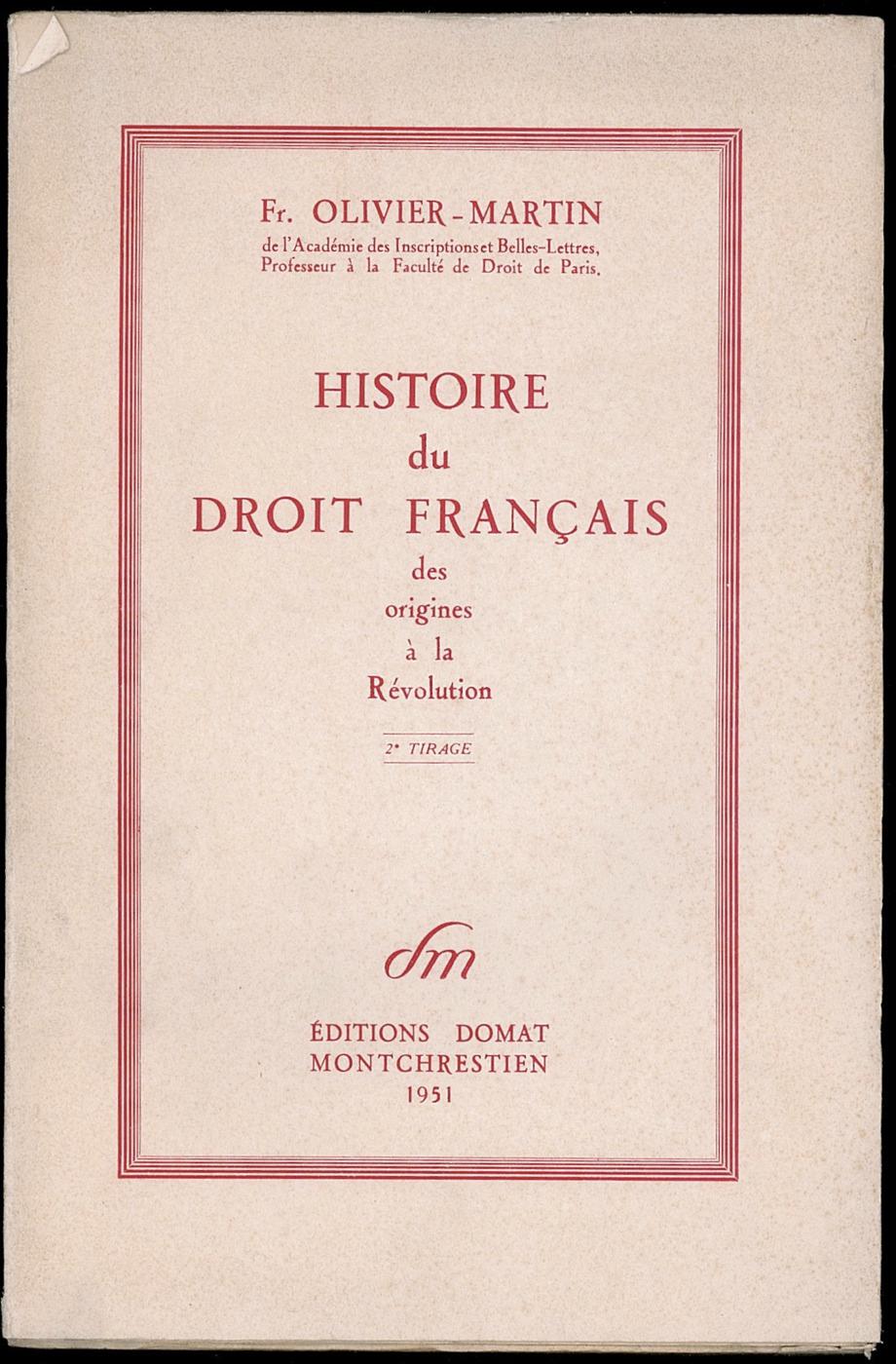
Ancienne collection de François Olivier–Martin : Histoire du droit français des origines à la Révolution

892808083François Jean Marie Olivier-Martin (1879-1952) was a prominent legal historian, doctor of law, and a professor of legal history. He began his academic career at the Faculty of Law of the University of Rennes in 1909. In 1921, he succeeded the famous legal historian Emile Chénon as director of the course on legal history of the University of Paris, where he taught until 1951. Olivier-Martin was a prolific scholar who published more than 60 articles and 9 monographs. His 3 major works unrivaled in their use of primary sources and the breadth of the synthesis are still inevitably cited by scholars writing about the history of pre-revolutionary French law. For his academic achievements Olivier-Martin was awarded multiple Doctor Honoris Causa, the Chevalier of the Legion of Honour in 1932 and in 1936 was elected to the “Academie des Inscriptions et Belles Lettres”, one of the five academies of the Institut de France.

In 1956, Doctor Jean-Gabriel Castel, a Professor at the McGill Law Faculty began the negotiations to purchase Olivier-Martin’s collection, which at the time was one of the most comprehensive private law libraries in France. The negotiations were successful, and the library was acquired with the funds generously donated by a former McGill graduate, Arnold Wainwright, a prominent Montreal practitioner, a long-time associate and friend of the Faculty of Law and a part-time lecturer in Civil Law, which he taught at McGill for twenty-five years.

On February 8, 1958, Olivier-Martin’s library of some 770 titles was formally presented to the McGill Law Library and officially renamed the Wainwright Collection. The generosity of Arnold Wainwright, continued through the Wainwright Trust, has enabled the Faculty of Law to purchase in the antiquarian book market many additional titles of interest to add to the original bequest of 1958. The Wainwright Collection today consists of over 1500 titles on the history of the pre-revolutionary French law.

The current exhibit features selected titles that represent the subject focus and the breadth of the original Olivier-Martin library as well as archival documents pertaining to the history of acquisition of the collection.

Olivier-Martin’s library consisted of contemporary commentaries and rare materials on the law of Ancien régime.  His library reflects with remarkable accuracy the academic interests of its former owner with three major themes of the collection: French customary law, History of professional corporations, and History of pre-revolutionary French law crystallised in his three the most significant works: Histoire de la coutume de la prévôté et vicomté de Paris (1922-1930), Organisation corporative de la France d’Ancien régime (1938), and Histoire du droit français des origines a la Révolution (1948).