Law in Everyday Life: The Invisible Roommate Who Never Does the Dishes

Most people think of “the law” as something that lives far away, preferably behind thick courtroom doors, guarded by people in robes who speak Latin for fun. In reality, law lives much closer to home. In fact, it lives with us—quietly judging our behavior, setting rules, and occasionally ruining our plans. Law is the invisible roommate of everyday life: always there, always watching, and very clear about what you are absolutely not allowed to do.

You encounter law before you even leave the house. Your alarm goes off at a socially acceptable time because employment law has decided that “whenever I feel like it” is not a valid work schedule. You make coffee, trusting that the machine won’t explode, thanks to product safety regulations written by people who clearly once had a very bad morning. You step outside and lock your door, comforted by property law, which gently whispers, “What’s yours is yours… unless you forget to pay your mortgage.”

The commute is where law really stretches its legs. Traffic rules transform ordinary adults into surprisingly obedient citizens who will sit patiently at a red light at 6 a.m., despite the complete absence of cross traffic, because the law said so. Speed limits, pedestrian crossings, parking signs—this is law’s way of reminding us that chaos is only three ignored rules away. Even jaywalking is less about crossing the street and more about negotiating your personal relationship with risk, authority, and nearby police officers.

At work, law continues its quiet supervision. Employment standards decide how long you can work, how little you can be paid (within reason), and how many breaks you are entitled to before becoming legally cranky. Privacy laws lurk behind every email marked “confidential,” while copyright law waits patiently to scold you for pasting “just one little image” into a presentation. Office kitchens, meanwhile, are governed by an unwritten but fiercely enforced body of law concerning stolen lunches and unwashed mugs—proof that not all law needs legislation to inspire fear.

Even leisure time isn’t free from legal influence. Streaming services remind you that sharing your password is “technically prohibited,” a phrase that means “illegal, but emotionally complicated.” Restaurants post allergy warnings and calorie counts because the law insists you deserve to know exactly how dangerous that dessert might be. And social media, that wild frontier of human expression, is quietly shaped by defamation law, harassment rules, and the sobering realization that screenshots last forever.

Perhaps the most impressive thing about law in everyday life is how rarely we notice it. It works best when it’s boring—when contracts are honored, sidewalks exist, food is labeled, and most people stop at stop signs. Law isn’t just about dramatic trials or landmark decisions; it’s about making daily life predictable enough that we can argue about important things, like who finished the milk.

So while law may not wear a cape, it does heroic work behind the scenes. It keeps society from descending into polite anarchy and ensures that, most of the time, we all play by roughly the same rules. Annoying? Sometimes. Necessary? Absolutely. Like that invisible roommate, law may never do the dishes—but without it, the place would be unlivable.

Come visit the new Spring 2026 exhibit at the Nahum Gelber Law Library 24 Hours of Law: How law shapes our day, curated by Sonia Smith and Megan Millward. And once you start noticing law in everyday life, you may never see a stop sign, coffee label, or “terms and conditions” box quite the same way again.
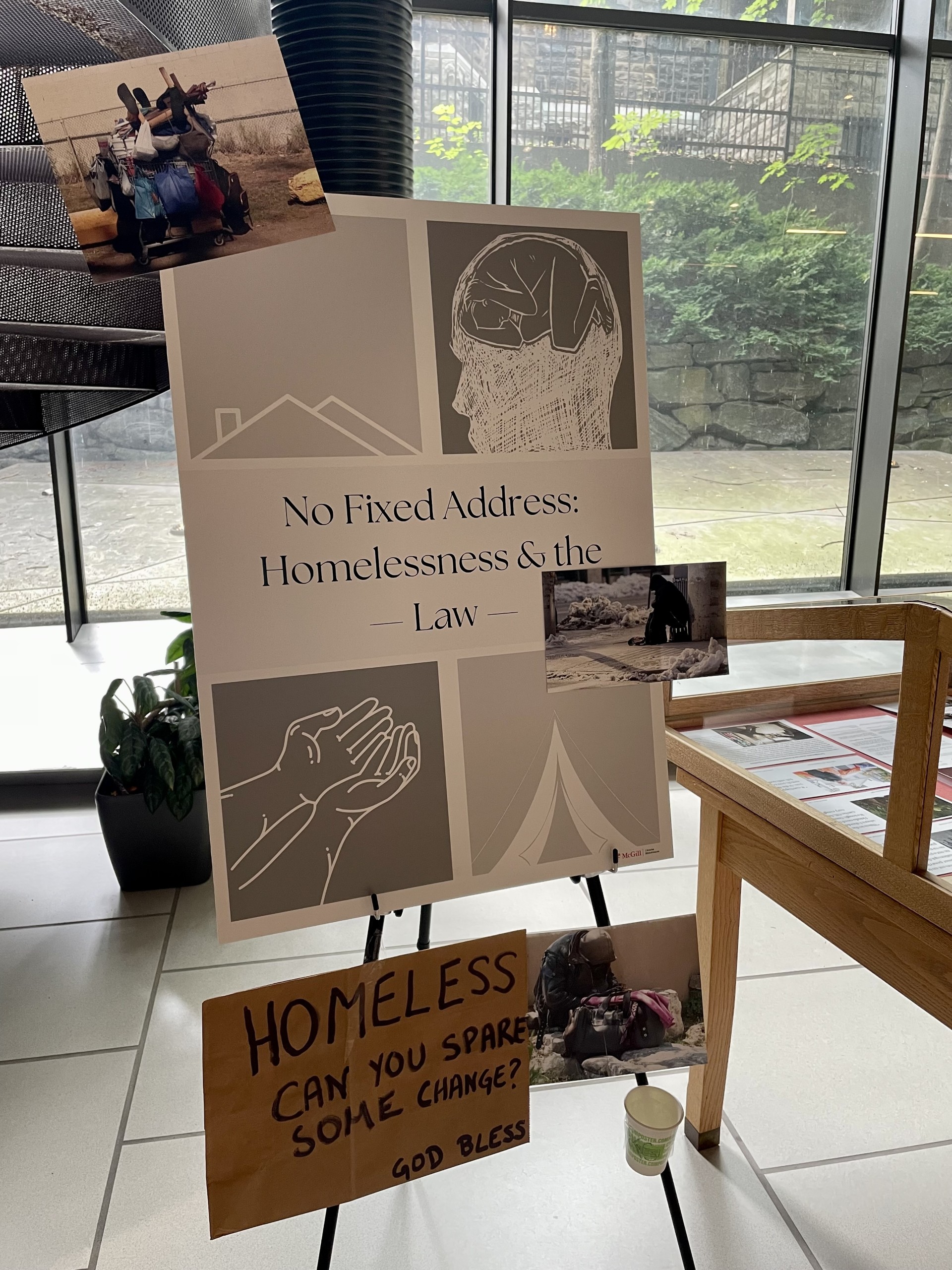
No Fixed Address: Homelessness & the Law

Montreal’s streets are rich in art, culture, and a joie de vivre that weaves through its iconic spiral staircases. However, beneath this vibrant energy lies a dark reality we can no longer overlook. According to the Service Régional de L’Itinérance (2025), nearly half of Quebec’s homeless population is concentrated in Montreal, with visible homelessness increasing by a staggering 33% since 2018. This crisis demands immediate action and the implementation of more robust social policies and support services to address this growing issue.

            Factors such as low income, mental health challenges, social marginalization, and escalating rent costs are contributing to this pressing concern in 2025, as reported by Centraide (2025). In response to this ongoing crisis, an educational exhibit has been developed to raise awareness and encourage meaningful change.

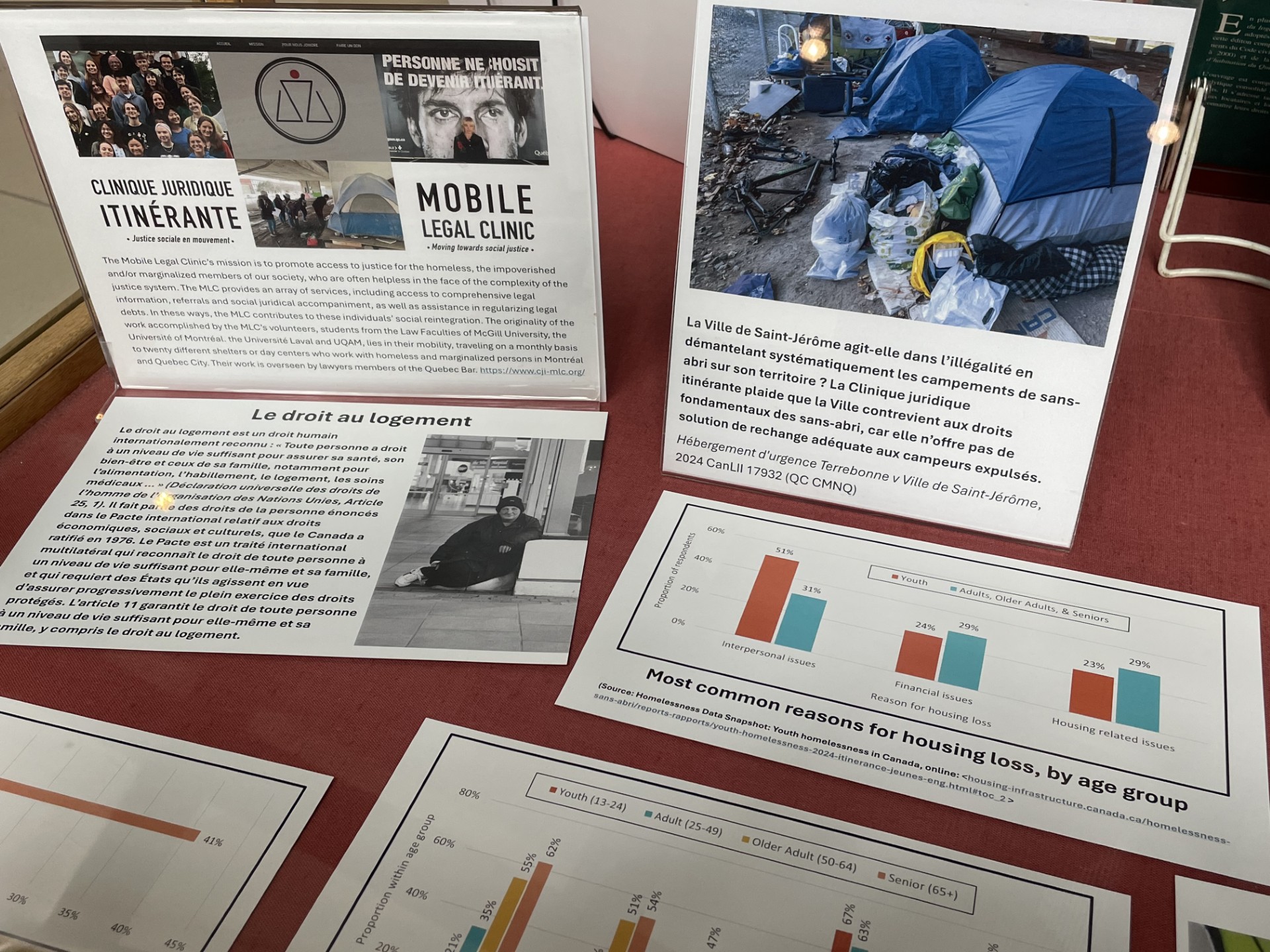
            The new exhibit, No Fixed Address: Homelessness & the Law, located on the main floor of the Nahum Gelber Law Library, presents resources related to homelessness and housing issues, particularly within the context of housing laws. Alongside these materials, photographs depicting the harsh realities of homelessness are displayed, paired with poignant quotes from newspapers highlighting the profound struggle of living without a place to call home. The photographs evoke a deep sense of isolation, shame and longing, offering an intimate glimpse into the lives of those without permanent shelter.

            Additionally, the exhibit features documents that highlight the critical importance of legal intervention. As future legal professionals, law students are uniquely positioned to advocate for significant change within the city. By engaging in these issues and working towards more effective and equitable housing laws, they have the opportunity to shape Montreal’s future, ensuring that every resident has access to safe and stable housing, and that all Montrealers are afforded the dignity of a permanent address.

Exhibition curated by Sonia Smith and Jessica Fernandes

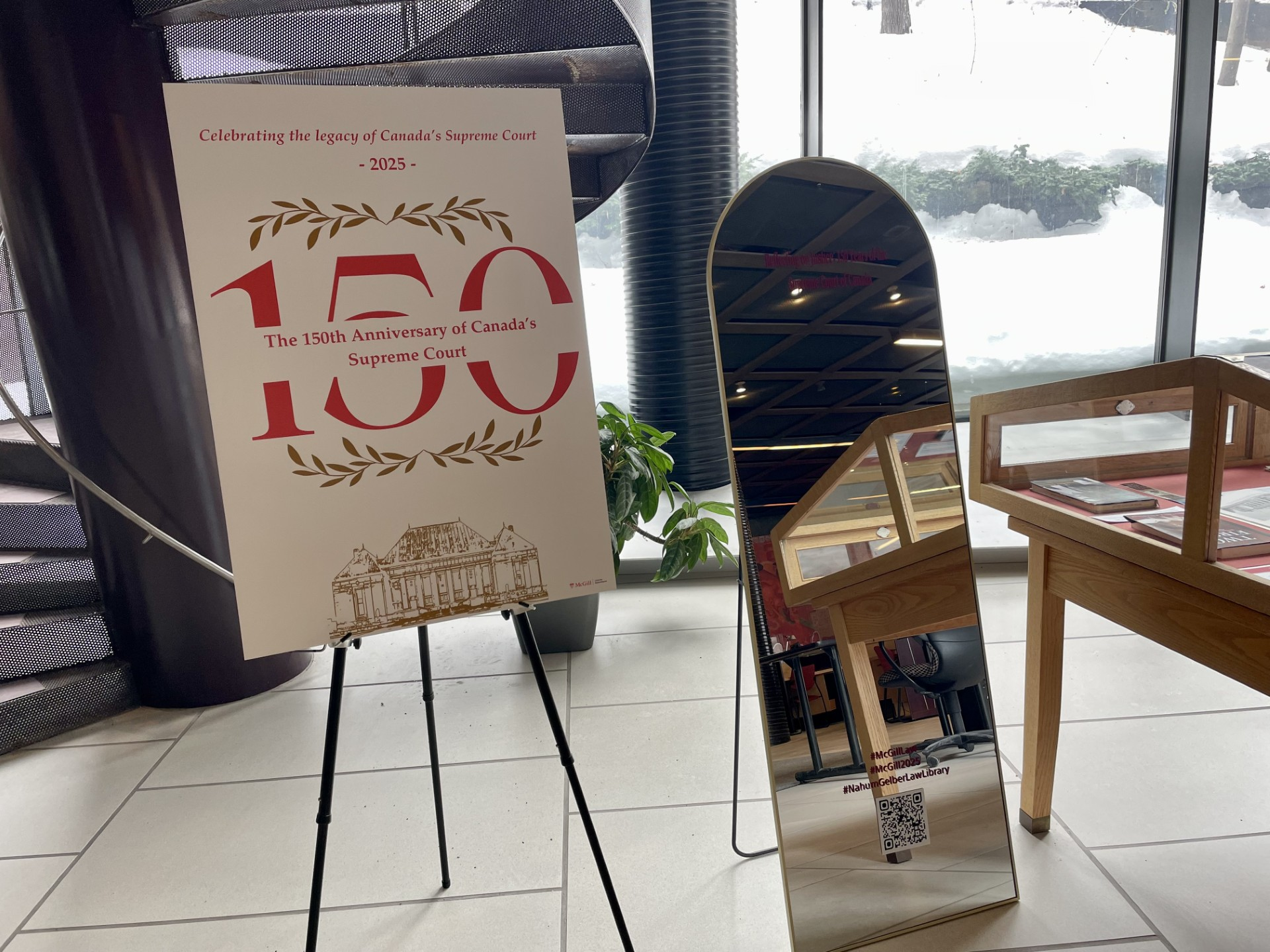
Celebrating the Legacy of Canada’s Supreme Court

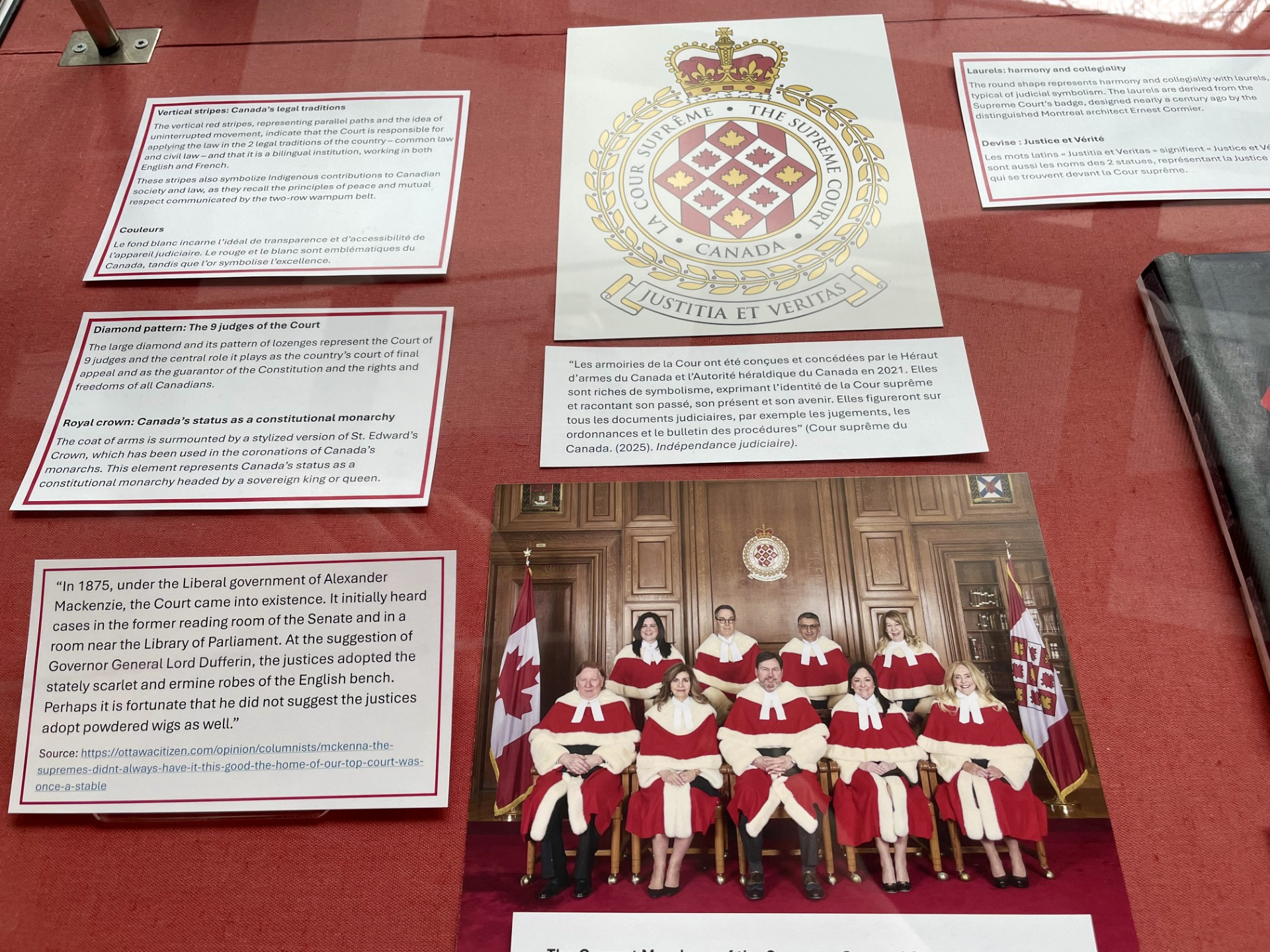
The year 2025 marks a special milestone for the Supreme Court of Canada as it celebrates its 150th anniversary. Over the years, its chambers have been the setting for landmark cases that have shaped the foundation of this country. Some decisions have reinforced fundamental principles of justice, while others serve as reminders of how far we’ve come. These cases provide an opportunity to reflect on our history and appreciate its ongoing evolution.

At the heart of these rulings are the Judges, many of whom once walked the same corridors as today’s law students at McGill University. Their decisions on equality, religious accommodation, Indigenous rights, gender and sexuality rights, and property rights have played a great role in shaping Canadian society.

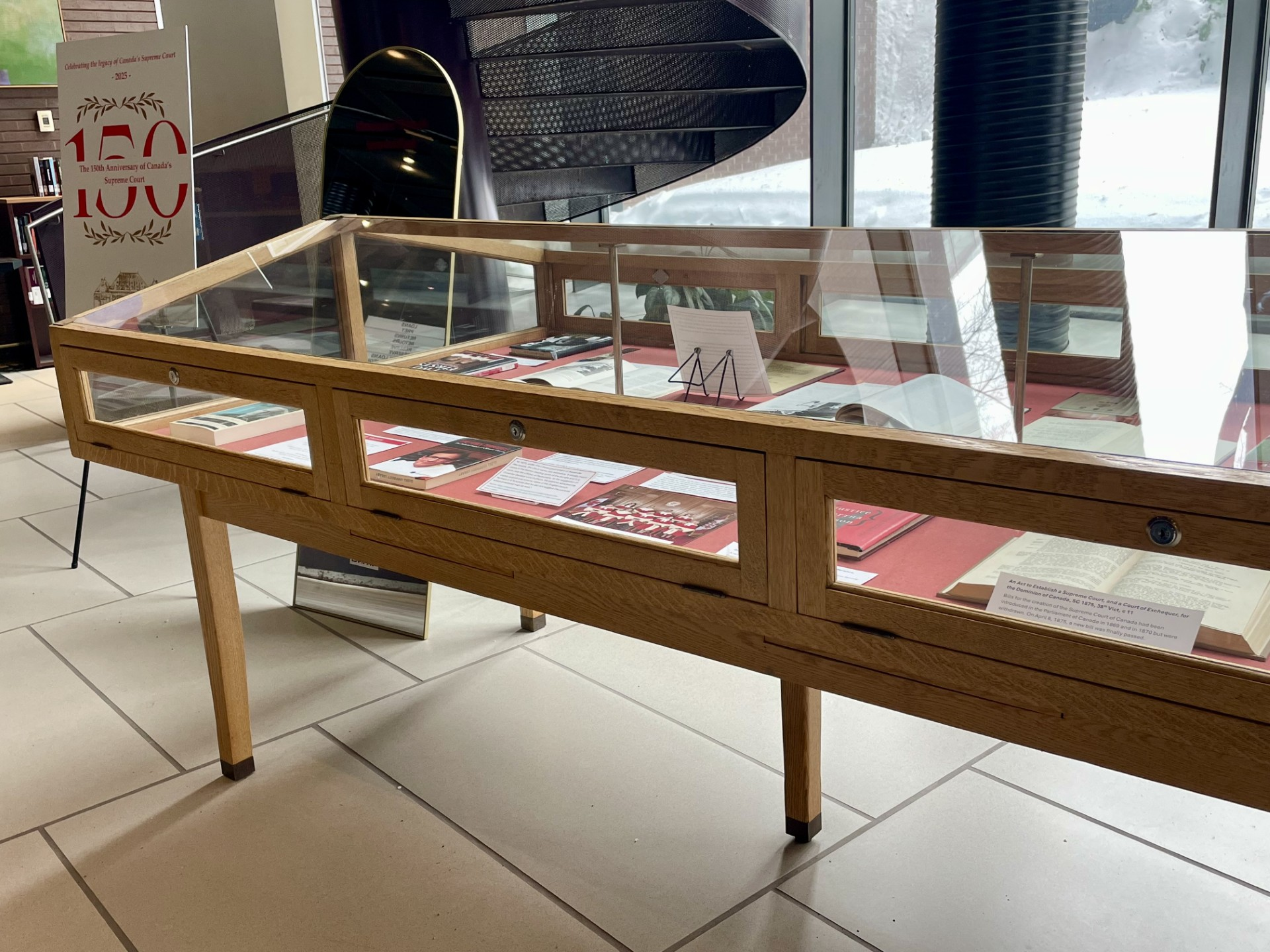
To commemorate this legacy, the Nahum Gelber Law Library is hosting an exhibition that pays tribute to the Judges who have shaped the Court’s history, with a highlight of pivotal cases that illustrate its influence on Canadian law.

We invite you to explore this curated exhibition on the first floor of the Nahum Gelber Law Library. Take this opportunity to reflect on the path of justice and the Court’s lasting impact. For those interested in further engaging with its history, additional resources are available on the exhibition website (https://ngllexhibit.wixsite.com/150th-anniversary). Join us in celebrating 150 years of the Supreme Court of Canada!

Exhibition curated by Sonia Smith and Jessica Fernandes