The U.S National Institutes of Health has launched a 3D print exchange website that allows users to download, edit and share models of anatomy, bacteria and lab equipment. Among the current available selections: a frog dissection kit, the base of a cervical spine, a bust of a Macaque, the influenza virus, a microscope, a DNA playset and a “three-dimensional structure of the toxin-delivery particle antifeeding prophage of Serratia entomophila.”
Category Archives: Blog
Catch the Next Tsunami: Natural Disasters MOOC Starts Tomorrow!
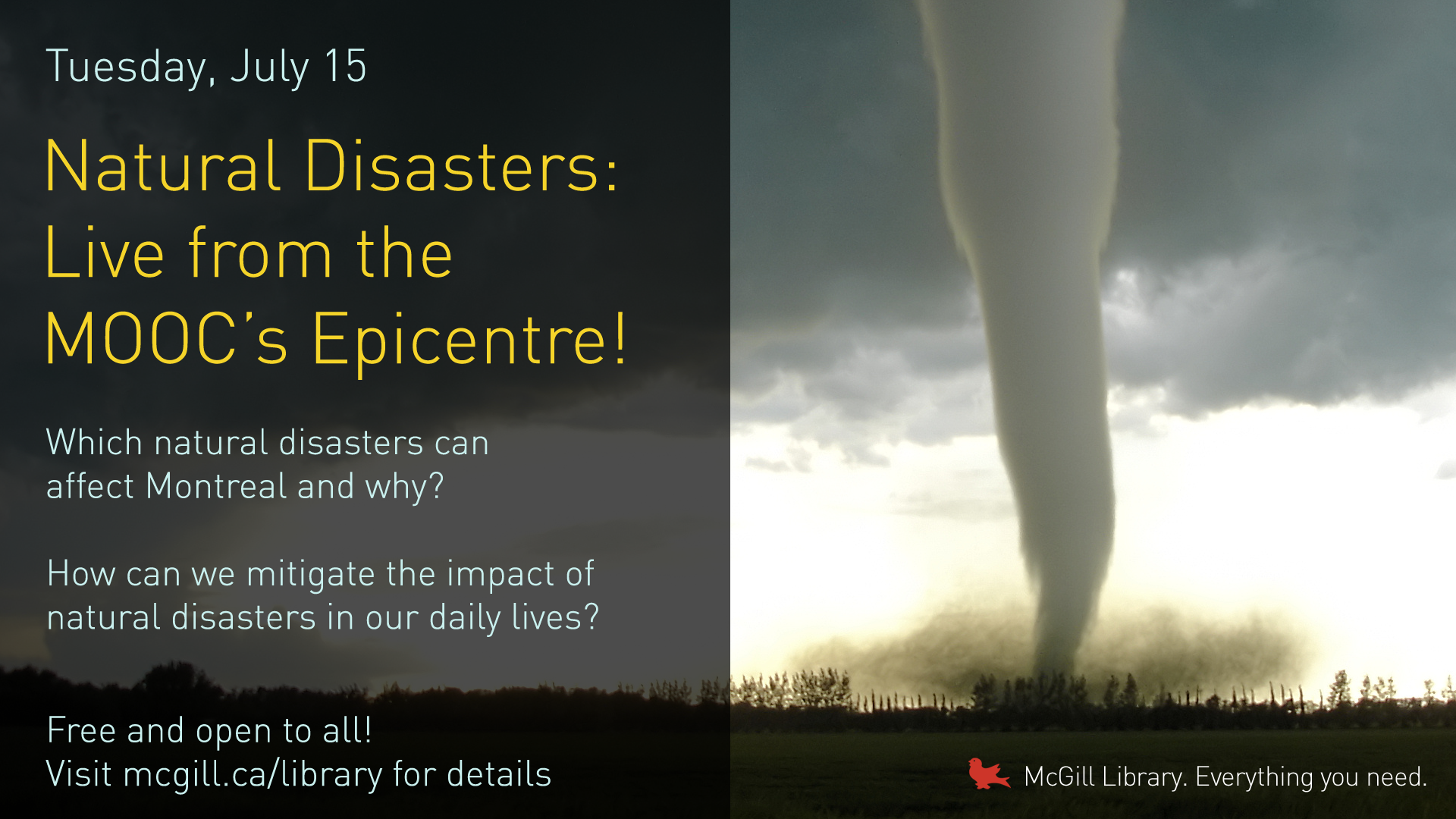
McGill is about to launch ATOC185x: Natural Disasters, its second MOOC (Massive Open Online Course), tomorrow and you can register here! The course is publicly available to anyone with an internet connection and interest in some of the most pressing environmental questions of our time:
- What makes certain areas more susceptible to earthquakes, ice storms, hurricanes, tornadoes and volcanoes?
- What factors are currently increasing the vulnerability of the world’s population to natural disasters?
- Do natural disasters happen in an isolated manner or can we predict them?
- How can we work together to better mitigate the impacts of natural disasters in the future?
Following in the footsteps of McGill’s first MOOC – “Food for Thought” that kicked off in January 2014 and saw over 30,000 people register, this second MOOC given by volcano expert John Stix from Earth and Planetary Sciences and ice storm expert Professor John Gyakum from Atmospheric and Oceanic Sciences continues to offer education for the masses on important topics that affect all our lives. Want more information on MOOCs? Check out the library’s MOOC subject guide and make sure you catch this next tsunami that is ATOC185x: Natural Disasters!
Image from www.mcgill.ca
Generation Evidence
Pop quiz: What’s your go-to review when you’re looking for a summary of high-quality evidence on your research topic?
If you answered “systematic review,” you get a (metaphorical) gold star. This study design collects, evaluates and analyzes the literature – often, randomized controlled trials – to see whether the best evidence supports a given hypothesis. Because of their rigor and attention to detail, well-executed systematic reviews are heavy hitters in medical, environmental and sociological research. They challenge assumptions. They change policy.
This New York Times essay from March 14* gives a glimpse of how systematic reviews are shaping medicine and medical education. McGill subscribes to the Cochrane Collaboration Library – so users have access to the full systematic reviews discussed in the piece – and thousands more.
So go forth. Ask questions. And answer them with evidence.
*Stable link to be posted shortly.
Engineering Education: A Paradigm Shift into High Gear, a talk by Dr. Cliff Davidson
Date and time: 14 May 2014, 17:30 to 18:30
Faculty Club : 3450 rue McTavish Montreal Quebec Canada , H3A 0E5
Dr. Cliff Davidson, will present the ‘why’ and ‘how’ of engineers’ re-education on new local and global environmental concerns. Engineering, architecture, and urban planning work around the world is changing rapidly – instructors and students need to keep up with the changes and see how their work can be applied to make our society more sustainable.
About this speaker: Cliff Davidson is the Director of the Center for Sustainable Engineering, a partnership among Syracuse University, Arizona State University, and the Georgia Institute of Technology. Since the 1990s, Dr. Davidson has studied the role of engineers in sustainable development as well as public perception of technology and public understanding of the environmental impact of daily activities. He is currently researching urban redevelopment for sustainability, considering the role of green infrastructure in helping to solve air and water management issues.
Light refreshments to follow.
Price: Free
The Sinking Wonder of the World

When given the option to choose any engineering-related topic for my CCOM206 research paper, I was inclined to write about Taj Mahal—one of the Seven Wonders of the World—since it is located in my homeland, India. My trip to Taj Mahal a decade ago changed my life in ways more than I could have imagined. Though I may not be a desi by personal choice, I am still Indian at heart. I want future generations to also have their breath taken away by the beauty of Taj Mahal, just as mine was when I first saw it.
The first thought that crosses one’s mind when thinking of India is likely the well-known Taj Mahal. This marble-clad mausoleum is considered one of the finest example of Mughal architecture in India. It was built to mark the passionate love of Emperor Shah Jahan for his beloved queen Mumtaj Mahal, after her sudden and tragic death.There is perhaps no better monument which is solely dedicated to love. Every year, over 3 million people come to visit this sacred symbol of love in search of inspiration, and they leave with a warm feeling of awe and admiration.
“A teardrop on the cheek of time” were the words of the Nobel laureate Rabindranath Tagore on Taj Mahal’s flawless symmetry and elegance. In 1983, Taj Mahal achieved the status of an UNESCO World Heritage Site. At that time, it was described as a “universally admired masterpieces of the world’s heritage”; even so, proper care has not been taken to preserve this monument.
Taj Mahal is an engineering marvel of its own kind. The construction of Taj Mahal represented the biggest technical challenge to be overcome by the Mughal builders of that era. As Shah Jahan was adamant about building this monument on the banks of the river Yamuna, the architects and engineers came up with a novel strategy known as “well foundation”. In order to support the considerable load resulting from the mausoleum, the white stone monument was built on hundreds of masonry cylindrical columns sunk into the ground close together. These wells were filled with rubble, iron and mortar—so they essentially acted as augured piles—and were reinforced with ebony wheels at regular intervals along their lengths. Ebony was used, as it is dense enough to sink in water and also has an infinite life-time in water.
Recently, a startling discovery has taken over the front page of all newspapers in India—Taj Mahal, the famous epitome of love, is starting to sink. The news that Taj Mahal is going to collapse in the next five years came during its 350th anniversary celebration. Shah Jahan is not to be blamed because when he commissioned to build Taj Mahal, he got everything right: from the design, to its science. He neither stinted on the ebony which props up the Taj, nor did he anticipate the Yamuna going dry. But even the finest ebony in the world needs a steady stream of moisture to ensure it does not expand or contract, both of which pose a grave threat to the structure.
In the past decade or so, the ‘perennial’ river has been completely drying up in the summer months in Agra, posing a potent threat to India’s most famous monument. Experts say a dry Yamuna could play havoc with the Taj’s foundation, making a solid marble love story wobbly at the base. The pressure of the river flowing by Taj has kept the building erect. But the building is no longer getting enough support due to the evaporating Yamuna River, and cracks have started to appear on Taj’s veneering marble slabs. Also, research shows that the south-west minaret has tilted by about 8.5 inches—this is quite a lot!
Taj Mahal is part and parcel of India’s identity and as such, Taj must be preserved. River restoration projects such as the Yamuna Action Plan (YAP) have been implemented but not yet found to be effective. As the situation grows increasingly dire, the Archaeological Survey of India (ASI) should take immediate measures to intervene. Otherwise, we might as well say goodbye to this three–and-a-half centuries-old monument.
Plant regrowth after 1,600 years
Spring is here and my parents have started planning their garden by growing tomato seeds indoors. In about a month’s time, these seeds will have grown into small plants that will be transplanted to the earth outside when the weather is warmer. There was an interesting article published in the March 17th issue of Current Biology that discusses how scientists were able to regrow a moss plant that had been frozen for 1,600 years. They just let it thaw and watered it. According to the authors, it is the first study to report the revival of a frozen plant or animal after such a long period of time.
The Biggest Transition
Starting undergraduate studies is definitely one of the biggest transitions in anyone’s life. This gets even more significant when you come from a different country. As an international student, I faced a lot of changes as well. The biggest being to stay alone – away from your family. Change is life’s biggest truth, regardless of whether one accepts it or not. But one can only take a certain amount of change at a time.
Change is life’s biggest truth, regardless of whether one accepts it or not.
I arrived at Montreal two days after the beginning of the semester. As with many other international students, I had some delays in getting my visa. Luckily I had my uncle over here with whom I stayed for the first week. I was overwhelmed by the sight, when he dropped me off at the Roddick Gates for the first time. I could see the McGill flag flying at the top of the arts building. I had a feeling that I came to the right place.
Things started to move on pretty fast afterwards. Honestly, you don’t have much time to fit in at McGill. The professors go into full gear, assignments keep on piling up and exams start to knock on your door sooner than you even realize. It’s good in a way that you don’t have time to sit and feel bad for being away from your family. Well, I never did. Friends, in this case are a crucial element. It’s always nice to have people who are in your shoes. We supported each other in our bad times, shared our happiness and learned to overcome obstacles together. This really makes the transition much smoother than one can imagine.
It has been one semester now. In fact, it’s almost the end of my second semester. When I think of the first days, it feels like as if it was just yesterday! I can see myself to be quite a changed person. I can live independently. Never thought of that before; can’t believe it even now. It’s the beginning of a new life. And yes, I accepted the change.
A New Addition to the Blogging Team
I am pleased to introduce Mushfique, the Turret’s newest blogger. He joins some of his fellow students from this semester’s Communication in Engineering course in contributing to the blog about his experiences as a new student at McGill. Mushfique is an electrical engineering student from Dhaka, Bangladesh who will be staying on in Montreal this summer to take part in McGill’s Summer Undergraduate Research in Engineering. Welcome to the Turret Mushfique! We look forward to hearing about your experiences as an international student in engineering. 
Do students need old school instruction?
While we are getting excited about the great opportunities that emerging technology brings to higher education and busy with creating distant learning modules, online tutorials, videos, and MOOCs, research from Concordia University’s Department of Education says that “Yes, students like technology, and yes, they want it in the classroom — but they still want classical instruction.” Read more at here.
Image from Why the digital classroom needs to go ‘old school’
STM starts testing 100% electric bus
Writing about one or more aspects of electric vehicles is a popular term paper topic. Beginning this week, the STM is testing an all-electric bus on select routes in Montreal as a possible option to help decrease its greenhouse emissions. I was pleasantly surprised to read in the Montreal Gazette t
hat the STM already owns hybrid buses (part diesel and electric). An electric bus, depending on the model, costs 7-14% more than a hybrid bus, and 50-70% more than a diesel bus. The STM aims to purchase only electric buses when it starts replacing its existing fleet in 2025. I look forward to riding on one!
Image from STM