While you are going to celebrate your Valentine’s day, are you interested in viewing a series of nature created, heart shaped topography: islands, lakes, coral reefs, and vegetation?
Read more at here.
Image from Microsoft Images.
While you are going to celebrate your Valentine’s day, are you interested in viewing a series of nature created, heart shaped topography: islands, lakes, coral reefs, and vegetation?
Read more at here.
Image from Microsoft Images.
I like posting videos in The Turret, like Minute Physics, TED Talks, and old scientific communication videos (I’m starting to think that I watch a lot of videos), but thus far I have neglected to talk about those created right here at McGill.
For example, in this video from the Soup & Science series Prof. Lehner from Geography poses the question: how much water do you use per day?
Videos from students and researchers are available on McGill’s YouTube channel or iTunesU (this link will launch iTunes).
Happy viewing!
Hundreds of journals allow authors to submit a video abstract, i.e., a short video describing their research, along with their article. Consequently, results of scientific experiments are now appearing on YouTube and attracting a larger audience. Read this informative article by Jacob Berkowitz to find out more.
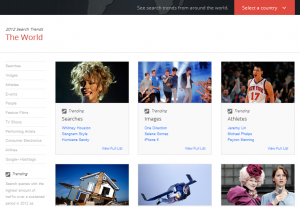
Zeitgeist revealed the most queries that Google received in 2012 worldwide. It lists the most searched celebrities, politicians, athletes, food, beer, jobs, videos, etc. You may also click the “select a country” button to limit your query to a specific country to see the difference. Montreal is the second city that was mostly searched on Google Maps in 2012 (when switching to Canada).
A picture is worth a thousand words. Check out the winners and runners-up of the 2012 International Science and Engineering Visualization Challenge. According to Breanna Draxler of Discover magazine, “the visualization challenge is designed to encourage a better public understanding of scientific research and is sponsored by the journal Science and the U.S. National Science Foundation. Criteria for entries include visual impact, effective communication, freshness and originality.”
My favorite image is the “Polar Mapping of Structures in the Universe.” What’s yours?
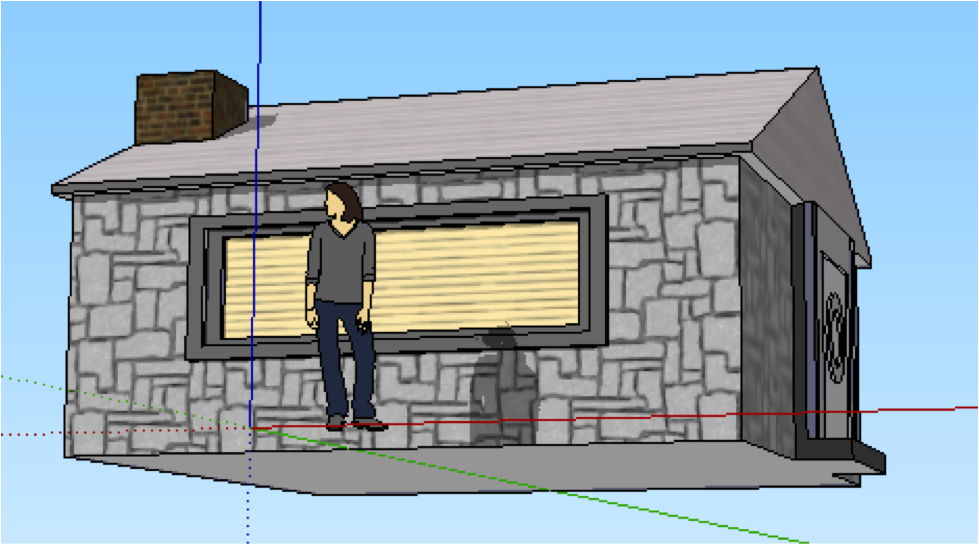
Here is a 3D drawing tool that surprised me by being extremely easy to use, not to mention free to download. SketchUp is one of the geo line of products that was offered by Google but was sold last year to Trimble.
I followed the new to SketchUp video tutorials to build this snazzy house. That is me outside trying to look cool because, as per usual, I can’t find my keys.
Happy sketching!
Hey McGill people! Did you know that you can order anything we don’t have at McGill Library through Interlibrary Loan? And today, it just got easier.
Starting this morning, McGill students, faculty and staff can log into Colombo using their McGill Username and Password. That’s right: just log in with your McGill email address and password and order away! No more separate registration or forgetting your Colombo username or password. Find out more about this change and how it will (or won’t) affect orders you’ve already placed.
Don’t forget that you don’t have to find the article, book, conference paper – or whatever you want to have a look at – in the Colombo database. Simply click on Create Request in the left-hand Colombo menu and fill in as much information as you have about the thing you want to borrow. I’m sure it goes without saying, but the more info you include the better!
Image: Books by shutterhacks

Queen’s University’s School of Computing, Plastic Logic and Intel Labs recently revealed a tablet computer, PaperTab, which “looks and feels just like a sheet of paper”. It is interactive by a plastic touchscreen and can work with ten or more displays simultaneously.
Read more at here.
DART-Europe allows you to search and access for free over 375,000 dissertations and theses from over 500 European universities. DART is the abbreviation for Digital Archive of Research Theses.
A reminder that the McGill Library also subscribes to ProQuest Dissertations & Theses, which provides references to dissertations and theses from around the world, going back to 1743. The full text is available for all those published since 1997, along with full text for selected works prior to 1997.
Finally, visit eScholarship@McGill for theses and dissertations written by McGill University students.
Do you ever wonder what is on the minds of influential scientists, scholars, writers and artists? What are the thinkers thinking about?
The Edge is here to help, by probing great minds with great questions, like “What scientific concept would improve everybody’s cognitive toolkit?” or “How is the Internet changing the way you think?”
I’m making my way through the responses to the 2013 Edge question: “What *should* we be worried about?”
Happy worrying?