May the Force be with you

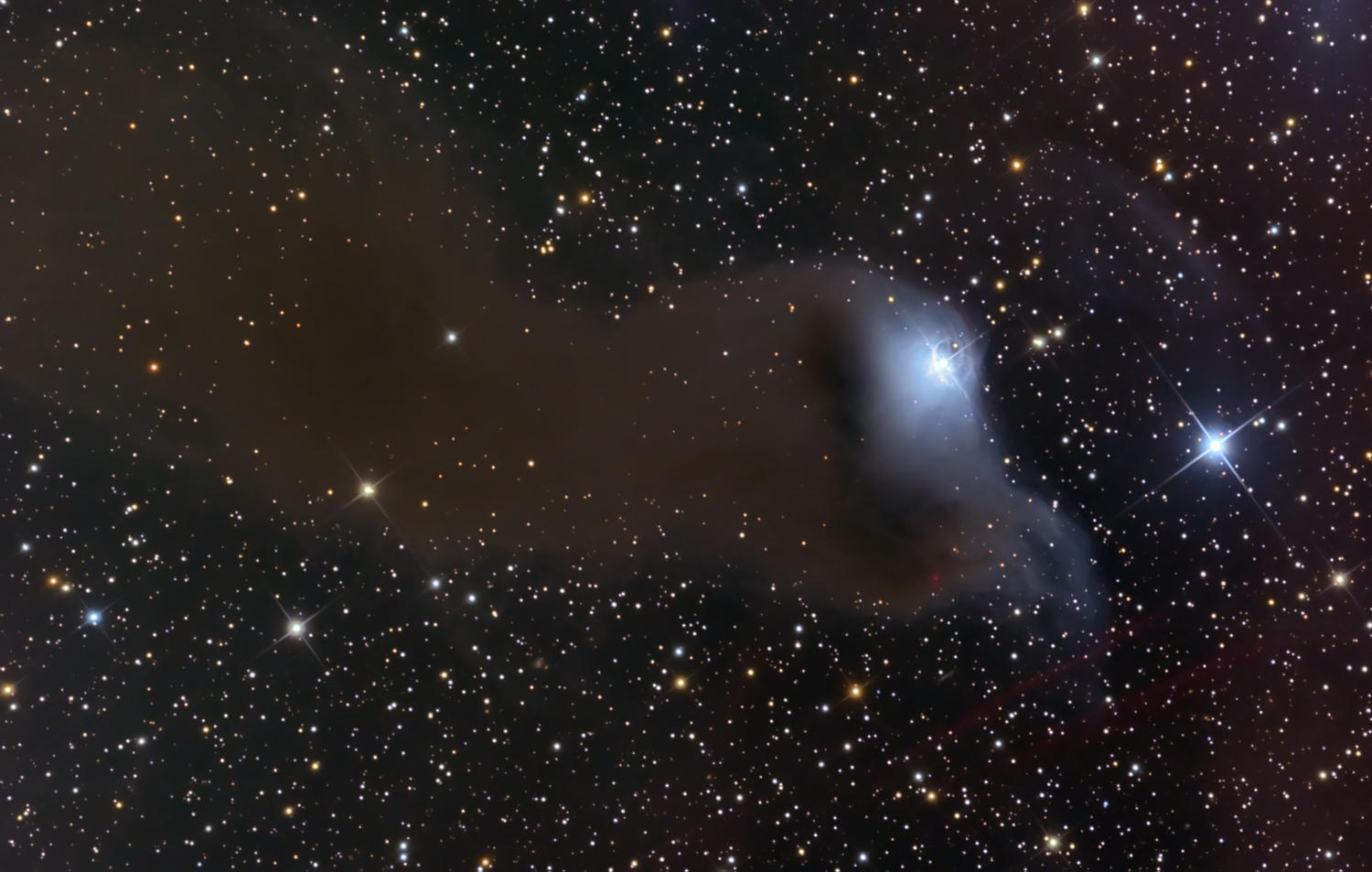
Last week it was announced that George Lucas sold his company, Lucasfilm, to the Walt Disney Company. This means that Disney now owns the Star Wars franchise. Disney plans to release a Star Wars movie every two to three years, starting with Episode 7 in 2015. With a rabid fan base, this is good news for Star Wars devotees. Next we’ll be keeping our ears open for news of who plans to direct. In the spirit of this announcement, here’s a link to a short video that explains light beam technology.

Image from www.nasa.gov

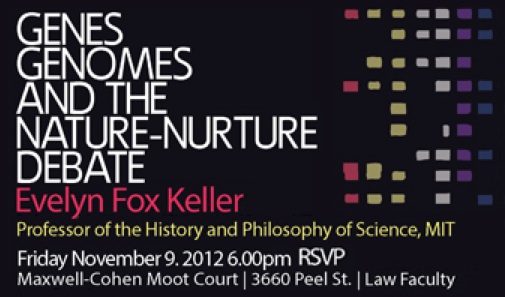
The nature versus nurture debate continues this Friday

The Mossman Endowment presents the following Elizabeth B. McNab Lecture in the History of Science:

Genes, Genomes and the Nature-Nurture Debate
with Evelyn Fox Keller, Professor of History and Science, MIT

Date:            Friday, November 9th, 2012
Time:            6:00 p.m.
Location:      Maxwell-Cohen Moot Court, 3660 Peel
RSVP:           e-mail rsvp.libraries@mcgill.ca or call 514-398-4681

Description:
Evelyn Fox Keller is concerned with the unreasonable persistence of the Nature/Nurture debate, and she argues that, in good part, that persistence derives from the fundamental uncertainty surrounding the subject of debate. What exactly is the question we are trying to answer?  What do we mean by “nature”?  And what effect does the changing discourse of genes and genomes have on this debate?

Speaker biography:
Evelyn Fox Keller is Professor Emerita of the history of science at MIT. Trained in both theoretical physics and molecular biology (PhD, Harvard, 1963), she has been a leading figure in the history and philosophy of modern genetics, and in the study of gender in science. Her major works include: A Feeling for the Organism (1983); Reflections on Gender and Science (1985); The Century of the Gene (2000); Making Sense of Life (2002); and The Mirage of a Space Between Nature and Nurture (2010). She has received many academic awards in recognition of her work, among them a MacArthur foundation fellowship.

Check our catalogue for the location and availability of Professor Keller’s major works in the McGill Library.

Click here for information about the Mossman Endowment and the Mossman Collection on the History of Science and of Ideas.

Lecture announcement and image from the McGill Library website

Scientific and technical writing

I recently attended an information session for civil engineering students enrolled in a one credit technical writing course. The students must write a fifteen page technical paper on a civil engineering topic of their choice. They will be graded on content, organization, paper presentation, and quality of writing. The benefits of being able to write well cannot be overstated. Students who are preparing for a career in a technical profession might not appreciate how important writing skills are. Without strong writing skills, it will be difficult to advance in your career. McGill Library has a great selection of writing and style guides, specifically for science and engineering students. Below are some examples:

1. The ACS style guide: effective communication of scientific information 

2. Making sense: a student’s guide to research and writing : engineering and the technical sciences

3. Pocket book of technical writing for engineers and scientists

4. Style and ethics of communication in science and engineering (eBook)

And be sure to visit the McGill Library webpage, Writing tools, where you will find links to resources on topics ranging from grammar to academic integrity.

Image from www.blogs.discovermagazine.com

Easy access to audiobooks

I have nice memories of listening to books on tape during long car rides. Feeling nostalgic for the classic road trip, I once bought a murder mystery on CD for what I thought would be an entertaining ride to Toronto with my husband. In the end, the voice of the woman reading the book was so monotonous that we had to pull in to a Tim Hortons for fear of both of us drifting off. I now know to listen to a sample of a book before going to the trouble of bringing it along.

Libraries have been in the business of offering audio versions of books, in one form or another, for quite some time but e-audiobooks (digital versions available for download) have made access easier than ever.

There is a guide on the Library website to borrowing e-audiobooks, which includes Overdrive and EbscoHost books. The Overdrive books are great for fiction or language learning but you can also browse by subject for audiobooks on science or science fiction, for example, like Doctor Who episodes read by David Tennant (which I highly recommend). Download the recordings and play them back on your computer or transfer them to your iPod or other listening devices.

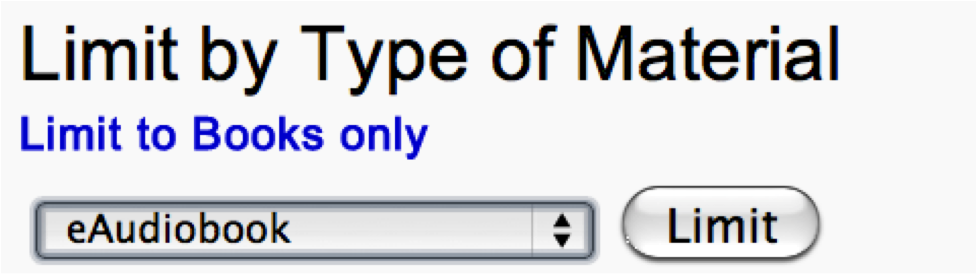
You can also find audiobooks in the Library’s Classic Catalogue. As shown here, you can limit your search results to eAudiobook. Likewise, the WorldCat Catalogue has a format option for audiobooks that includes eAudiobook, along with cassettes, CDs, and LPs, all of which are perfect for those long drives.

Enjoy the ride!

Films on Demand

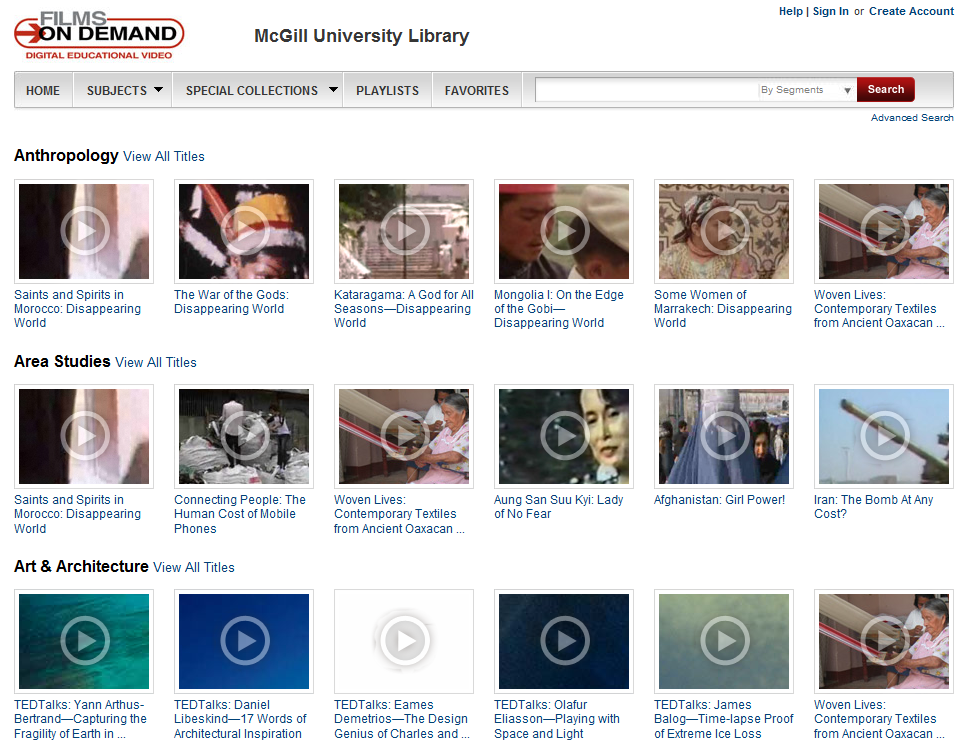
For those of you who don’t know this database yet, I would like to share it with you. Films on Demand is a McGill Library subscribed database offering streaming video clips on many disciplines such as Computer Science and Technology, Geography, Education, Social Sciences, etc.

Canadian Public Performance rights have been purchased for teaching purposes. Instructors may embed a clip into their lecture slides or post the link onto myCourses to let students watch it at their spare time. Since it is one of the online resources available for McGill users, remember to activate VPN or log into the EZproxy window with your McGill email and password when you use it off campus.

Happy watching.

Learning LaTeX online

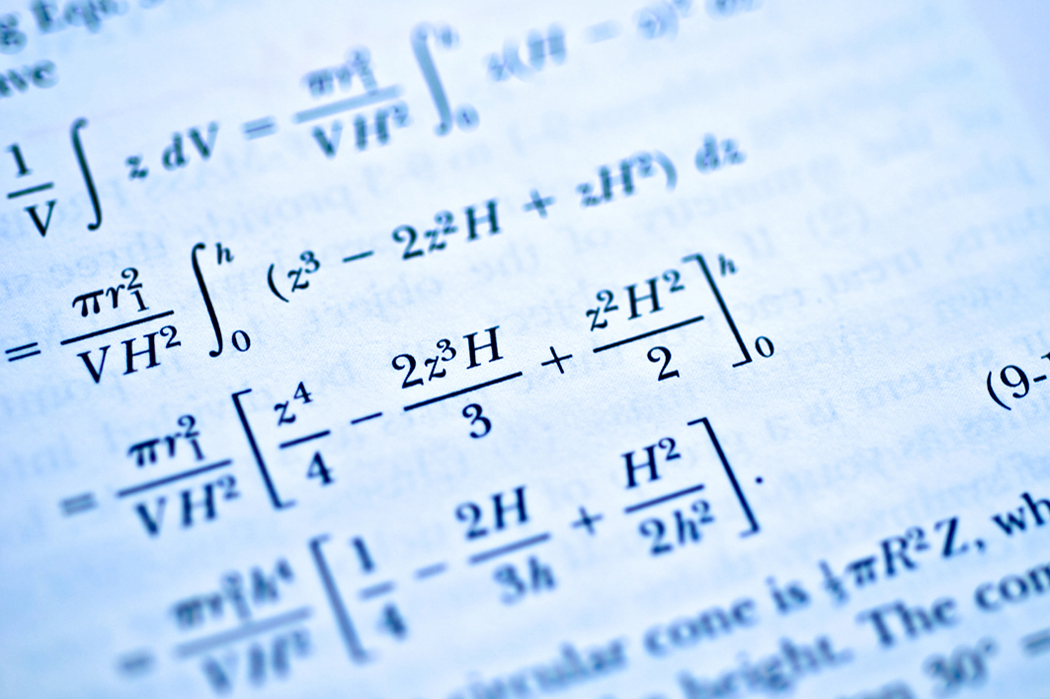
I recently had to learn some basics about LaTeX, which is free software used to create professionally typeset documents.  Its strength lies in formatting technical and scientific documents that contain mathematical notations.

Below are links to some short videos that are useful for learning how to use LaTeX:

Image from Microsoft Office Clipart

Earth as Art and other images

If you are looking for images to spruce up a class presentation or a conference poster here are just a few of my favourites.  Google Images may be the most obvious place to start, with the option to limit to faces, photos, clip art or line drawings, or to a particular size or colour. I use the colour option a lot to find images with a white or transparent background.

Flickr: Creative Commons is another resource that I use often. Here you can find images that others are willing to share, so that you can use them and credit whoever they belong to, based on a Creative Commons license as an alternative to copyright.

Most science magazines have image galleries online but I do love to browse NASA’s image gallery and 3D resources.  They are generally not copyrighted and can be used with acknowledgements.

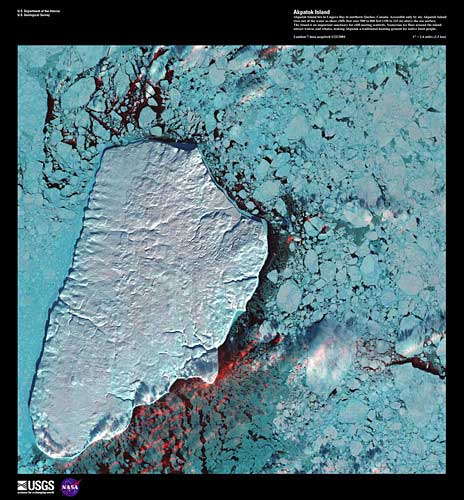
Lastly, there is a gorgeous set of images from the U.S. Geological Survey (USGS). The image gallery of the Earth Resources Observation and Science (EROS) Center contains the Earth as Art photo seen here. This is Akpatok Island, where native Inuit people hunt walrus and whales in northern Quebec, that “rises out of the water as sheer cliffs that soar 500 to 800 feet (150 to 243m) above the sea surface.” The USGS EROS Digital Image Gallery also includes land remote sensing images of the Journey of Lewis and Clark.

Happy viewing!

Image from USGS EROS Digital Image Gallery

To cite or not to cite?

I take the BMW (bus, metro, walk) to work each morning and, on the way, I read the newspaper back to front, i.e., I start with the comics’ page.  My favorite comic strip is Zits, which is about the daily adventures of a teenager named Jeremy Duncan.  Last week, there was an amusing episode involving a bibliography.  Read the episode here.

This reminded me of a question that I am frequently asked by students.  When should I cite a source in my paper?

You would cite a source when the idea is not yours, i.e., when you obtained the information from elsewhere.  The source could be a book, journal article, website, etc.  Whether you quote the source or paraphrase it, you need to cite it within the text of your paper and include the reference in your bibliography.  The only cases in which you would not cite a source are when the idea is yours or when you state a common fact, such as “the earth is round” or “Stephen Harper is the prime minister of Canada.”

Image from Microsoft Office Clipart