A Perfect Match: The Sustainability Park and McGill Libraries

Sustainability has long been a priority for McGill and rightly so, as climate action is essential now given the rapidly increasing climate emergencies occurring globally. It’s fantastic that there is so much work happening in this area at our university. For example, McGill recently ranked in the top ten along with University of Toronto and University of British Columbia in the QS World Sustainability rankings. There is also excellent work being done by the McGill Office of Sustainability (MOOS). Two of MOOS’ major initiatives have won awards:  their sustainability learning module and the sustainable workplace certification program. And, of course, the Sustainability Park, McGill’s revitalization of a portion of the former site of the Royal Victoria Hospital to create a state-of-the-art research, teaching and learning hub dedicated to sustainability and public policy, is getting closer to reality every day!

You might be more familiar with the Sustainability Park by its previous name: the New Vic Project. The new name was launched in the fall: Le Parc du développement durable McGill/McGill Sustainability Park. The new name heralds the exciting developments that are moving forward on the project.

To learn more about the project, consider attending the upcoming information session open to the entire McGill community this Thurs. Dec. 11 from 12-1:30pm. A recent What’s New for faculty and staff points to details about the meeting and provides information about how you may submit your questions in advance. You can also watch a short video to learn more about the project.

Since 2024, I have had the privilege to serve on a Community of Practice related to the academic aspects of the project. It has been really interesting to learn about the plans and to provide feedback to the project team, as well as to work with faculty, staff and students all across campus who are so vested in sustainability. As the McGill Libraries’ representative, I have helped to integrate the Libraries within the project.

So, what exactly does the Sustainability Park have to do with the McGill Libraries? Well, most notably, the McGill Libraries will open a Grand Reading Room in the space. This is the first time in my many years at McGill Libraries when we will be getting a new library space! Given how highly in demand our current library spaces are, with two million in-person visits per year (PDF booklet at: https://www.mcgill.ca/libraries/about/planning/strategic-priorities), we surely can use the extra space!

The Grand Reading Room will be located in one of the Nightingale Wings in the heritage portion of the site. With its large dual aspect windows, the space was originally a ward for patients. Dual aspect windows are windows that are on at least two walls of a space, which allows for natural light to enter and for there to be increased cross ventilation and outside views in multiple directions. The space had (and will continue to have) lots of natural light, which was helpful in the well-being of patients before there was electricity.

The reason the wards were called the Nightingale Wings was because of Florence Nightingale, the famous founder of modern nursing. In fact, she was even consulted on the design of these kinds of hospital wards, including those in the original Royal Victoria Hospital! (Table 1 at: https://journals.sagepub.com/doi/10.1177/1937586720931058). Her Environmental Theory emphasized the importance of clean air and natural light in speeding up patient recovery. Her “signature innovation [was] large windows that allowed cross-ventilation and abundant natural light.” (https://www.scientificamerican.com/article/what-florence-nightingale-can-teach-us-about-architecture-and-health/). The design of the Grand Reading Room honours her legacy in its continued adherence to her foundational principles.

Nightingale was ahead of her time in understanding how much human health depends on a healthy environment – a message that certainly rings true today when what we need more than anything is a clean and healthy planet. In the Sustainability Park, researchers will study how best to deal with the most tackling issues of sustainability while practicing sustainability within its walls, in much the same way the wards Nightingale helped design were places both for healthcare research and for applying the research to treat patients.

Here is what one of the Nightingale Wings looked like when it was part of the hospital in 1897 and used for hospital patients:

Image: Ward D of the Royal Victoria Hospital and the staff during Christmas. (photo 1897). MUA PR023861. From: archives.mcgill.ca/public/hist_mcgill/nursing/nursing04_lg.htm

Here is what the future Reading Room looked like when I had the opportunity to go on a site visit in fall 2024:

Image: Taken by Tara Mawhinney.

Here is a glimpse of what the future holds for this important historical space when it opens as part of the Sustainability Park:

Image: Architectural rendering of the Grand Reading Room, courtesy of the Sustainability Park Project Office.

The library space will include study space and library staff on site, but no physical book collections. The space will be open to the public. However, as with existing McGill Libraries’ spaces, students are expected to be the main clientele.

To find out how the project is progressing these days, check out this sneak peek video of the Park as of Oct. 2025. If you pay close attention at the 2 minute 55 second mark, you’ll even get a view of how the Grand Reading Room space is coming along!

So, when will the McGill Libraries get to welcome you to the new Library space? The Sustainability Park will officially open in 2029, which might seem a long way off, but it will be here in no time. I hope that you will join the Sustainability Park project team on Dec. 11 to learn all about what they have in store for McGill!
Finding Research on Sustainability Topics

As the liaison librarian for the Trottier Institute for Sustainability in Engineering and Design (TISED), I love it when McGill students and researchers ask me for help finding research related to environmental sustainability and climate action. My two go-to research databases for these kinds of questions are ProQuest One Sustainability and Scopus. The tips below on these databases will be particularly useful for students and researchers in TISED and in engineering but I hope people researching in other fields may find them useful too!

ProQuest One Sustainability

This is the leading sustainability database available through McGill Libraries. You can access it at: ProQuest One Sustainability. This database contains references to journal articles, conference papers, books and book chapters, case studies and more on topics such as environmental engineering, water resources, climate policy and environmental health. The database allows you to filter your results to limit to one or more of the three sustainability pillars: environmental, social and economic.

So, for example, if I wanted to find academic sources on cycling in cities and focus on the social aspects, I could type in: cycling and cities; once the results are displayed, I can choose the “social” filter, under the “sustainability pillar” category, from the left-hand column. My search results will include literature on topics like gender inequality in cycling, the lived experience of cyclists, motivations for cycling, recreational cycling and so on.

Another reason I recommend this database is that it has implemented a feature that maps its research content to the UN Sustainable Development Goals (SDGs), thus allowing researchers to identify literature on many sub-topics within sustainability. The UN goals are 17 specific objectives that are part of a plan that all UN member states adopted in 2015 to reduce poverty, protect the planet and improve the lives of everyone. Research in addressing these goals is helping to solve real-world problems. ProQuest One Sustainability has added the goals into their database to raise awareness of research that is making a difference in the world by addressing critically important issues for humanity and the environment.

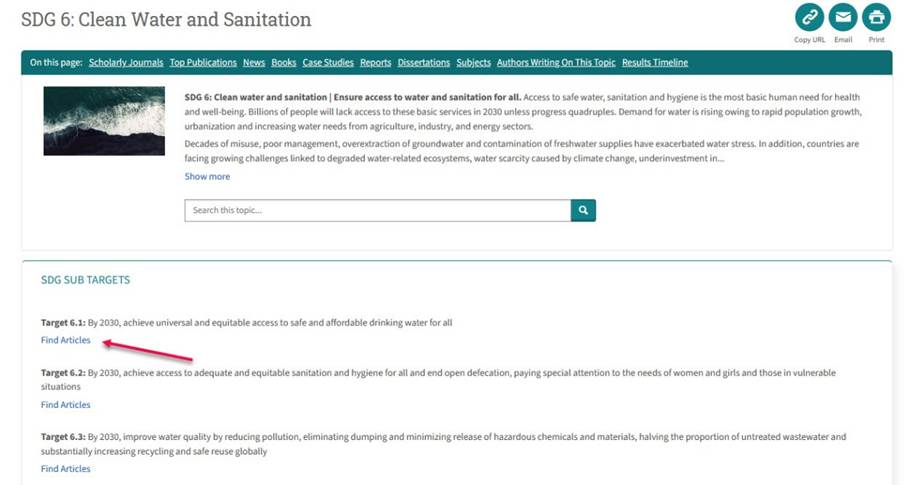
How does this feature work? The database highlights research that relates to each of the 17 goals by listing the goals on the database’s home page. When you click on a specific goal (e.g. “Goal 6: Clean Water and Sanitation”), the database lists the targets within each goal (e.g. “Target 6.1: By 2030, achieve universal and equitable access to safe and affordable drinking water for all”). You can click on “Find articles” to view the literature that addresses this specific target. In the image below, you can see what the “Find articles” link looks like in the database.

One strange quirk of ProQuest One Sustainability is that when you run a search using the default search box on the database’s home page, the database looks for your words anywhere in the description of the items in the database, including in the full text when available. This kind of search is different from most other research databases at McGill that only look for your words in the title, abstract and description of the items and not the full text, which gives a more precise and targeted search. What this means is that in ProQuest One Sustainability, you can get a lot of noise (irrelevant results) cluttering up your search. I recommend going to the “advanced search” and, from the dropdown menu, selecting this option to search instead: “Anywhere except full text.” This kind of search will help you retrieve more focused results and reduce the clutter.

Scopus

Another of my go-to databases for sustainability topics is Scopus and I’ll explain why. Scopus is a multidisciplinary database covering research on every topic you can imagine, and not limited to sustainability-related topics, like ProQuest One Sustainability. You can access it at: Scopus. What makes Scopus stand out in terms of sustainability is that it recently implemented a feature similar to the functionality in ProQuest One Sustainability that ties literature to the Sustainable Development Goals.

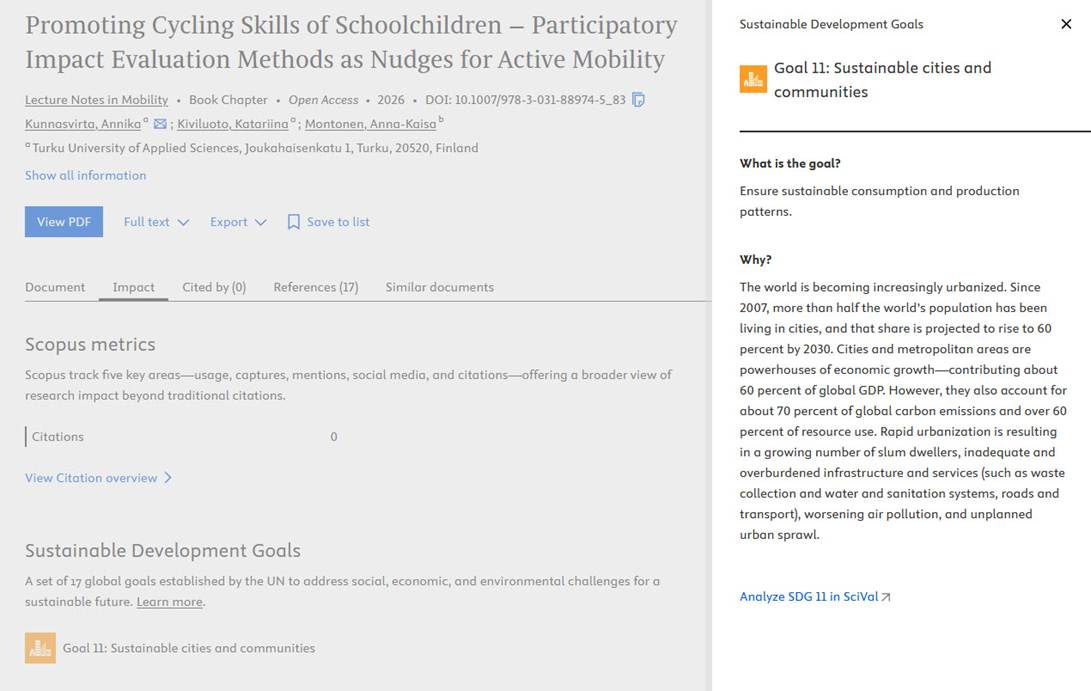
When you run a search, say for cycling in cities, Scopus has incorporated the goals within the description of literature that addresses one or more of the goals. Scopus will help you identify which research articles address the SDGs by indicating, under the “Impact” section of each document’s record, when the research relates to one or more SDGs. Scopus uses machine learning to help identify which articles discuss which SDGs. For example, in my Scopus search: cycling and cities, I found an article on promoting cycling to schoolchildren and after choosing the “Impact” tab, I found that the article mapped to “Goal 11: Sustainable Cities and Communities.” Scopus also gives a summary of what each goal is about and why it is important. Here is what Scopus looks like in action:

Limitations

My hope is that both ProQuest Sustainability One and Scopus will make their mapping features even more useful by integrating a search filter for SDGs, much like the sustainability pillar filter within ProQuest Sustainability One. That way, it will be really easy to filter down from your list of results to only show the literature that addresses a specific SDG. For now, when you run a search in either of these databases from their main search boxes, this isn’t possible. In Scopus, we need to look through all the results in a search one by one to see if there are any SDGs mapped to the research articles. In ProQuest One Sustainability, only those articles listed under the special section on the 17 goals on the database’s home page will get you to research on any specific SDG.

For more information

I hope this gives you a glimpse into how you can use some of McGill Libraries’ best resources to find literature on sustainability topics. You’ll find other resources related to environmental sustainability on my TISED research guide at: https://libraryguides.mcgill.ca/tised and on the Environmental Studies research guide at: https://libraryguides.mcgill.ca/environmental-studies. For help on finding research related to any topic, McGill students and researchers can consult the list of liaison librarians. We’re happy to help!

Libraries Are Celebrating Climate Action Week!

Climate Action Week Logo

To mark Climate Action Week taking place this week and spearheaded by the British Columbia Library Association, here are some interesting things that are happening related to environmental sustainability and climate action both here at McGill and further afield:

  • Do some reading! Various libraries have put together booklists on climate change including these resources:
    • The University of Toronto Scarborough Library has created a Climate Action Week Reading List with many book titles on climate change. The books in the “Fuelling Hope” section offer lots of good reading for getting inspired.
    • The University of British Columbia Library has created a variety of climate change booklists on different topics like climate-related books by BC authors, the history of climate science and action, books of hope from strong climate voices and many others.
    • The University of Waterloo Library has created a climate action booklist with subsections on topics such as sustainable development and innovations.
  • Join a climate café to share your thoughts and current experiences related to the climate crisis. There are many such groups including this free one offered monthly by the US-based Resilient Activist organization.
  • Learn more about climate change and the climate crisis by registering for the McGill Course: “ATOC 183: Climate and Climate Change” being offered this winter. Read all about the course in an interview dating from last year when the course first was offered.

Within the McGill Libraries, various units have been hard at work completing the university’s Sustainable Workplace Certification program. In fact, it’s one of the library system’s objectives to have all units certified at the bronze level or higher. Schulich Library is proud to have achieved bronze certification and is currently working toward silver. The new McGill Collections Centre opened in 2024 as a LEED gold certified facility and its staff have now earned platinum level in the university’s workplace certification program. You can learn more about the program and several other sustainability initiatives by checking out information from the McGill Office of Sustainability.

Happy Climate Action Week!

Enhanced Visibility of Engineering Standards at Schulich Library!

logos of standards-producing organizations

Schulich Library now has a collection of engineering standards in printed format that is browsable within the library catalogue! It is called the Schulich Library Standards Collection and it currently contains over 200 standards and growing. You can access the collection at: Schulich Library Standards Collection.

What are engineering standards anyway? They are very important technical documents that allow engineers to design products and processes that are high-quality and safe. They are produced by industry experts, academics and others brought together by professional organizations, non-profits and government organizations, like the International Organization for Standardization (ISO), the American Society for Testing and Materials (ASTM) and many others.

To borrow a standard from the new collection, please make note of the item’s call number and ask for it at the Schulich Library service desk on the main floor. You can also search for a standard produced by a specific organization by accessing the collection and modifying the search string at the top of the screen to include the organization’s name. For example, to search the ASME standards in the new collection, add ASME to the existing search string: ut: Schulich Library Standards Collection. So your search would look like this: ASME AND ut: Schulich Library Standards Collection.

Please note, most standards held at McGill Libraries are available in printed format only, with the exception of engineering standards produced by select organizations like IEEE. Also, engineering standards are one of the rare item types that generally cannot be request through the Libraries’ interlibrary loans service.

To find out more about the new collection and all the engineering standards available through McGill Libraries, including a list of standard-issuing organizations from which McGill Libraries have standards, please see: McGill Libraries’ Patents, Standards, and Technical Reports Research Guide or email us at schulich.library@mcgill.ca

If you would like the staff at McGill Libraries to consider purchasing a standard for the new collection, please use the email options on the right-hand side of the page to contact the Schulich Librarians for physical sciences and engineering topics and the Macdonald Campus Librarians for agricultural, environmental science, nutrition and parasitology topics. Please keep in mind that standards normally take a few weeks to be acquired and made accessible.

An active Science Literacy Week

This year, Science Literacy Week will keep you moving. Beginning September 16, there are tours lined up, a game-based session around data management, a hands-on Excel workshop, interactive sound demonstrations, and exhibits to explore.

Here is the daily rundown of downtown activities organized by the Library:

Monday, (Sept 16): Montreal’s Urban Heat Island: Tour of temperature sensors on campus

Tuesday, (Sept 17): Tour of the Maude Abbott Medical Museum

Wednesday, (Sept 18): Sounds in the City + Treasures from the History of Science in Rare Books and Special Collections

Thursday, (Sept 19): Tour of the Steinberg Centre for Simulation and Interactive Learning + Discover the cure! An introduction to the fundamentals of data management

Friday, (Sept 20): Chart Making in Excel: Going Further by Telling a Story with your Data

Register for an event today!

We also have exhibits going on so don’t miss out on those. You will get the opportunity to test out your map literacy in the Redpath Library Building, and check out a science book in person or online.

A little piece of Schulich Library goes to China!

One of the main reasons I love working at McGill is the opportunity to interact with amazing students and staff who are doing exciting projects that could potentially change the world. The 99 McGill and Concordia student, staff, and alumni members of Team Montreal are currently part of one such endeavor. They are building a net zero energy home, a prototype that could revolutionize how we live in the future since the technological design features of this house enable it to create as much energy as the house dwellers consume. They have all kinds of sponsors including their lead presenting sponsor, Hydro Quebec, who sees this project as an opportunity for them to become a main player in technologies related to intelligent and sustainable home design. Hydro Quebec’s vice-president of client services, Eric Filion, sees this project as a way for them to learn more about innovative technologies and actually test them out.

Not only is Team Montreal building a house that could change for the better the way we live, they are also out to win the Solar Decathlon China 2018 competition currently taking place in China, where, as the only team from Canada, they are competing against 21 other teams from around the world. Once the competition is over, most houses will remain on public display either in China or elsewhere. Team members say there are plans to build other houses in Montreal using the same design.

What is particularly cool about the Team Montreal design is the way it takes the traditional row housing style of architecture so predominant in Montreal and creates something new, incorporating Asian-style features such as an open-air courtyard, and innovative technologies that enhance the house’s sustainability. For a sneak peek of how the house will look upon completion, check out the 3-minute video here (part-way down the page on the right-hand side).

I had heard about the project a few months back and was thrilled to be contacted in April by one of the team members who was asking for help. They wanted to have books on architecture and engineering to add to the house’s built-in bookshelves. The books could show signs of use since they wanted to give the house a lived-in feel. I was so happy to be able to support this fantastic project. Right away, I contacted my engineering librarian counterpart at Concordia, Joshua Chalifour to see if he could help out. Joshua had a number of engineering books that were going to be discarding due to them being so well-used and they had purchased replacement copies already. He willingly lugged a bunch of them over by foot from Concordia for me to add to the pile. So along with the books Joshua brought over, we had a combination of items from Schulich Library that were donations we already had in our collection, items that we were going to discard because we had duplicate copies or newer editions, and some old engineering trade magazines from my personal collection.

It was very exciting to correspond and meet with team members Kim Chayer and Thierry Syriani. Their enthusiasm for this project is certainly contagious! When they came to see the books, they were really happy to take everything! The books went out in two shipments, with the pre-fabricated house materials in big crates, the 1st shipment being in April and the 2nd one in June.

How can you help? You can support the team by liking and following them on Facebook or by following their diary where, as I write, they are in the home stretch of needing to assemble the house within the next few days. They are battling hot weather, challenges associated with pre-fabrication construction, heavy rain, and typhoon threats in order to complete the house on time. You can also support them by making a donation.

Go Team Montreal! Who knows, some of the engineering books you may have used in courses taught at McGill and Concordia might be lining the shelves of this year’s prize-winning house of the Solar Decathlon China competition!

Welcoming new Librarians

The Schulich Library is excited to welcome not one, not two, but THREE new librarians to our ranks!

First, we have Nu Ree Lee. Nu Ree comes to us from Purdue University in Indiana where she was a research data management librarian. Nu Ree is the new librarian for Bioengineering, Biomedical engineering, Chemical engineering, Mining and Materials engineering, and Earth and Planetary Sciences (whew, so many). If she is your subject librarian, you can reach Nu Ree at nuree.lee@mcgill.ca

In addition to being an awesome librarian, Nu Ree has a King Charles Spaniel/Bichon mix dog named Chopin, is originally from Toronto, and recently took up kickboxing.

Next, we have Lucy Kiester. Lucy has moved here from Dalhousie University in Halifax where she worked in the Health Sciences library with Nursing and Dentistry. She is the new Undergraduate Medical Education Librarian (only 800 students!) and can be reached at lucy.kiester@mcgill.ca.

Lucy hails from a very small town in the Pacific Northwest, loves to salsa dance, and admits to watching a stunning number of videos on Youtube.

Last, but certainly not least, we have Andrea Quaiattini. Andrea comes to us from the University of Alberta where she worked all over their Health and Sciences libraries. She is the new liaison for Graduate Medicine, Medical Education, and many of the Medical Specialties. To reach Andrea email andrea.quaiattini@mcgill.ca.

Andrea is originally from Calgary, loves a good walk in the mountains, and proudly admits to knowing far too much (or exactly the right amount) about Monty Python.

All three of these librarians are very excited to be joining the team of librarians at Schulich and are looking forward to making connections with their students and faculty! Send an email to say hello, ask for a consult, or get other library support.

As ever, if you are unsure of who your subject librarian is, feel free to send an email with your question or topic of research to schulich.library@mcgill.ca, and we will be sure to direct your email to the correct librarian.

Science cinema with Kanopy

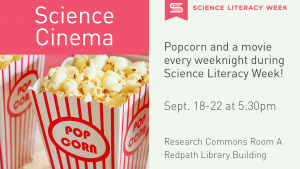
Science CinemaIt’s Science Literacy Week and this year we’ve added movies to the calendar, selected from the Kanopy streaming video service.

We will also have popcorn, so be sure to join us at 5:30pm in the Redpath Library Building, Research Commons Room A, where the visualization wall is perfect for screenings.

Here is what’s on:

  • Monday: Google and the World Brain

  • Tuesday: I Dream of Wires: The Machine that Shaped Electronic Music

  • Wednesday: Queen of the Sun: What are the Bees Telling Us?

  • Thursday: Top Secret Rosies

  • Friday: GTFO: Get the F**k Out – Women in Gaming

Read descriptions here.

With Kanopy in the Library collection, every day can be movie day. Whether you love classic films or documentaries, there is plenty to explore.

Happy viewing!

Walk and work @ Schulich Library

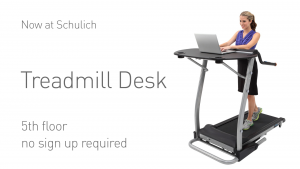
Schulich treadmill deskIt is important to move around throughout the day to meet those fitness goals, reduce stress, and get our creative juices flowing. Living through your average Montreal winter does not make it easy. Once we arrive at our destination it is easy to rationalize staying put for as along as possible.
To help make moving around a little easier, we have installed a treadmill desk at Schulich Library. It is up on the group study floor so that the little noise it makes will not be an issue. The height of the desk portion is adjustable and the speed can be set up to 4 mph. While you can’t get a full on run on the treadmill, you can get a nice brisk walk going and get your heart rate up.

I know it is a little unusual but don’t be shy about getting on the treadmill and setting up your work on the desk. Seeing you there will help others feel more comfortable about walking while working. Also, if you get the chance, please fill out our short survey after your walk and give us your feedback.

From Star Trek to honeybees

United States design patent 307,923This year’s Science Literacy Week really does have it all, starting with two amazing library exhibits:

  1. The Science of Star Trek at Schulich Library
  2. Knowing Blood, Medical Observations, Fluid Meanings at Osler Library of the History of Medicine.

If you can’t make it up to Osler Library, we have a touch table coming to Schulich Library tomorrow that will allow you to explore the Knowing Blood exhibit from Tuesday to Friday.

The fun with technology does not stop there, however, because we have 3D printing and learn to code workshops. You can also explore virtual reality technologies with the Oculus Rift. I will definitely be there for that.

I haven’t forgotten about the bees…we have hives on the roof of Schulich Library and they make the best honey. Take a visit up there with an experienced beekeeper.

There is more happening than I can mention here but I don’t want to leave out Wednesday’s Wikipedia edit-a-thon on women in science, or the talk from Dr. Joe Schwarcz on the facts and myths of eating right on Thursday afternoon.

I will leave you with the calendar of events to explore. Now if only we had transporter rooms… Well, there is always next year!