Formula for constructing perfect sandcastles

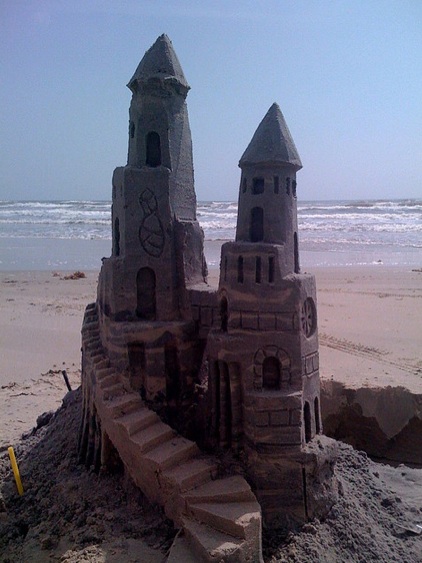
Researchers from France, Iran, and the Netherlands have published a journal article on “How to construct the perfect sandcastle” in Nature Publishing Group’s Scientific Reports.  They present a mathematical formula for building stable sandcastles, which can be used on land or below water.

According to the authors, the study’s “results are of practical interest for civil engineering and soil mechanics… In addition, it explains the maximum height of, and provides us with a recipe to construct, the perfect sandcastle.”

In ScienceNordic, one of the authors also explains in layman’s terms how it can be applied to building sandcastles on the beach.

Image from Sandyfeet

Science at the movies

Peter Parker (a.k.a. Spider-Man) is one of my favorite action superheroes.  It turns out that the “Decay Rate Algorithm” in the movie, The Amazing Spider-Man, is based on real science.  Jim Kakalios, the author of The Physics of Superheroes and a physics professor at the University of Minnesota, explains the science behind the most recent Spider-Man movie in this short video:

Olympic fever continues

Anette Hosio, an associate professor in MIT’s Department of Mechanical Engineering recently talked to MIT news about the mechanics of sports. From her points of view, what helped Usain Bolt give the record-breaking performance in 2008 is “his unique combination of both strength and the long stride.” In the following video, Hosio also explained the mystery of the “fast pool” from the perspective of fluid mechanics.

Read more at 3 Questions: Anette Hosoi on engineering and the Olympics

Curiosity lands on Mars

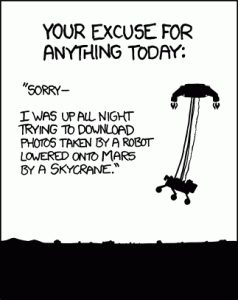
Curiosity (XKCD comic for August 6, 2012), http://xkcd.com/1091/NASA successfully landed their Curiosity rover on Mars last night/early this morning (depending on your earthly location) and Curiosity is already sending back pictures. I am now following Curiosity on Twitter!

You can find out more about the mission from NASA and JPL.

Previously: Curiosity Rover to discover whether Mars was once habitable

Image: XKCD comic Curiosity (August 6, 2012) by Randall Munroe

Summer fireworks

Since 1985, LaRonde has been hosting the Montreal International Fireworks Competition, also known as L’International des Feux Loto-Québec.  Tonight at 10pm is this year’s finale.  Every summer over the past few years, I have made the trip to go see them at least once.  My favorite spot to view the fireworks is just outside the Longueil metro station; a lesser-known, quiet spot that is right across the highway from LaRonde.  I had the opportunity to see the fireworks last Friday night and, as always, I was amazed by the spectacular light show.

I recently found this short video about the chemistry involved in making fireworks that features Professor Conkling, the author of the Chemistry of Pyrotechnics: Basic Principles and Theory.

Will You Consider a Free E-textbook?

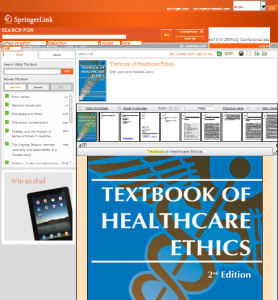
I just read the news that University of Windsor students now have access to their textbooks in digital formats through Flat World Knowledge – one of the publishers of openly-licensed college textbooks. This reminded me of the electronic books that we have at McGill University. We have more than two million e-books in our collection! They work on a variety of platforms from e-book providers; some of them are major publishers for academic content, such as Springer, Wiley, and Palgrave Macmillan. They are accessible for  McGill students and staff for free (see instructions on how to access our online resources). You can read them online or choose to download by chapter. The Library Catalogue is a great place to start your search. For books published recently, I would recommend an extra search on the publisher’s platform through our e-books webpage. SpringerLink, the electronic content platform from Springer – a globally-known publisher in science, technology, and medicine disciplines also allows you to Buy A Print Copy For $24.99 for some of their books. McGill subscriptions in SpringerLink are indicated by a green box.

Not the scary kind of spider

I received a box of promotional items at the library from Royal Society of Chemistry (RSC) Publishing and it served as a reminder to write a few words about ChemSpider.

ChemSpider is a free database that really is easy to use. You may not see yourself as a chemical searcher but I promise that you’ll find interesting facts about chemicals you use everyday. Continue reading

Big money in physics?

Yuri Milner

Who knew? As a scientist in the field of physics, you have the chance to be awarded the most lucrative academic prize in the world. Nine physicists became multimillionaires after Yuri Milner, a billionaire who made his fortune investing in Internet companies like Facebook and Groupon after quitting his PhD in physics, and then established the Fundamental Physics Prize, dropped $3 million into their bank accounts. The prize is larger than the Nobel Prize, which is currently $1.2 million, split among 2 or 3 people and differs from the Nobel Prize in crucial ways. The Fundamental Physics Prize can go to younger scientists who are still in the experimental stage of their research. The nomination and voting process is also different, with anyone being able to nominate a winner online and the selection panel is public. Milner hopes that the significant size of the prize will shine a spotlight on fundamental physics and drive home the importance of the field. To read more about Yuri Milner, the Fundamental Physics Prize and its recipients, check out this article in The Guardian.

Image from The New York Times

This is your mouse on drugs

I love exploring online learning tools and Mouse Party is a fun one from learn.genetics at the University of Utah. It demonstrates how drugs alter the brain’s reward pathway.

With the researcher’s arm in your control, select a subject from the mice under the effects of different drugs to get a look inside their brain and the mechanisms of drug action.

Oh, and make sure your sound is on…

Image from Genetic Science Learning Center