Please see the link here:
http://people.csail.mit.edu/billf/www/papers/doresearch.pdf
It is informative and useful.

Please see the link here:
http://people.csail.mit.edu/billf/www/papers/doresearch.pdf
It is informative and useful.
When it comes to evaluating scientific papers, citation counts are mentioned more often than not. A paper can be cited for a variety of reasons but it is generally agreed that citations are one of many indicators of impact. There are a number of resources that are either free or subscribed to by the Library for looking up citing references, such as Google Scholar, Scopus, and Web of Science.
The authors of The Wisdom of Citing Scientists discuss the limitations of citing references for assessing the usefulness of papers. For example, one cannot assume that a paper with few citations has been widely read and critiqued. It is possible that the paper was not found by others or that it did have some influence on future writings. They argue that cited references in a paper tell a more complete story, revealing a scientist’s preference for particular journals and theoretical approaches, and his/her ability to identify relevant, current, and high quality publications. As librarians we are always stressing the importance of examining the reference list of a paper so it was quite nice to see this articulated.
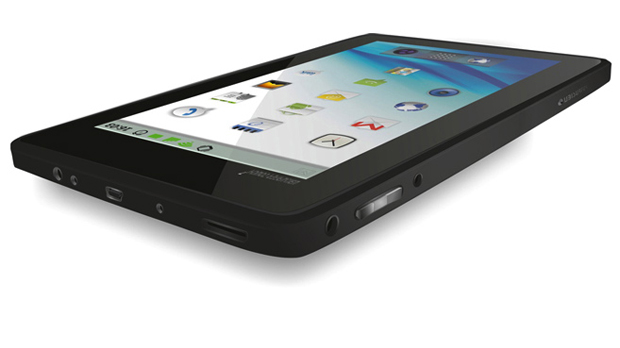
A tablet, touted as the world’s cheapest, designed and developed by a Canadian-run company with operations in Montreal? Who knew? Now priced at around $40, the product is called the Aakash and it’s heading into version 3.0. Datawind, the company that produces it, has ambitions to bring the price down even further to around $25. Their company slogan is: “Bridging the digital divide” and now that they have the largest market share of tablets in India, the world’s second most populous nation, they may just be living up to it. In order to bring low-cost internet to developing markets, Datawind has patented a process that uses a proxy server between a portable device and an internet service provider’s server to reduce the volume of data that get transmitted over the web. This process shortens the time users wait to view a webpage, which is especially useful in developing countries where internet access is often slow and expensive.
I had a chance to speak with Derek Kopke, a McGill alumni (B. Ed. 1992) who is Datawind’s Executive Vice President of International Business Development. He explained that the Aakash’s popularity took off from the time the company won an Indian government bid in 2010 against 17 competitors to produce a tablet for use in India’ schools that would be subsidized for students. Ever since the Aakash received endorsement by the President of India, Pranab Mukherjee, it’s been a challenge to keep up with demand.
Datawind now has its headquarters in London, England and offices in India but maintains a Research and Development office and a touch screen lab here in Montreal. In an interview given to the Montreal Gazette, Datawind’s Chief Technical Officer Raja Tuli states that the company finds Montreal to be a great location because it possesses “engineering graduates with impressive skills and he’s not sure he would be able to find the same level of expertise in another city.”
I was curious to know what kind of skills his company looks for in new employees. Kopke said that they hire for very specific needs, but he suggests that new engineering graduates gain a basic understanding of how to work with open source software. He sees future growth to be in low-cost and free applications and hardware. For those of you in Computer Science, you may be interested in taking COMP 529: Software Architecture. Last year’s syllabus describes the final project where students learn how to reverse engineer a large open source system. The course will be offered again this winter.
I asked Derek if we can expect to see the Aakash on McGill campus anytime soon. He said Datawind is planning to market their product in North America within the next couple of months. And with that, Derek had to get back to work bringing his tablet to the masses.
Image from Smart Planet
Have you ever wondered how to find a book that you can read instantly from anywhere at any time? This is possible if you use an e-book (short version for electronic books). McGill Libraries have millions of e-books in collection. They are available from various platforms with different features. Below are two upcoming workshops that you can attend and discover the secret. You may be able to find an electronic copy for your textbooks or a title for your research.
Date and time: September 20, 2013 from 12:00pm to 1:30pm
Location: room 313, Schulich Library of Science and Engineering
Register
Date and time: September 25, 2013 from 12:30pm to 1:30pm
Location: Room 5 (next to the McGill Engineering Student Centre), Frank Dawson Adams Building
Register
Are you a student in CIVE 432, CHEE 360, CHEE 462 or any other course in Engineering where you are writing a technical paper? If so, please join us for a hands-on workshop on Researching and Citing for Your Technical Paper! The sessions will be held on Mon. Sept. 16 from 2:30-4pm and Tues. Sept. 17 from 1-2:30pm in Room 313 of Schulich Library. The same workshop will be offered on both dates. You will learn how to:
If you can’t make the workshop, here are some of the sources we will be exploring for finding material on your research topic: Technical Report Archive and Image Library (TRAIL), ProQuest Dissertations and Theses, and McGill Library’s subject guide to standards.
If you have any questions about this workshop or about writing and citing for your technical paper, please contact tara.mawhinney@mcgill.ca or giovanna.badia@mcgill.ca
We hope to see you there!
Image from Microsoft Images
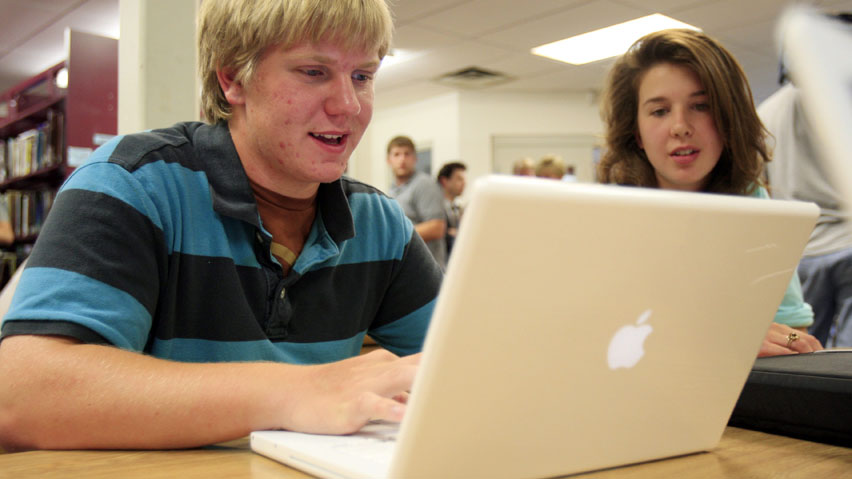 Laptops have been widely used in classes as a note-taking tool. However, a recent study shows that using laptops in a class not only lowers students’ grades but also has a negative impact on their classmates’ marks due to the distraction from computer screens around. Read the full story here and decide if you should use pen and paper instead.
Image from CBC
You may have seen boxes on multiple floors in the Schulich Library of Science & Engineering. The reason behind this is that the books and journals from the Life Sciences Library are moving into Schulich.
To make space for this collection, extremely low use materials in the physical sciences and engineering are being shipped to the library’s storage facility at the Currie Gym. It will be possible to retrieve these items on an “on demand” basis later on in the semester.
Books and journals from the Life Sciences Library are arriving on a daily basis, and are being unpacked and shelved as soon as possible. To check whether a book or journal from the Life Sciences Library is available on the shelf to be borrowed, please visit our “Collections: Relocation Update.” This page is also accessible under the “Happening now!” heading on the right-hand side of the library’s homepage. Please note that Life Sciences course reserve materials are available at the Life Sciences Library to borrow.
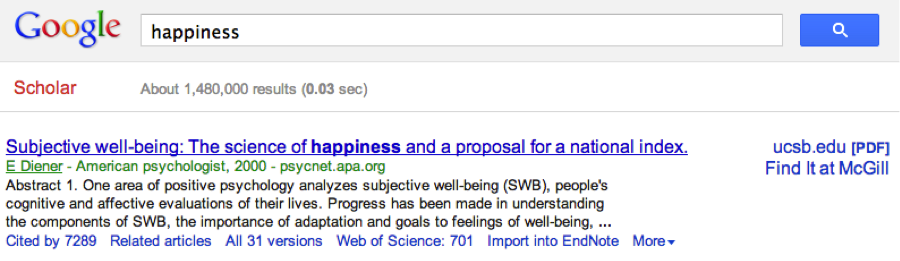
The “Cited by” option in Google Scholar now includes a link to citations in Web of Science. Take a look under the reference to the article in this screen shot. Google found 7289 citations from all sorts of items on the web, but also links to the 701 citing articles in the multidisciplinary database, Web of Science. I was using Google Scholar today to send references over to EndNote but this is a nice new feature that I will be sure to explore further.
As the new school year begins, hope you have your pencils sharpened and are ready to learn all about the library’s resources and services! (If you don’t have any pencils, don’t worry we have some spares.) With workshops and tours happening almost every day, take advantage of your time now by learning about the library so you can save time later. Everyone is welcome: new students, returning students, undergraduates, graduate students, even parents! There are two different activities scheduled at Schulich Library. At Library Quick Start 101, you will learn how to:
At the Welcome Tour, you will discover your home away from home! We’ll show you where to:
For the schedule of orientation activities taking place at Schulich Library, please go here.
On behalf of the Schulich Library staff, we look forward to meeting you or welcoming you back soon!
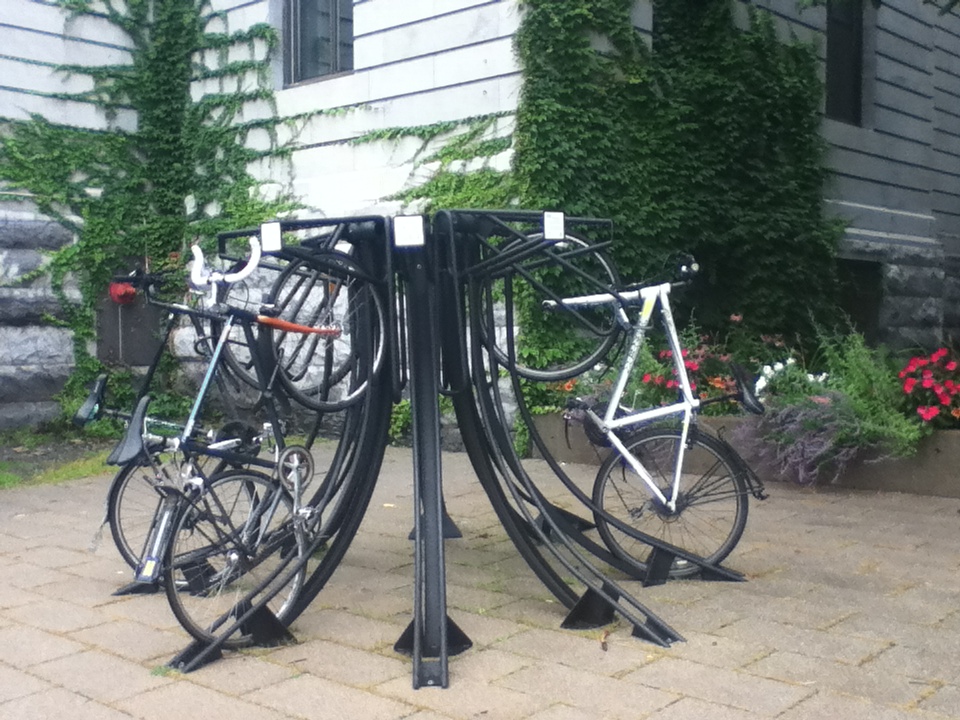
The best part of my day is my bike commute to and from work. It energizes me for the workday ahead and gives me time to reflect on the day that’s gone by. Often it’s a time when creative solutions to the day’s challenges pop into my head like a happy email suddenly appearing in my inbox. How can we ensure that more McGillians have the chance to partake of this bliss on two wheels that is as good for the body as it is for the soul? On an already crowded campus, there’s not much room for bikes and it certainly could be a challenge really soon once new and returning students descend on the campus en masse for the start of classes. One way would be to ensure that there is ample bike parking and this is just what a group of McGill Mechanical Engineering students set out to do a couple of years ago when they designed a space-saving bike rack as part of a class project.
The result is impressive. Their bike rack is called the VeloCurve and is situated next to the Redpath Museum. It looks like a work of modern art, resembling part spider, part flower. The aesthetic component was important as a potential factor in encouraging people to cycle, say the founders in a video clip found here. The bike rack first appeared on campus last summer and since then the students, who have now graduated, have been busy commercializing their product through their company VeloCyko. The bike rack is space saving because it stores bikes vertically, saving 40% more space compared to a traditional bike rack, an important feature on this campus and in many other places in our densely crowded cities. It discourages theft too because when locking a bike, the cyclist stands upright and is visible rather than crouched down and out of sight as a thief would want to be.
If you want more details, check out their website at www.velocyko.com where more innovative designs are on the way.
And once school starts, if you can’t get yourself a spot using the VeloCurve, here is a map of other bike parking on campus.