This year I’ve spent a lot of time at Department of Geography and the Geographic Information Center on the 5th floor of Burnside Hall. While helping students find maps, data, and literature, I received a common question from people outside of Geography. That was, “I am not quite interested in my subject and this [the application of GIS data and software to her research] makes it exciting…Should I switch to Geography?” I am not a geographer, so I cannot tell you exactly what a geographer does and what makes this profession appealing. However, I was lucky enough to come across the following video which might be able to answer your question.
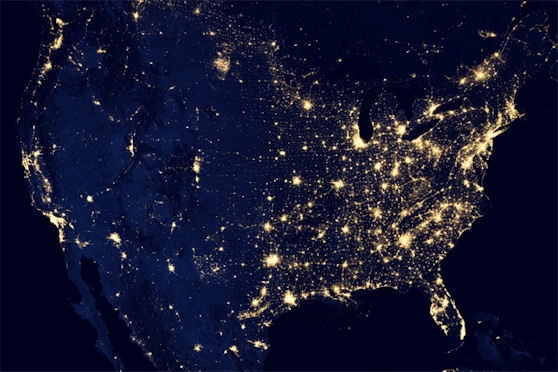
“Unlike humans, the Earth never sleeps”
Words are hardly necessary here because the image says it all. When I first saw this I
thought it was fake or enhanced in some way. I was wrong. It’s actually “[a] global composite image, constructed using cloud-free night images from a new NASA and National Oceanic and Atmospheric Administration (NOAA) satellite, [and it] shows the glow of natural and human-built phenomena across Earth in greater detail than ever before.” Read more about this image and how it was created here.
Image courtesy of www.science.nasa.gov
This article has been retracted
Here is an interesting site, Retraction Watch, that documents papers that are pulled from published scientific journals. Papers or authors can be withdrawn from the literature for various reasons (fraud, misconduct, errors, etc.). Their tagline is “Tracking retractions as a window into the scientific process.” For example, they recently covered article retractions due to faked peer-reviews using Elsevier’s editorial system. Check it out.

There is a new service called CrossMark from CrossRef, the organization that provides Digital Object Identifiers (DOIs). The goal is to have a CrossMark logo on digital documents (Web or PDF) that links to information about corrections, changes, and withdrawals. Be sure to click on the logo when it appears.
Santa’s journey across the globe
Have you ever wondered about the route that Santa takes on Christmas Eve? Here’s a 2-minute video that hypothesizes what Santa’s route would be if he used population statistics to plan his journey:
A prize-winning galaxy photo
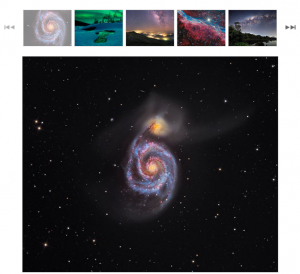
Are you wondering what it is in this image? It is “a spiral arm of the Whirlpool Galaxy grazes the light of a smaller companion galaxy that’s slowly being torn apart by its neighbor’s gravity.”
This photo won Australia’s Martin Pugh top prize in the 2012 Astronomy Photographer of the Year competition run by the U.K.’s Royal Observatory Greenwich. Also wonder what the blue, pink, and reddish things are in the big arm? Read more at here.
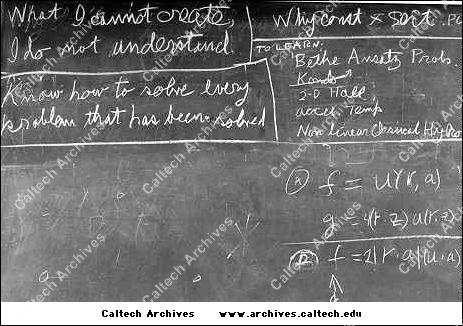
Know how to solve every problem that has been solved
One of the images of Richard Feynman’s blackboard at time of his death from the Caltech archives.
In their collection they also have photographic negatives made of Feynman’s blackboards during his famous physics lecture series for undergraduates in 1961-1964.
Zip it!
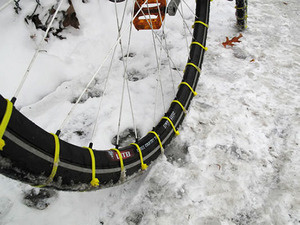
I just recently retired my bike for the season. It’s true, the roads are not icy or covered in snow…yet. So I do feel like a bit of a wimp for walking and taking the Metro when I could be cruising to work in 15 minutes on my trusty Peugeot. However, I will have to get used to the longer/less convenient commute, because I’m not the girl who gears up with goggles and snow pants and shreds through downtown Montreal mid-January! I want to be though. So with that in mind, I started researching cheap and easy ways to winterize my bike for next year (I need substantial time to get used to the idea) and I came across this great little invention: zip tie snow tires! Fritz Rice, the man behind the zip tie snow tires idea, has this to say: “I can accelerate, brake, and corner with aplomb, even on the vile snowpack/sheet ice mix the plows leave in the bike lanes. The zip ties dig nicely into the hardest packed surfaces, but they’re thin enough not to bounce the bike around at low speed or on short pavement sections.” Simple and effective. A great combo. Read more here.
Image courtesy of ca.gizmodo.com
Extreme scientific analysis
Discoblog is one o
f my favorite blogs. It reports on weird, humorous, and astonishing studies that have been published. Here are links to some posts about studies that the Disco-bloggers labeled, “analysis taken too far”:
- How academics face the world: a study of 5829 homepage pictures.
- Bobcats eating cadavers. Now THAT’s science.
- Dynamics of conflicts in Wikipedia.
- The effect of hurricanes on popular baby names.
- Effects of pleasant ambient fragrances on dental fear: comparing apples and oranges.
- Presidential laugh lines. Candidate display behavior and audience laughter in the 2008 primary debates.
- Rating of personality disorder features in popular movie characters.
Image from Microsoft Office Clipart
Windows 8 apps
April recently wrote a post about designing your own applications for iphone. On the lately released Windows 8, getting apps is more like the way we use for an Apple device. Instead of the Apple store, we get apps from the Microsoft store either for free or for a payment. Read more at here.
If you are interested in learning more about Windows 8, here is a review.
NASA news: Mercury water ice
NASA held a news conference today, unveiling new evidence for water ice at Mercury’s polar regions from the MESSENGER spacecraft.
MESSENGER is an acronym for MErcury Surface, Space ENvironment, GEochemistry and Ranging. Powered by two solar panels, it was launched August 3, 2004, reaching Mercury’s orbit March 18, 2011 (UTC).
Mercury has a temperature range of 610 degrees Celsius: 427 degrees on the side closest to the Sun, and -183 degrees on the night side. There are crater floors around Mercury’s poles that are in persistent shade, since its rotation axis does not tilt. NASA’s latest data points to water ice and other frozen deposits in these craters.
The red areas in this image are the permanently shadowed craters of Mercury’s north pole, with the polar deposits in yellow.