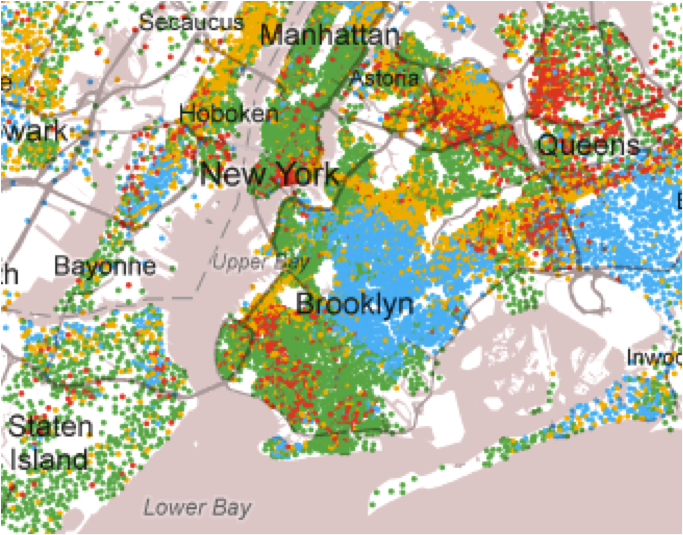
I am always astounded by what can be done with geospatial data – here is a map from The New York Times that uses data from the U.S. Census Bureau’s American Community Survey (2005-9) to show the distribution of racial and ethnic groups for every city block.
Since 1985, LaRonde has been hosting the Montreal International Fireworks Competition, also known as L’International des Feux Loto-Québec. Tonight at 10pm is this year’s finale. Every summer over the past few years, I have made the trip to go see them at least once. My favorite spot to view the fireworks is just outside the Longueil metro station; a lesser-known, quiet spot that is right across the highway from LaRonde. I had the opportunity to see the fireworks last Friday night and, as always, I was amazed by the spectacular light show.
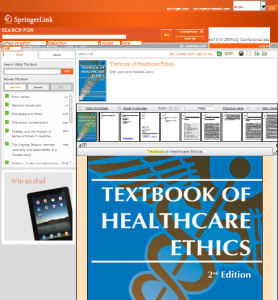
I just read the news that University of Windsor students now have access to their textbooks in digital formats through Flat World Knowledge – one of the publishers of openly-licensed college textbooks. This reminded me of the electronic books that we have at McGill University. We have more than two million e-books in our collection! They work on a variety of platforms from e-book providers; some of them are major publishers for academic content, such as Springer, Wiley, and Palgrave Macmillan. They are accessible for McGill students and staff for free (see instructions on how to access our online resources). You can read them online or choose to download by chapter. The Library Catalogue is a great place to start your search. For books published recently, I would recommend an extra search on the publisher’s platform through our e-books webpage. SpringerLink, the electronic content platform from Springer – a globally-known publisher in science, technology, and medicine disciplines also allows you to Buy A Print Copy For $24.99 for some of their books. McGill subscriptions in SpringerLink are indicated by a green box.
I received a box of promotional items at the library from Royal Society of Chemistry (RSC) Publishing and it served as a reminder to write a few words about ChemSpider.
ChemSpider is a free database that really is easy to use. You may not see yourself as a chemical searcher but I promise that you’ll find interesting facts about chemicals you use everyday. Continue reading →
Who knew? As a scientist in the field of physics, you have the chance to be awarded the most lucrative academic prize in the world. Nine physicists became multimillionaires after Yuri Milner, a billionaire who made his fortune investing in Internet companies like Facebook and Groupon after quitting his PhD in physics, and then established the Fundamental Physics Prize, dropped $3 million into their bank accounts. The prize is larger than the Nobel Prize, which is currently $1.2 million, split among 2 or 3 people and differs from the Nobel Prize in crucial ways. The Fundamental Physics Prize can go to younger scientists who are still in the experimental stage of their research. The nomination and voting process is also different, with anyone being able to nominate a winner online and the selection panel is public. Milner hopes that the significant size of the prize will shine a spotlight on fundamental physics and drive home the importance of the field. To read more about Yuri Milner, the Fundamental Physics Prize and its recipients, check out this article in The Guardian.
I love exploring online learning tools and Mouse Party is a fun one from learn.genetics at the University of Utah. It demonstrates how drugs alter the brain’s reward pathway.
With the researcher’s arm in your control, select a subject from the mice under the effects of different drugs to get a look inside their brain and the mechanisms of drug action.
Coursera recently announced that it had signed on with more than a dozen major educational institutions worldwide, including U of T, the only university from Canada. Coursera was created by two computer science professors at Stanford University earlier this year. The plan of Coursera is “to partner with the top universities in the world to offer courses online for anyone to take, for free”. The creators “envision a future where the top universities are educating not only thousands of students, but millions.”
The courses on Coursera contain lectures, forums, quizzes, assignments, and exams. The students will be able to join online discussion with classmates everywhere on the earth, submit their assignments, and get grades for free. Coursera has now 111 courses available which are categorized in Biology & Life Sciences, Business & Management, Computer Science, Engineering, Sciences, etc. Below is an example of a Coursera course, Software Engineering for SaaS, which is currently offered by Fox and Patterson, professors from UC Berkeley.
Other than Coursera, edX and Udacity are also known for offering MOOCs. The most influential MOOC so far is Stanford University’s computer science professor, Sebastian Thrun’s Introduction to Artificial Intelligence which drew more than 160,000 students who eventually received detailed grades and a class ranking.
This partnership between the U.S. National Science Foundation and NBC brings athletes and engineers together to share their experiences and perspectives. For example, you can learn about the biomechanics of 6 ft. 5 in. sprinter, Usain Bolt, or the design of the pool at the London Aquatic Centre that promises to maximize speed and minimize waves.
During a trip to Chicago last week, I had occasion to see one of the American Society of Civil Engineers’ (ASCE) monuments of the millennium, the Chicago Wastewater System. By the end of the 19th century, Chicagoans had heavily polluted the Chicago River by dumping all of their garbage in the water, which flowed into Lake Michigan, the source of the city’s drinking supply. This caused deadly diseases such as cholera and typhus. To solve the problem, the flow of the Chicago River was reversed, sending it in the opposite direction from Lake Michigan.
Here’s a brief documentary on the reversal of the Chicago River:
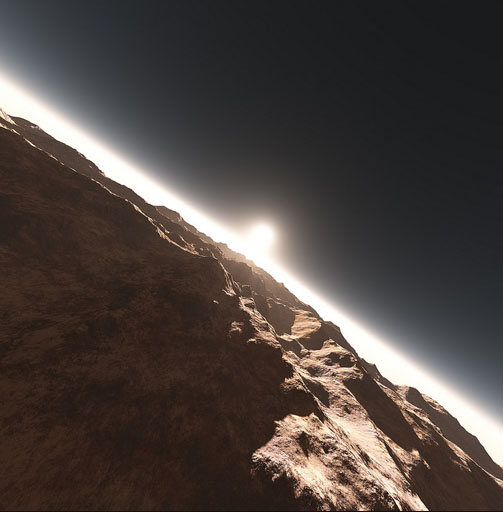
NASA’s new mobile Mars Science Laboratory, also known as the Curiosity Rover, will be launched on August 5th to study the rocks, soil, and atmosphere on Mars’ Gale Crater for signs of historical and current habitable environments. A habitable environment contains water, energy, and carbon to support life. Past missions have discovered the limited presence of water and energy on Mars, but none, so far, have found carbon in a form that can sustain life.
Curiosity’s purpose is to determine how to conduct a search for carbon, as well as find carbon. The former will assist planetary scientists in further research, since they are uncertain about how to probe rock strata for biosignatures, whether on Earth or on Mars.
This month’s issue of Scientific American provides an overview of Curiosity’s mission and a step-by-step description of its landing sequence.