A Perfect Match: The Sustainability Park and McGill Libraries

Sustainability has long been a priority for McGill and rightly so, as climate action is essential now given the rapidly increasing climate emergencies occurring globally. It’s fantastic that there is so much work happening in this area at our university. For example, McGill recently ranked in the top ten along with University of Toronto and University of British Columbia in the QS World Sustainability rankings. There is also excellent work being done by the McGill Office of Sustainability (MOOS). Two of MOOS’ major initiatives have won awards:  their sustainability learning module and the sustainable workplace certification program. And, of course, the Sustainability Park, McGill’s revitalization of a portion of the former site of the Royal Victoria Hospital to create a state-of-the-art research, teaching and learning hub dedicated to sustainability and public policy, is getting closer to reality every day!

You might be more familiar with the Sustainability Park by its previous name: the New Vic Project. The new name was launched in the fall: Le Parc du développement durable McGill/McGill Sustainability Park. The new name heralds the exciting developments that are moving forward on the project.

To learn more about the project, consider attending the upcoming information session open to the entire McGill community this Thurs. Dec. 11 from 12-1:30pm. A recent What’s New for faculty and staff points to details about the meeting and provides information about how you may submit your questions in advance. You can also watch a short video to learn more about the project.

Since 2024, I have had the privilege to serve on a Community of Practice related to the academic aspects of the project. It has been really interesting to learn about the plans and to provide feedback to the project team, as well as to work with faculty, staff and students all across campus who are so vested in sustainability. As the McGill Libraries’ representative, I have helped to integrate the Libraries within the project.

So, what exactly does the Sustainability Park have to do with the McGill Libraries? Well, most notably, the McGill Libraries will open a Grand Reading Room in the space. This is the first time in my many years at McGill Libraries when we will be getting a new library space! Given how highly in demand our current library spaces are, with two million in-person visits per year (PDF booklet at: https://www.mcgill.ca/libraries/about/planning/strategic-priorities), we surely can use the extra space!

The Grand Reading Room will be located in one of the Nightingale Wings in the heritage portion of the site. With its large dual aspect windows, the space was originally a ward for patients. Dual aspect windows are windows that are on at least two walls of a space, which allows for natural light to enter and for there to be increased cross ventilation and outside views in multiple directions. The space had (and will continue to have) lots of natural light, which was helpful in the well-being of patients before there was electricity.

The reason the wards were called the Nightingale Wings was because of Florence Nightingale, the famous founder of modern nursing. In fact, she was even consulted on the design of these kinds of hospital wards, including those in the original Royal Victoria Hospital! (Table 1 at: https://journals.sagepub.com/doi/10.1177/1937586720931058). Her Environmental Theory emphasized the importance of clean air and natural light in speeding up patient recovery. Her “signature innovation [was] large windows that allowed cross-ventilation and abundant natural light.” (https://www.scientificamerican.com/article/what-florence-nightingale-can-teach-us-about-architecture-and-health/). The design of the Grand Reading Room honours her legacy in its continued adherence to her foundational principles.

Nightingale was ahead of her time in understanding how much human health depends on a healthy environment – a message that certainly rings true today when what we need more than anything is a clean and healthy planet. In the Sustainability Park, researchers will study how best to deal with the most tackling issues of sustainability while practicing sustainability within its walls, in much the same way the wards Nightingale helped design were places both for healthcare research and for applying the research to treat patients.

Here is what one of the Nightingale Wings looked like when it was part of the hospital in 1897 and used for hospital patients:

Image: Ward D of the Royal Victoria Hospital and the staff during Christmas. (photo 1897). MUA PR023861. From: archives.mcgill.ca/public/hist_mcgill/nursing/nursing04_lg.htm

Here is what the future Reading Room looked like when I had the opportunity to go on a site visit in fall 2024:

Image: Taken by Tara Mawhinney.

Here is a glimpse of what the future holds for this important historical space when it opens as part of the Sustainability Park:

Image: Architectural rendering of the Grand Reading Room, courtesy of the Sustainability Park Project Office.

The library space will include study space and library staff on site, but no physical book collections. The space will be open to the public. However, as with existing McGill Libraries’ spaces, students are expected to be the main clientele.

To find out how the project is progressing these days, check out this sneak peek video of the Park as of Oct. 2025. If you pay close attention at the 2 minute 55 second mark, you’ll even get a view of how the Grand Reading Room space is coming along!

So, when will the McGill Libraries get to welcome you to the new Library space? The Sustainability Park will officially open in 2029, which might seem a long way off, but it will be here in no time. I hope that you will join the Sustainability Park project team on Dec. 11 to learn all about what they have in store for McGill!

Finding Research on Sustainability Topics

As the liaison librarian for the Trottier Institute for Sustainability in Engineering and Design (TISED), I love it when McGill students and researchers ask me for help finding research related to environmental sustainability and climate action. My two go-to research databases for these kinds of questions are ProQuest One Sustainability and Scopus. The tips below on these databases will be particularly useful for students and researchers in TISED and in engineering but I hope people researching in other fields may find them useful too!

ProQuest One Sustainability

This is the leading sustainability database available through McGill Libraries. You can access it at: ProQuest One Sustainability. This database contains references to journal articles, conference papers, books and book chapters, case studies and more on topics such as environmental engineering, water resources, climate policy and environmental health. The database allows you to filter your results to limit to one or more of the three sustainability pillars: environmental, social and economic.

So, for example, if I wanted to find academic sources on cycling in cities and focus on the social aspects, I could type in: cycling and cities; once the results are displayed, I can choose the “social” filter, under the “sustainability pillar” category, from the left-hand column. My search results will include literature on topics like gender inequality in cycling, the lived experience of cyclists, motivations for cycling, recreational cycling and so on.

Another reason I recommend this database is that it has implemented a feature that maps its research content to the UN Sustainable Development Goals (SDGs), thus allowing researchers to identify literature on many sub-topics within sustainability. The UN goals are 17 specific objectives that are part of a plan that all UN member states adopted in 2015 to reduce poverty, protect the planet and improve the lives of everyone. Research in addressing these goals is helping to solve real-world problems. ProQuest One Sustainability has added the goals into their database to raise awareness of research that is making a difference in the world by addressing critically important issues for humanity and the environment.

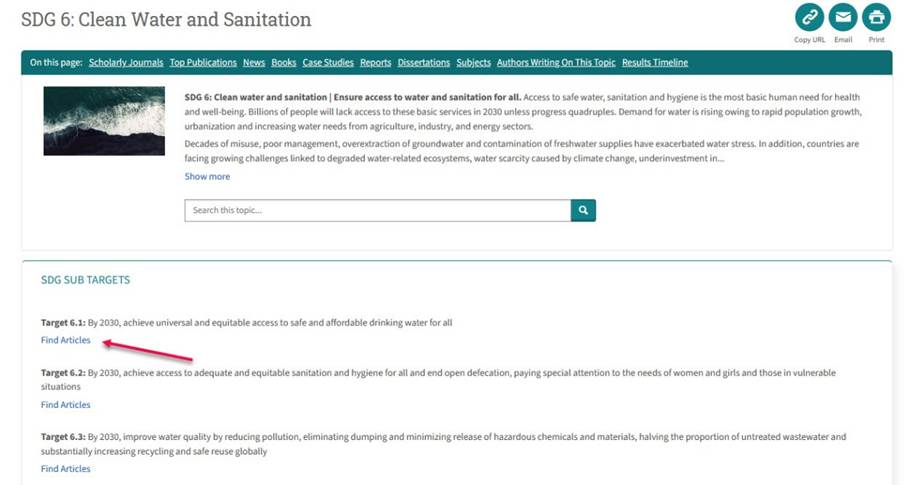
How does this feature work? The database highlights research that relates to each of the 17 goals by listing the goals on the database’s home page. When you click on a specific goal (e.g. “Goal 6: Clean Water and Sanitation”), the database lists the targets within each goal (e.g. “Target 6.1: By 2030, achieve universal and equitable access to safe and affordable drinking water for all”). You can click on “Find articles” to view the literature that addresses this specific target. In the image below, you can see what the “Find articles” link looks like in the database.

One strange quirk of ProQuest One Sustainability is that when you run a search using the default search box on the database’s home page, the database looks for your words anywhere in the description of the items in the database, including in the full text when available. This kind of search is different from most other research databases at McGill that only look for your words in the title, abstract and description of the items and not the full text, which gives a more precise and targeted search. What this means is that in ProQuest One Sustainability, you can get a lot of noise (irrelevant results) cluttering up your search. I recommend going to the “advanced search” and, from the dropdown menu, selecting this option to search instead: “Anywhere except full text.” This kind of search will help you retrieve more focused results and reduce the clutter.

Scopus

Another of my go-to databases for sustainability topics is Scopus and I’ll explain why. Scopus is a multidisciplinary database covering research on every topic you can imagine, and not limited to sustainability-related topics, like ProQuest One Sustainability. You can access it at: Scopus. What makes Scopus stand out in terms of sustainability is that it recently implemented a feature similar to the functionality in ProQuest One Sustainability that ties literature to the Sustainable Development Goals.

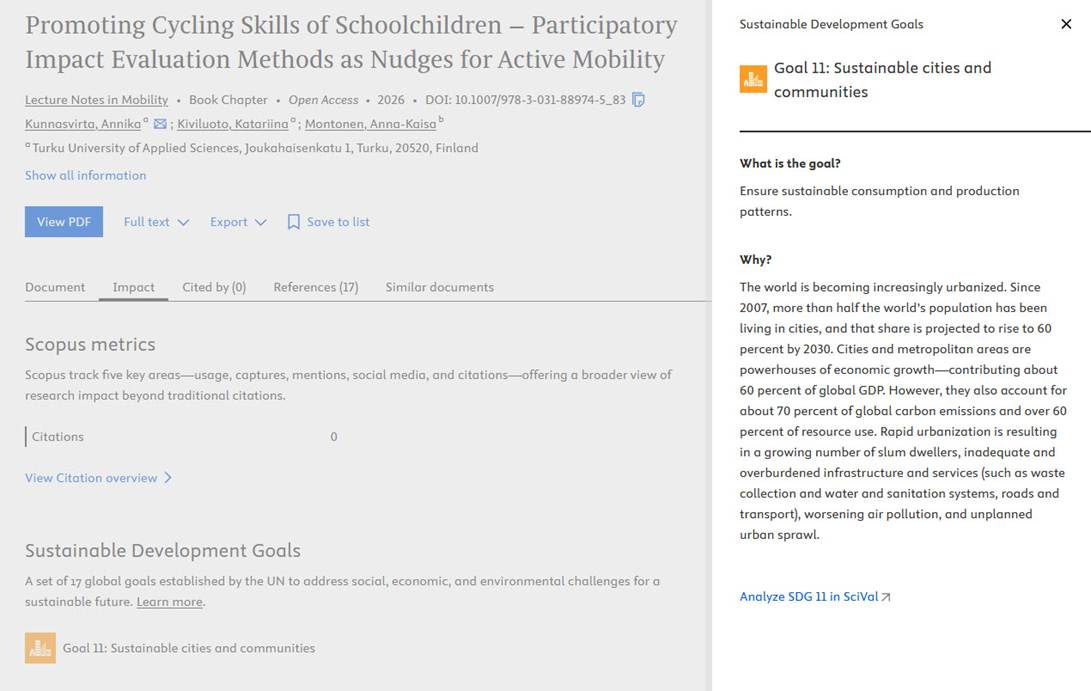
When you run a search, say for cycling in cities, Scopus has incorporated the goals within the description of literature that addresses one or more of the goals. Scopus will help you identify which research articles address the SDGs by indicating, under the “Impact” section of each document’s record, when the research relates to one or more SDGs. Scopus uses machine learning to help identify which articles discuss which SDGs. For example, in my Scopus search: cycling and cities, I found an article on promoting cycling to schoolchildren and after choosing the “Impact” tab, I found that the article mapped to “Goal 11: Sustainable Cities and Communities.” Scopus also gives a summary of what each goal is about and why it is important. Here is what Scopus looks like in action:

Limitations

My hope is that both ProQuest Sustainability One and Scopus will make their mapping features even more useful by integrating a search filter for SDGs, much like the sustainability pillar filter within ProQuest Sustainability One. That way, it will be really easy to filter down from your list of results to only show the literature that addresses a specific SDG. For now, when you run a search in either of these databases from their main search boxes, this isn’t possible. In Scopus, we need to look through all the results in a search one by one to see if there are any SDGs mapped to the research articles. In ProQuest One Sustainability, only those articles listed under the special section on the 17 goals on the database’s home page will get you to research on any specific SDG.

For more information

I hope this gives you a glimpse into how you can use some of McGill Libraries’ best resources to find literature on sustainability topics. You’ll find other resources related to environmental sustainability on my TISED research guide at: https://libraryguides.mcgill.ca/tised and on the Environmental Studies research guide at: https://libraryguides.mcgill.ca/environmental-studies. For help on finding research related to any topic, McGill students and researchers can consult the list of liaison librarians. We’re happy to help!

Libraries Are Celebrating Climate Action Week!

Climate Action Week Logo

To mark Climate Action Week taking place this week and spearheaded by the British Columbia Library Association, here are some interesting things that are happening related to environmental sustainability and climate action both here at McGill and further afield:

  • Do some reading! Various libraries have put together booklists on climate change including these resources:
    • The University of Toronto Scarborough Library has created a Climate Action Week Reading List with many book titles on climate change. The books in the “Fuelling Hope” section offer lots of good reading for getting inspired.
    • The University of British Columbia Library has created a variety of climate change booklists on different topics like climate-related books by BC authors, the history of climate science and action, books of hope from strong climate voices and many others.
    • The University of Waterloo Library has created a climate action booklist with subsections on topics such as sustainable development and innovations.
  • Join a climate café to share your thoughts and current experiences related to the climate crisis. There are many such groups including this free one offered monthly by the US-based Resilient Activist organization.
  • Learn more about climate change and the climate crisis by registering for the McGill Course: “ATOC 183: Climate and Climate Change” being offered this winter. Read all about the course in an interview dating from last year when the course first was offered.

Within the McGill Libraries, various units have been hard at work completing the university’s Sustainable Workplace Certification program. In fact, it’s one of the library system’s objectives to have all units certified at the bronze level or higher. Schulich Library is proud to have achieved bronze certification and is currently working toward silver. The new McGill Collections Centre opened in 2024 as a LEED gold certified facility and its staff have now earned platinum level in the university’s workplace certification program. You can learn more about the program and several other sustainability initiatives by checking out information from the McGill Office of Sustainability.

Happy Climate Action Week!

Teaching Climate Change: Prof. John Gyakum Discusses His New Course, ATOC 183

Recently, I had the opportunity to speak with Professor John Gyakum from the department of Atmospheric and Oceanic Sciences about his new course “ATOC 183: Climate and Climate Change” being offered this winter. Full disclosure: I am the liaison librarian for his department and will be working with him to provide library support for the course.

Here is what he had to say.

Tara:

Thanks so much Professor Gyakum for taking the time to share with our blog readers about your new course “Climate and Climate Change”. First off, tell us about the course.

Professor Gyakum:

As you probably know, I’ve been teaching Natural Disasters (ATOC/EPSC 185) with John Stix for 25 years. And the thing is climate change is a natural disaster and I’m really passionate about talking to students and working together to understand what we know about climate change and perhaps more importantly what we don’t know.

Tara:

25 years, that’s a long time.

Professor Gyakum:

It is. I had no idea until John Stix mentioned it earlier this term, but yeah, it’s been that long.

Tara:

What is your anticipated student demographic for this course?

Professor Gyakum:

You know, I have not looked in detail at the registration numbers. We have about 145 students. My expectation is that the demographics of our student population will be very similar to what we’ve been having in Natural Disasters. The levels will range probably from U0 to U3. And we’re expecting to have students from all faculties.

Tara:

Are you expecting students to have a certain base level of knowledge when they’re starting this course or will it be for people new to this area of study?

Professor Gyakum:

There are no prerequisites whatsoever and I expect to be able to reach out to all students without any preparation for this course.

Tara:

What led you to developing the course?

Professor Gyakum:

We’ve been incorporating climate change into the Natural Disasters course for the past 5-7 years. It only lasts for one week as a module. It’s an exciting field. Furthermore, I’m in the Department of Atmospheric and Oceanic Sciences and it’s my view that we should be leaders in articulating the science [of climate change] to our students and doing so in an accessible way.

Tara:

Was this [initiative] driven from your own experience in Natural Disasters or was it a combination of hearing about needs for a course like this from students in that class or from elsewhere?

Professor Gyakum:

A combination of my experience in Natural Disasters and also as Department Chair. I’m not Department Chair now, but I had been for about 16 years. And Chairs assign teaching. It was pretty clear to me that this was a gap in our departmental outreach that we needed to fill.

Tara:

Absolutely. A lot of people report feelings of eco anxiety when faced with the immensity of the problem of climate change. How will your course help students deal with the kinds of feelings that this topic can generate?

Professor Gyakum:

Well, you know, we’ve touched on this a little bit in our [Natural Disasters] course. There’s no doubt about it that when we pose this question as a Slido [polling] question to the students, their reactions are predominantly pessimistic and lots of people are really quite depressed about this, with good reason. It’s very frustrating for students when they see that governments are not acting in a way that is responsible. What we tell them and what I’m going to be intending to articulate to our students is that there’s a lot of reason for optimism. Primarily because we, as individuals, can work towards a better future. In other words, we do not have to rely upon a government that may not be so proactive. We can do things for ourselves, that contribute to mitigating against climate change and taking actions.

Tara:

Things like?

Professor Gyakum:

On a personal level, of course, your own habits, including transportation. Take the bus, take the metro, walk. It’s not always possible for people to do that but, at the same time, people can and should be acting responsibly. Diet has a role as well. Our choices of what we eat have an impact on the climate.

Tara:

Definitely. How will your course fit in with existing courses? How will it complement things that are already being offered at McGill like “FSCI 198: Climate Crisis and Climate Actions,” offered through the Office of Science Education and “GEOG 514: Climate Change Vulnerability and Adaptation?”

Professor Gyakum:

First of all, I think our department should be playing a leadership role in this aspect. And I think the contributions that we’re going to be making with this climate course are, in fact, not duplicating what exists already but rather complementing. To do that, what I intend to do is focus on what we do know as scientists in Atmospheric and Oceanic Sciences. In particular, I will be discussing extreme weather systems and we will be having guest speakers from various areas in the Atmospheric and Oceanic Sciences community to articulate this. Water vapour is the most important greenhouse gas. And that’s not really looked upon very much in current climate change courses. One of the reasons is that water vapour has a tendency to disperse. You have a warm air mass, particularly in the summer. It goes away with a cold front and the water vapour lifetime is rather short. However, there’s been more recent evidence to suggest that extreme weather systems and even submarine volcanic eruptions can, in fact, inject a massive amount of water vapour into the stratosphere, where the lifetimes are much longer. Also, we’re going to be looking at some of the radiative aspects of clouds that have an impact on our climate. So there are some nuances here, very important subtleties that are critical to our understanding of the problem.

Tara:

So would it be fair to say that this course will be taking more of a science bent than some of the other courses that might be more [policy-oriented]?

Professor Gyakum:

I mean the other courses certainly have science in them. What we’re doing here is to emphasize extreme weather systems not just simply as a symptom but rather as a really significant producer of sometimes cataclysmic feedbacks on the climate system.

Tara:

I’m a fan of the Walrus Magazine and there was an article that came out in 2022 on climate change education. One of the people interviewed in that article was saying and I’m quoting “climate education should be framed in a way that incites hope and incites change.” That sounds like a very challenging, yet very important, task. How do you plan to incite hope and change in your classroom?

Professor Gyakum:

I think what we can do here is show our students tangible examples of what we as individuals can do and what we can do on a political level, albeit relatively small-scale to begin with, depending upon the students’ own personalities, to affect positive changes in our political system that would facilitate taking strong action against the ill effects of climate change. So I think this can be done really at all ages and at all levels and at all areas of expertise. I think that’s an excellent article that you were referring to. I have to produce a realistic state of affairs – there’s no question about that – but at the same time, there are good examples that I can show of individuals and also governments doing a terrific job in addressing the whole issue of climate change.

Tara:

You’re making me want to take the course! Are you accepting people auditing the course?

Professor Gyakum:

Totally. It’s not a remotely-given course, so some of this depends upon the size of the classroom, of course.

Tara:

Related to that, I know you have taught online before. I remember the years before the pandemic when you offered the very popular Natural Disasters course free online as a Massive Open Online Course (MOOC). What lessons about the way you taught that course will inform how you teach this new in-person one?

Professor Gyakum:

So when we taught the MOOC, both John Stix and I had this idea that teaching a 45 or 75 minute lecture was just fine, but what we found with the MOOC was that we really needed to break things up and focus on a topic for a limited period of time, 10 to 15 minutes. And then, at the same time, what we found since the MOOC, and since the pandemic, is that we’re really working harder towards engaging students more proactively, even in a 600-person class. We do this with questions, feedback and even discussions. I think that’s going to be a readily available tool that we can use in this climate course, which right now has about 140 students, which is a fraction of what we have in Natural Disasters. So I’m looking forward to that.

Tara:

So what you’re saying is that you’re taking the practice from your online course of integrating engaging activities and bringing that into the physical classroom?

Professor Gyakum:

Absolutely. We’re going to be using techniques to actively engage the students in every single class much more frequently than has been a typical practice. At the same time, we want to know if anything that we’ve said during the lecture has gotten into people’s brains. We can do that with some of the questions that we ask students. It’s very important. Sometimes we, as instructors, can be very surprised at what a student really learns and does not learn from what we’ve just said. [Using techniques for engaging students] is an excellent tool for gathering fairly quick feedback for both the students and the instructors.

Tara:

That can help you then to tailor your teaching moving forward.

Professor Gyakum:

Yes. Even in Natural Disasters – we’ve done this for 25 years – but we’re constantly changing the way we teach.

Tara:

That’s fantastic. I think that makes so much sense because every class is different and, as these things move forward and time passes, the kinds of knowledge that students are bringing to the classroom are different and that impacts what you teach.

Professor Gyakum:

That’s exactly right. And you know, one of your first questions about the demographics, I don’t know the specifics of the demographics, but I’m going to try in the very first class to engage with the students and work with them to address student strengths because the demographics of a particular class change from year to year. I want to know where they’re from, what sort of background they have. I can’t do it all in one day, but at least I can get an idea of what students’ interests are and what they would like to learn.

Tara:

Excellent. What are some of the main things that you hope students will take from your class this upcoming semester? What main takeaways are you hoping they’re going to come away from your class having learned?

Professor Gyakum:

I think the real emphasis is to instill students with a good idea of what we know about climate change and in particular what we don’t know. A lot of times, politicians, naysayers and so forth spend a lot of time talking about issues that are related to climate change, which are really unknown, totally unknown. There is a lot that we do know about climate change and in particular some of the initial phases of the course are going to go into basics. We will cover what the greenhouse gases are, what they do to our climate and how we as human beings can make changes. Following up on that, we’re going to be talking about some of the implications of the science and what we can do to learn and also to work towards a better environment, a more habitable environment for humans.

Tara:

Is there anything else that you want to tell me about the course?

Professor Gyakum:

Well, it’s going to be fun. I can’t wait for it to start. I realize there is a holiday coming on, but at the same time, I feel very enthusiastic and very passionate about this course. I hope to convey some of that enthusiasm and passion to the students so that they themselves will be able to move ahead and learn. And get something positive out of this course [that can help them] in the different paths they will take in the future. That might be policy, science, arts, anything that the students can do to convey their knowledge and do so in a constructive way to make our society better. So that’s my goal.

Tara:

That’s a very big mission.

Professor Gyakum:

It is. In academia, we have to think big, but at the same time, we have to be practical about what we can do. But just conveying the enthusiasm to some fantastic students that we have at McGill is sometimes all it really takes to expand this vision and to make ourselves a part of a much better world. So, to some extent, I’m relying upon the wisdom and the strength and the enthusiasm of our McGill students to go forward.

Tara:

You’ve got a good bank of people to do work with, that’s for sure. I think McGill students are definitely on board with this topic.

Professor Gyakum:

They certainly are and, like I said, I think I’ve told you before, I feel very privileged to be a part of the McGill community. To have you, in particular, as our librarian to help us and provide resources to students for doing their work. And the student body itself makes a huge contribution to our scholarly community. And I’m just very, very thankful that I can be a part of that.

Tara:

Me too. Thank you so much. I’m really looking forward to hearing more about the class as it moves forward. It’s been really exciting to hear about the course. Thanks again!

It’s Virtually Science Literacy Week!

Science Literacy Week will be celebrated this September 20 to 26 with climate as the theme. We can help you become a citizen climate scientist with a workshop on capturing the McGill Observatory’s historical weather logs with DRAW, the Data Rescue: Archives and Weather Project.

You can also learn The Art of Explaining Science to Non-Specialists, or how to turn your research into a business, with From Science to Startup: A Beginner’s Guide to Entrepreneurship as a Researcher.

If you are looking for something relaxing this semester, McGill Visual Arts Collection invites you to a Science Literacy Week edition of their on-going De-Stress + Sketch series.

Our Science Literacy Week guide also has lots of virtual exhibits and links promoting resources and materials at McGill Library and beyond, including the wonderful Ocean School from the National Film Board of Canada.

Join us as we help spread the wonders of science Canada-wide!

Bill Nye Inspires and Educates Rutgers’ Class of 2015

rutgersbill nye

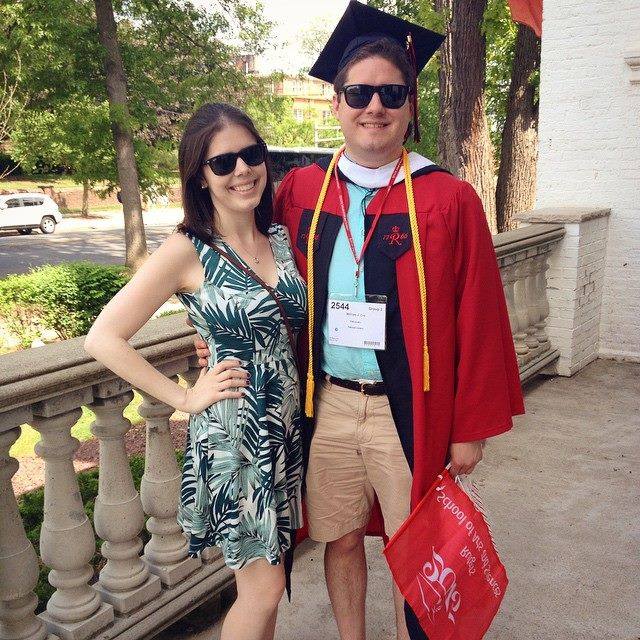
I recently had the pleasure of traveling down to Rutgers University in New Brunswick, NJ to watch my brother’s graduation.

While I am extremely proud of all his accomplishments another draw was that Bill Nye was slated to be the 2015 commencement speaker. As a childhood fan I certainly wasn’t going to miss this opportunity!

Nye imparted some excellent words of wisdom on the audience, while also tying in his views on climate change and racism. He urged the graduates to take climate change seriously, and expressed his hope that they would rise to the challenge of solving this crucial issue. Along with this wish, Nye also pointed out that in order to solve the problem of climate change the class of 2015 would have to put aside preconceived notions of race. We are all members of the human species, worthy of respect, and capable of making world changing discoveries said Nye.

Nye’s speech was inspiring as well as educational, and an excellent reminder that we are all responsible for building one another up for the good of the world.

To read Nye’s remarks in full click on the link below!

http://time.com/3882613/bill-nye-graduation-speech-rutgers-university/

Climate change and its impacts on human lives

For those who are interested in exploring how much people’s lives have been affected by global warming, I would recommend  this source where you could find Dr. Mauro and his team’s research findings over the past few years.

Dr. Mauro was also the filmmaker of Qapirangajuq: Inuit Knowledge and Climate Change, the first Inuktitut-language film on people’ experience of adapting into global warming.

Image from Microsoft Images

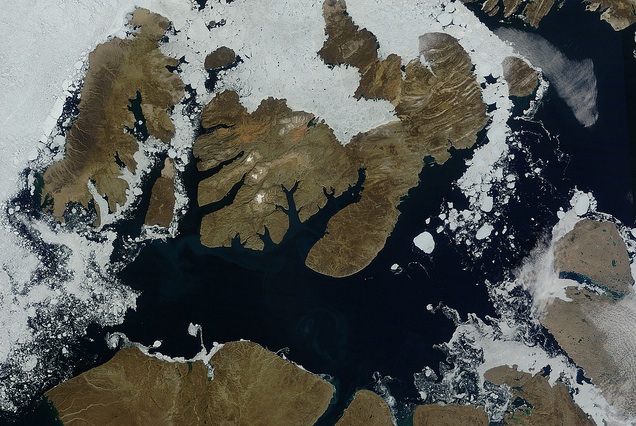
Climate change permits sailing through the Arctic

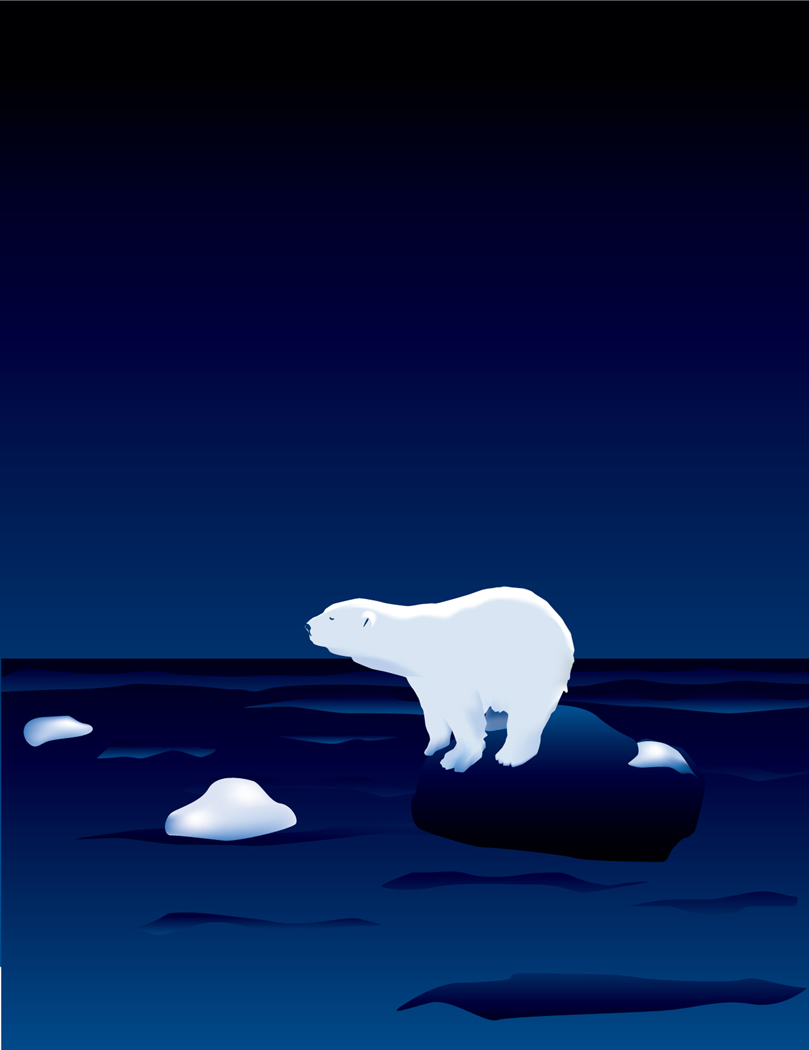
Three international sailors made history by being the first crew to successfully cross the M’Clure Strait in Canada’s Arctic Ocean after 90 days at sea.  The M’Clure Strait has always been entirely covered by ice.  This small crew departed from Newfoundland and is crossing the Arctic to record the melting of polar ice and increase awareness of climate change.

Visit “A Passage through Ice” for more information about this expedition.

Image from NASA Goddard Space Flight Center

Melting in the Arctic

Throughout the year, the U.S. National Snow & Ice Data Center in Colorado provides scientific analysis and daily image updates of sea ice in the Arctic Ocean.  This research center has recently been in the news due to their reporting that the Arctic sea ice has been melting more quickly this summer, which has resulted in flooding and damage to structures.  Their website provides interesting FAQs about sea ice and our climate, such as “What is causing Arctic sea ice decline?

Photo courtesy of: Patrick Kelley (U.S. Coast Guard) and the National Snow and Ice Data Center, University of Colorado, Boulder.

Climate change and the Great Lakes

“Earlier this month, researchers at the University of Duluth revealed that the temperature of Lake Superior – the coldest and deepest of the bodies of water that make up the Great Lakes – is sitting at about 20°C, the warmest it’s been in a century.”

We have all heard that rising temperatures have the potential to impact almost everything. For example, if water levels decrease, loads of shipping vessels would need to be decreased too and shipping costs would increase accordingly. And if levels shrink to the point that the Great lakes were no longer connected, shipping might discontinue.

Rising temperatures also lead to the growth of toxic algal in Lake Erie, which increases pollution for people living in that region.

If you are interested in keeping track of this topic, you could set up an email alert in a database, such as SCOPUS. Search by the topic, and then click “Set alert” from the top menu of the search results page. You will be able to receive the updates weekly in your email.

Adapted from Climate change and the Great Lakes