Finding Research on Sustainability Topics

As the liaison librarian for the Trottier Institute for Sustainability in Engineering and Design (TISED), I love it when McGill students and researchers ask me for help finding research related to environmental sustainability and climate action. My two go-to research databases for these kinds of questions are ProQuest One Sustainability and Scopus. The tips below on these databases will be particularly useful for students and researchers in TISED and in engineering but I hope people researching in other fields may find them useful too!

ProQuest One Sustainability

This is the leading sustainability database available through McGill Libraries. You can access it at: ProQuest One Sustainability. This database contains references to journal articles, conference papers, books and book chapters, case studies and more on topics such as environmental engineering, water resources, climate policy and environmental health. The database allows you to filter your results to limit to one or more of the three sustainability pillars: environmental, social and economic.

So, for example, if I wanted to find academic sources on cycling in cities and focus on the social aspects, I could type in: cycling and cities; once the results are displayed, I can choose the “social” filter, under the “sustainability pillar” category, from the left-hand column. My search results will include literature on topics like gender inequality in cycling, the lived experience of cyclists, motivations for cycling, recreational cycling and so on.

Another reason I recommend this database is that it has implemented a feature that maps its research content to the UN Sustainable Development Goals (SDGs), thus allowing researchers to identify literature on many sub-topics within sustainability. The UN goals are 17 specific objectives that are part of a plan that all UN member states adopted in 2015 to reduce poverty, protect the planet and improve the lives of everyone. Research in addressing these goals is helping to solve real-world problems. ProQuest One Sustainability has added the goals into their database to raise awareness of research that is making a difference in the world by addressing critically important issues for humanity and the environment.

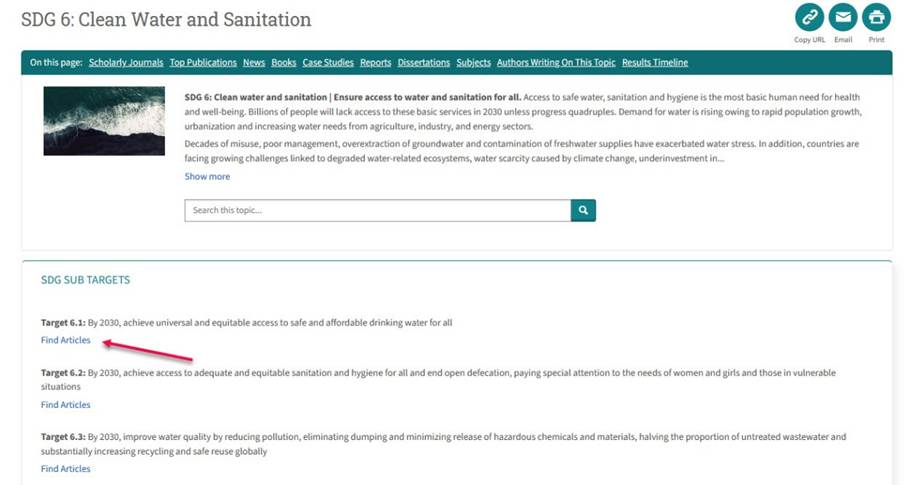
How does this feature work? The database highlights research that relates to each of the 17 goals by listing the goals on the database’s home page. When you click on a specific goal (e.g. “Goal 6: Clean Water and Sanitation”), the database lists the targets within each goal (e.g. “Target 6.1: By 2030, achieve universal and equitable access to safe and affordable drinking water for all”). You can click on “Find articles” to view the literature that addresses this specific target. In the image below, you can see what the “Find articles” link looks like in the database.
One strange quirk of ProQuest One Sustainability is that when you run a search using the default search box on the database’s home page, the database looks for your words anywhere in the description of the items in the database, including in the full text when available. This kind of search is different from most other research databases at McGill that only look for your words in the title, abstract and description of the items and not the full text, which gives a more precise and targeted search. What this means is that in ProQuest One Sustainability, you can get a lot of noise (irrelevant results) cluttering up your search. I recommend going to the “advanced search” and, from the dropdown menu, selecting this option to search instead: “Anywhere except full text.” This kind of search will help you retrieve more focused results and reduce the clutter.

Scopus

Another of my go-to databases for sustainability topics is Scopus and I’ll explain why. Scopus is a multidisciplinary database covering research on every topic you can imagine, and not limited to sustainability-related topics, like ProQuest One Sustainability. You can access it at: Scopus. What makes Scopus stand out in terms of sustainability is that it recently implemented a feature similar to the functionality in ProQuest One Sustainability that ties literature to the Sustainable Development Goals.

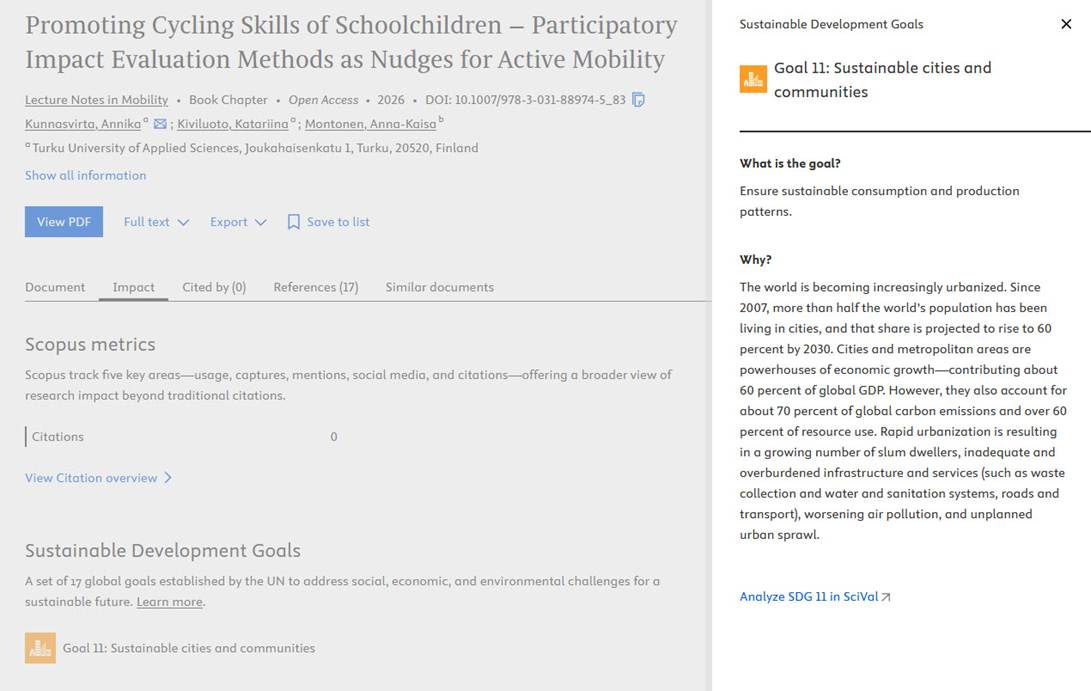
When you run a search, say for cycling in cities, Scopus has incorporated the goals within the description of literature that addresses one or more of the goals. Scopus will help you identify which research articles address the SDGs by indicating, under the “Impact” section of each document’s record, when the research relates to one or more SDGs. Scopus uses machine learning to help identify which articles discuss which SDGs. For example, in my Scopus search: cycling and cities, I found an article on promoting cycling to schoolchildren and after choosing the “Impact” tab, I found that the article mapped to “Goal 11: Sustainable Cities and Communities.” Scopus also gives a summary of what each goal is about and why it is important. Here is what Scopus looks like in action:
Limitations

My hope is that both ProQuest Sustainability One and Scopus will make their mapping features even more useful by integrating a search filter for SDGs, much like the sustainability pillar filter within ProQuest Sustainability One. That way, it will be really easy to filter down from your list of results to only show the literature that addresses a specific SDG. For now, when you run a search in either of these databases from their main search boxes, this isn’t possible. In Scopus, we need to look through all the results in a search one by one to see if there are any SDGs mapped to the research articles. In ProQuest One Sustainability, only those articles listed under the special section on the 17 goals on the database’s home page will get you to research on any specific SDG.

For more information

I hope this gives you a glimpse into how you can use some of McGill Libraries’ best resources to find literature on sustainability topics. You’ll find other resources related to environmental sustainability on my TISED research guide at: https://libraryguides.mcgill.ca/tised and on the Environmental Studies research guide at: https://libraryguides.mcgill.ca/environmental-studies. For help on finding research related to any topic, McGill students and researchers can consult the list of liaison librarians. We’re happy to help!


Enhanced Visibility of Engineering Standards at Schulich Library!

logos of standards-producing organizations

Schulich Library now has a collection of engineering standards in printed format that is browsable within the library catalogue! It is called the Schulich Library Standards Collection and it currently contains over 200 standards and growing. You can access the collection at: Schulich Library Standards Collection.

What are engineering standards anyway? They are very important technical documents that allow engineers to design products and processes that are high-quality and safe. They are produced by industry experts, academics and others brought together by professional organizations, non-profits and government organizations, like the International Organization for Standardization (ISO), the American Society for Testing and Materials (ASTM) and many others.

To borrow a standard from the new collection, please make note of the item’s call number and ask for it at the Schulich Library service desk on the main floor. You can also search for a standard produced by a specific organization by accessing the collection and modifying the search string at the top of the screen to include the organization’s name. For example, to search the ASME standards in the new collection, add ASME to the existing search string: ut: Schulich Library Standards Collection. So your search would look like this: ASME AND ut: Schulich Library Standards Collection.

Please note, most standards held at McGill Libraries are available in printed format only, with the exception of engineering standards produced by select organizations like IEEE. Also, engineering standards are one of the rare item types that generally cannot be request through the Libraries’ interlibrary loans service.

To find out more about the new collection and all the engineering standards available through McGill Libraries, including a list of standard-issuing organizations from which McGill Libraries have standards, please see: McGill Libraries’ Patents, Standards, and Technical Reports Research Guide or email us at schulich.library@mcgill.ca

If you would like the staff at McGill Libraries to consider purchasing a standard for the new collection, please use the email options on the right-hand side of the page to contact the Schulich Librarians for physical sciences and engineering topics and the Macdonald Campus Librarians for agricultural, environmental science, nutrition and parasitology topics. Please keep in mind that standards normally take a few weeks to be acquired and made accessible.

“Maptember” in the UK

The United Kingdom will hold a month of map and GIS related conferences in September:

Society of Cartographers Conference 2013 in Stoke-on-Trent (2nd to 4th Maptember)

Conference on Spatial Information Theory 2013 in Scarborough (2nd to 6th Maptember)

British Cartographic Society Mapping 2013 Symposium in Leicestershire (3rd to 5th Maptember)

Remote Sensing and Photogrammetry Society 2013 Conference in Glasgow (4th to 6th Maptember)

State of the Map 2013 in Birmingham (6th to 8th Maptember)

European Planetary Science Congress 2013 in London (8th to 13th Maptember)

OpenStreetMap Professional Large User Summit in Birmingham (9th Maptember)

The Second Joint FIG/IAG/ISPRS Symposium on Deformation Monitoring in Nottingham (9th to 11th Maptember)

Humanitarian OpenStreetMap Team House Hack Week (9th to 13th Maptember)

QGIS-Dev Meeting in Brighton (12th to 16th Maptember)

Association for Geographic Information (AGI)’s Annual Conference, AGI’s GeoCommunity ’13 in Nottingham (16th to 18th Maptember)

GEOMED 2013 in Sheffield (16th to 18th Maptember)

FOSS4G 2013 in Nottingham (17th to 21st Maptember)

Read more at http://www.maptember.org/

FracFocus Chemical Disclosure Registry

Both Canada and the U.S. maintain a national registry for the disclosure of chemicals used in hydraulic fracturing:

FracFocus.ca
FracFocus.org

FracFocus.ca, built by the BC Oil and Gas Commission and conceived based on the American site, is an up-to-date resource for students and professionals in environmental sciences, earth sciences, and engineering, as well as members of the general public. Visitors to the Canadian site can discover the location of oil and gas wells and the chemicals used at each site in British Columbia and Alberta. From the FracFocus.ca Welcome Page: [FracFocus.ca] is a collaboration between provinces, territories, regulators and industry to provide Canadians with objective information on hydraulic fracturing, what legislation and regulations are in place to protect the environment including groundwater, and transparency on the ingredients that make up hydraulic fracturing fluids. Visit the site(s) to learn more.

America’s 100 Best Adventures

americanadvanturesHave you finished your exams and are you planning your summer trips? If so, you will probably find this article useful. National Geographic recently created a list of 100 most appealing adventure places in the States where you might be able to enjoy your favorite activities in pure nature.

If you decide to visit several places on one trip, you may draw your itinerary using this interactive map.

If you cannot go to any of these sites this summer,  you can at least play fun puzzles by creating one of these famous natural beauties.

Read more on National Geographic.

Image: America’s Best Adventures Maps from National Geographic

DOAJ – Directory of Open Access Journals

doajYou probably have heard of the open access movement or open access journals. Do you know of a source that exclusively lists open access scholarly journals? The Directory of Open Access Journals (DOAJ) is such a list, where you could search for peer-reviewed journal articles and browse them by subject. For example, Geography has 123 journal titles right now. Since this source is freely available, it may become one of your essential sources for academic content once you graduate.

Dutch National Library makes progress with copyrighted material

Copyright has been an issue which sustains authors’ ability to produce, on the one hand, and, on the other hand, limits readers’ use to a certain extent. As guardians of copyrighted material, libraries make every effort to help maximize the use of its materials.

The Dutch National Library recently took this a step further by digitizing its copyrighted material and giving full access to the public. Instead of resolving the copyright issue with authors one by one, it took an “opt-out model” and asked copyright owners to contact the library if they didn’t agree to making their material available online.

Read more at Dutch National Library gives full access to in copyright material.

Ten tips for a GIS job interview

interviewApril is a busy month when you are wrapping up your studies and planning your summer activities. For those of you who are preparing for a job interview in the GIS field, I would like to share the following tips from GIS Lounge.

  1. Volunteer
  2. Create a portfolio
  3. Research the GIS job you are interviewing for
  4. Don’t rush to answer
  5. Project the right body language
  6. Make sure to highlight your experiences
  7. Demonstrate your ability to work collaboratively
  8. Be positive
  9. Show an interest in your prospective place of employment
  10. Show your passion

For details of these tips, please read here.

Image credits to Microsoft Images.

Compare databases

We are forever recommending the big databases for finding journal articles and conference proceedings but do you ever wonder how much overlap there is between the databases in science and engineering? You can compare databases using the Academic Database Assessment Tool from the Center for Research Libraries.

Compare the journal coverage of the two major multidisciplinary databases, Web of Science and Scopus, or see how the content overlaps with Compendex (engineering), Inspec (physics) and Geobase (geosciences). According to this tool, there are 11377 overlapping journal titles between Web of Science and Scopus – not a small number.

The redundancy in the search results from searching multiple databases is why we also recommend using citation management software. You can send all of your records to EndNote, for example, from the different databases and then remove the duplicates before you look through them to delete ones you don’t like and select papers of interest you’d like to read. EndNote can also check the McGill Library holdings and attach full text PDFs to records (just fyi).