April 10th marks the annual celebration of Indigenous Nurses Day in Canada, a day to recognize and honour the many remarkable contributions of Inuit, First Nations and Métis nurses across the Canadian healthcare system. This day specifically honours the memory and legacy of Charlotte Edith Anderson Monture(Kanien’kehà:ka), Canada’s first registered Indigenous nurse, whose trailblazing career continues to inspire generations of nurses.
Reading and learning are powerful ways to learn about the stories and experiences of Indigenous nurses. Stories written by and about Indigenous nurses offer insight into their knowledge, leadership, advocacy, and lived experiences within health systems shaped by colonial histories. They also highlight the strength and continuity of Indigenous nursing practice today.
Below is a curated selection of textbooks, memoirs, and lived-experience narratives by Indigenous nurses in Canada. Click on the book cover of interest to find it in the McGill Libraries’ catalogue. These works invite reflection, learning, and deeper appreciation of Indigenous nurses’ enduring impact on health care and community wellbeing.
Since its inception on April 22, 1970, Earth Day has evolved into a worldwide annual celebration. The 2026 theme, Our Power, Our Planet reflects a fundamental truth that environmental stewardship “…is sustained by the daily decisions of communities, educators, workers, innovators, and families who understand that protecting the places they live and work is both a responsibility and a long-term investment.”
Despite major corporations and governments bearing primary responsibility for emissions worldwide, the theme seeks to empower individuals and communities to persist in the environmental progress for which we have fought hard.
In the McGill Libraries, we are committed to ongoing action toward environmental and social sustainability. Many of our branches and units have been working towards Sustainable Workplace Certification and as of fall 2025 every McGill Library unit is now recognized as a certified Sustainable Workplace.
As part of the McGill research community, we each bring valuable skills to the table. Why not use those skills to support grassroots climate justice movements by volunteering your time with Research for the Front Lines, or help build a people-centered scientific practice by becoming a member of Science for the People’s local chapter?
Finally, explore this curated collection of climate justice books. If you are on campus, why not come by and check out the physical display in the Schulich Library, located at the end of the hall on the main floor. From understanding eco-anxiety to discovering climate-resilient agricultural practices, from exposing greenwashing to amplifying environmental activism in the global majority, these books offer compelling opportunities to learn and make a difference. Grab a book and share what you learn with people in your life!
In an era where artificial intelligence tools are becoming increasingly integrated into our research and daily workflows, it’s important to remember that even the most sophisticated AI systems can make mistakes, sometimes with information that is easily verifiable. Let’s use a very Montreal example: hockey.
Simple Question, Contradictory Answers
Recently, I conducted a simple experiment with Perplexity, an AI tool that markets itself as a one-stop shop for research and general questions. Their interface features dedicated tabs for Business, Arts & Culture, Tech & Science, Entertainment, and Sports, and their marketing emails actively encourage users to rely on it for everyday task, including looking up sports statistics like “NBA scores from last night.”
I asked a straightforward question: “Who has the most overtime goals in the NHL in the 2025-2026 season as of right now.” Note: this question was asked on January 21st 2026.
The AI’s initial response seemed confident and specific. After reviewing 10 sources, it told me that as of January 21st, 2026, there was a six-way tie for the league lead, with players like J.T. Miller, Steven Stamkos, and Adrian Kempe each having 3 overtime goals.
Fair enough. Six players tied at the top. A reasonable answer for an in-season statistic question.
But then I asked a follow-up question. Because I’m a Montreal Canadiens fan, and something wasn’t adding up.
“How many overtime goals does Cole Caufield have this season?”
After reviewing the same 10 sources, the AI confidently replied that Cole Caufield had 4 overtime goals in the 2025-2026 NHL season.
Wait a minute. If six players were tied for the lead with 3 goals each, how could Cole Caufield have 4 overtime goals and not be mentioned as the leader?
When I pointed out this logical contradiction, the AI had no choice but to acknowledge its error. It confirmed that yes, if Caufield had 4 overtime goals and no other player had more than 3, then he would indeed be the number one overtime goal scorer for the season, contradicting its original answer entirely.
What This Teaches Us
This simple example illustrates several critical lessons for students, researchers, and anyone using AI tools.
1. AI Tools Make Mistakes Even With Verifiable Facts
This wasn’t a matter of opinion or interpretation. Overtime goals in the NHL are publicly tracked statistics that should be straightforward to verify. Yet the AI provided contradictory information within the same conversation.
2. Confidence Doesn’t Equal Accuracy
The AI presented both answers with equal confidence, citing sources each time. A confident tone and reference to sources doesn’t guarantee correctness.
3. Critical Thinking is Your Best Tool
The error only became apparent when I asked a follow-up question and noticed the logical reasoning inconsistency. Passive acceptance of the first answer would have left me with incorrect information.
4. Always Verify Important Information
Admittedly, this particular error had low stakes. No one’s getting hurt if I mistakenly credit the wrong player with the overtime goal lead. But the same AI tool that fails on sports statistics could just as easily provide incorrect information about medication dosages, historical dates for your research paper, or citation requirements for your thesis. If you’re relying on AI-generated information for academic work, professional decisions, or anything where accuracy matters, always verify the facts through authoritative primary sources.
In this case, the NHL’s official statistics page would have provided the correct answer in seconds. No contradictions, no confusion, just reliable data from the source.
Which brings me to my next point…
5. Some Questions Don’t Need AI
Why ask an AI for NHL overtime goal leaders when you could check NHL.com’s official statistics in seconds? For straightforward, easily verifiable facts (sports scores, current weather, stock prices, published statistics, etc.) going directly to the authoritative source is often faster, more reliable, and more appropriate than routing the question through an AI tool.
6. AI is a Tool, Not an Authority
Generative AI tools are powerful assistants for brainstorming, drafting, and exploring ideas, but they should not be treated as authoritative sources of factual information without verification.
Best Practices When Using AI
As you integrate AI tools into your academic work, keep these principles in mind:
Cross-reference important facts with authoritative sources
Question contradictions when you notice them
Maintain healthy skepticism, even with correct-sounding answers
Use AI as a starting point, not an endpoint, for research
Cite primary sources, not AI-generated summaries
The Bottom Line
Artificial intelligence is a remarkable technology that can enhance productivity and learning, but it’s not perfect. The responsibility for accuracy still rests with you, the human user. Think of AI as a well-meaning but occasionally confused assistant rather than an all-knowing oracle.
The next time AI gives you an answer, ask yourself: Does this make sense? Can I verify this? What would happen if this information were wrong? Your critical thinking skills are more valuable than ever in the age of AI.
Have you encountered AI making verifiable errors? Share your experiences in the comments below. And remember: The McGill Libraries team is available to help you find authoritative sources for your academic work.
Sustainability has long been a priority for McGill and rightly so, as climate action is essential now given the rapidly increasing climate emergencies occurring globally. It’s fantastic that there is so much work happening in this area at our university. For example, McGill recently ranked in the top ten along with University of Toronto and University of British Columbia in the QS World Sustainability rankings. There is also excellent work being done by the McGill Office of Sustainability (MOOS). Two of MOOS’ major initiatives have won awards: their sustainability learning module and the sustainable workplace certification program. And, of course, the Sustainability Park, McGill’s revitalization of a portion of the former site of the Royal Victoria Hospital to create a state-of-the-art research, teaching and learning hub dedicated to sustainability and public policy, is getting closer to reality every day!
You might be more familiar with the Sustainability Park by its previous name: the New Vic Project. The new name was launched in the fall: Le Parc du développement durable McGill/McGill Sustainability Park. The new name heralds the exciting developments that are moving forward on the project.
To learn more about the project, consider attending the upcoming information session open to the entire McGill community this Thurs. Dec. 11 from 12-1:30pm. A recent What’s New for faculty and staff points to details about the meeting and provides information about how you may submit your questions in advance. You can also watch a short video to learn more about the project.
Since 2024, I have had the privilege to serve on a Community of Practice related to the academic aspects of the project. It has been really interesting to learn about the plans and to provide feedback to the project team, as well as to work with faculty, staff and students all across campus who are so vested in sustainability. As the McGill Libraries’ representative, I have helped to integrate the Libraries within the project.
So, what exactly does the Sustainability Park have to do with the McGill Libraries? Well, most notably, the McGill Libraries will open a Grand Reading Room in the space. This is the first time in my many years at McGill Libraries when we will be getting a new library space! Given how highly in demand our current library spaces are, with two million in-person visits per year (PDF booklet at: https://www.mcgill.ca/libraries/about/planning/strategic-priorities), we surely can use the extra space!
The Grand Reading Room will be located in one of the Nightingale Wings in the heritage portion of the site. With its large dual aspect windows, the space was originally a ward for patients. Dual aspect windows are windows that are on at least two walls of a space, which allows for natural light to enter and for there to be increased cross ventilation and outside views in multiple directions. The space had (and will continue to have) lots of natural light, which was helpful in the well-being of patients before there was electricity.
The reason the wards were called the Nightingale Wings was because of Florence Nightingale, the famous founder of modern nursing. In fact, she was even consulted on the design of these kinds of hospital wards, including those in the original Royal Victoria Hospital! (Table 1 at: https://journals.sagepub.com/doi/10.1177/1937586720931058). Her Environmental Theory emphasized the importance of clean air and natural light in speeding up patient recovery. Her “signature innovation [was] large windows that allowed cross-ventilation and abundant natural light.” (https://www.scientificamerican.com/article/what-florence-nightingale-can-teach-us-about-architecture-and-health/). The design of the Grand Reading Room honours her legacy in its continued adherence to her foundational principles.
Nightingale was ahead of her time in understanding how much human health depends on a healthy environment – a message that certainly rings true today when what we need more than anything is a clean and healthy planet. In the Sustainability Park, researchers will study how best to deal with the most tackling issues of sustainability while practicing sustainability within its walls, in much the same way the wards Nightingale helped design were places both for healthcare research and for applying the research to treat patients.
Here is what one of the Nightingale Wings looked like when it was part of the hospital in 1897 and used for hospital patients:
Image: Ward D of the Royal Victoria Hospital and the staff during Christmas. (photo 1897). MUA PR023861. From: archives.mcgill.ca/public/hist_mcgill/nursing/nursing04_lg.htm
Here is what the future Reading Room looked like when I had the opportunity to go on a site visit in fall 2024:
Image: Taken by Tara Mawhinney.
Here is a glimpse of what the future holds for this important historical space when it opens as part of the Sustainability Park:
Image: Architectural rendering of the Grand Reading Room, courtesy of the Sustainability Park Project Office.
The library space will include study space and library staff on site, but no physical book collections. The space will be open to the public. However, as with existing McGill Libraries’ spaces, students are expected to be the main clientele.
To find out how the project is progressing these days, check out this sneak peek video of the Park as of Oct. 2025. If you pay close attention at the 2 minute 55 second mark, you’ll even get a view of how the Grand Reading Room space is coming along!
So, when will the McGill Libraries get to welcome you to the new Library space? The Sustainability Park will officially open in 2029, which might seem a long way off, but it will be here in no time. I hope that you will join the Sustainability Park project team on Dec. 11 to learn all about what they have in store for McGill!
As the liaison librarian for the Trottier Institute for Sustainability in Engineering and Design (TISED), I love it when McGill students and researchers ask me for help finding research related to environmental sustainability and climate action. My two go-to research databases for these kinds of questions are ProQuest One Sustainability and Scopus. The tips below on these databases will be particularly useful for students and researchers in TISED and in engineering but I hope people researching in other fields may find them useful too!
ProQuest One Sustainability
This is the leading sustainability database available through McGill Libraries. You can access it at: ProQuest One Sustainability. This database contains references to journal articles, conference papers, books and book chapters, case studies and more on topics such as environmental engineering, water resources, climate policy and environmental health. The database allows you to filter your results to limit to one or more of the three sustainability pillars: environmental, social and economic.
So, for example, if I wanted to find academic sources on cycling in cities and focus on the social aspects, I could type in: cycling and cities; once the results are displayed, I can choose the “social” filter, under the “sustainability pillar” category, from the left-hand column. My search results will include literature on topics like gender inequality in cycling, the lived experience of cyclists, motivations for cycling, recreational cycling and so on.
Another reason I recommend this database is that it has implemented a feature that maps its research content to the UN Sustainable Development Goals (SDGs), thus allowing researchers to identify literature on many sub-topics within sustainability. The UN goals are 17 specific objectives that are part of a plan that all UN member states adopted in 2015 to reduce poverty, protect the planet and improve the lives of everyone. Research in addressing these goals is helping to solve real-world problems. ProQuest One Sustainability has added the goals into their database to raise awareness of research that is making a difference in the world by addressing critically important issues for humanity and the environment.
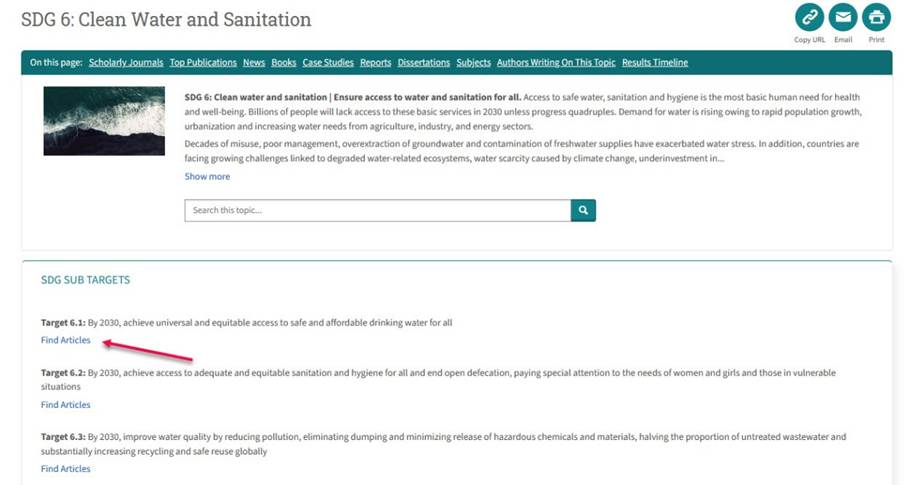
How does this feature work? The database highlights research that relates to each of the 17 goals by listing the goals on the database’s home page. When you click on a specific goal (e.g. “Goal 6: Clean Water and Sanitation”), the database lists the targets within each goal (e.g. “Target 6.1: By 2030, achieve universal and equitable access to safe and affordable drinking water for all”). You can click on “Find articles” to view the literature that addresses this specific target. In the image below, you can see what the “Find articles” link looks like in the database.
One strange quirk of ProQuest One Sustainability is that when you run a search using the default search box on the database’s home page, the database looks for your words anywhere in the description of the items in the database, including in the full text when available. This kind of search is different from most other research databases at McGill that only look for your words in the title, abstract and description of the items and not the full text, which gives a more precise and targeted search. What this means is that in ProQuest One Sustainability, you can get a lot of noise (irrelevant results) cluttering up your search. I recommend going to the “advanced search” and, from the dropdown menu, selecting this option to search instead: “Anywhere except full text.” This kind of search will help you retrieve more focused results and reduce the clutter.
Scopus
Another of my go-to databases for sustainability topics is Scopus and I’ll explain why. Scopus is a multidisciplinary database covering research on every topic you can imagine, and not limited to sustainability-related topics, like ProQuest One Sustainability. You can access it at: Scopus. What makes Scopus stand out in terms of sustainability is that it recently implemented a feature similar to the functionality in ProQuest One Sustainability that ties literature to the Sustainable Development Goals.
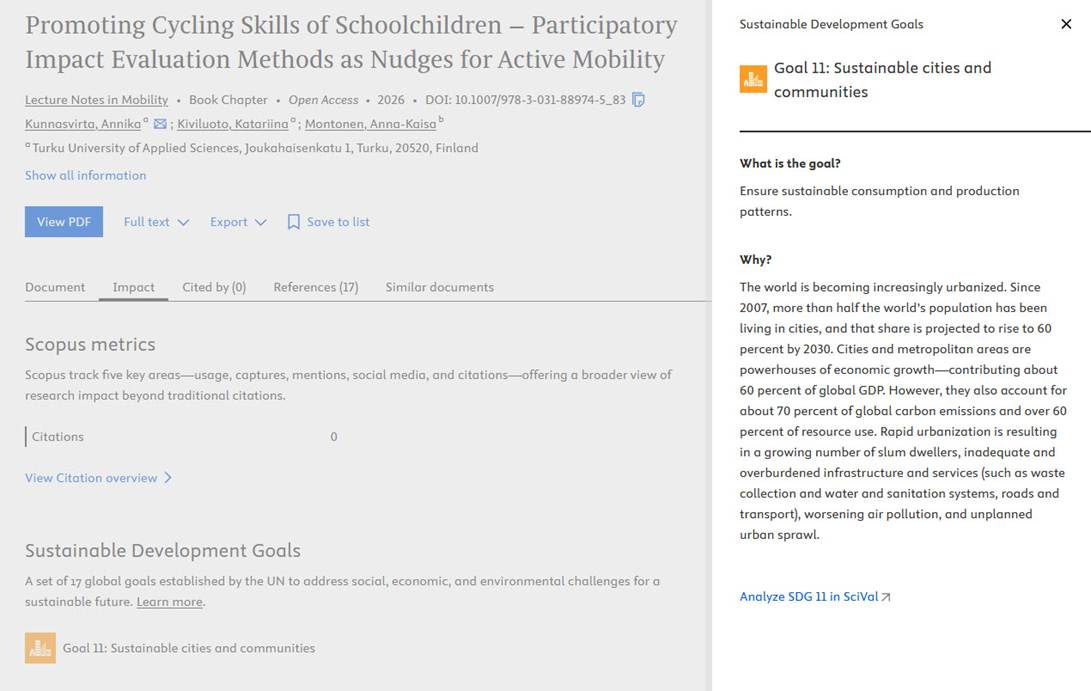
When you run a search, say for cycling in cities, Scopus has incorporated the goals within the description of literature that addresses one or more of the goals. Scopus will help you identify which research articles address the SDGs by indicating, under the “Impact” section of each document’s record, when the research relates to one or more SDGs. Scopus uses machine learning to help identify which articles discuss which SDGs. For example, in my Scopus search: cycling and cities, I found an article on promoting cycling to schoolchildren and after choosing the “Impact” tab, I found that the article mapped to “Goal 11: Sustainable Cities and Communities.” Scopus also gives a summary of what each goal is about and why it is important. Here is what Scopus looks like in action:
Limitations
My hope is that both ProQuest Sustainability One and Scopus will make their mapping features even more useful by integrating a search filter for SDGs, much like the sustainability pillar filter within ProQuest Sustainability One. That way, it will be really easy to filter down from your list of results to only show the literature that addresses a specific SDG. For now, when you run a search in either of these databases from their main search boxes, this isn’t possible. In Scopus, we need to look through all the results in a search one by one to see if there are any SDGs mapped to the research articles. In ProQuest One Sustainability, only those articles listed under the special section on the 17 goals on the database’s home page will get you to research on any specific SDG.
For more information
I hope this gives you a glimpse into how you can use some of McGill Libraries’ best resources to find literature on sustainability topics. You’ll find other resources related to environmental sustainability on my TISED research guide at: https://libraryguides.mcgill.ca/tised and on the Environmental Studies research guide at: https://libraryguides.mcgill.ca/environmental-studies. For help on finding research related to any topic, McGill students and researchers can consult the list of liaison librarians. We’re happy to help!
To mark Climate Action Week taking place this week and spearheaded by the British Columbia Library Association, here are some interesting things that are happening related to environmental sustainability and climate action both here at McGill and further afield:
Do some reading! Various libraries have put together booklists on climate change including these resources:
The University of Toronto Scarborough Library has created a Climate Action Week Reading List with many book titles on climate change. The books in the “Fuelling Hope” section offer lots of good reading for getting inspired.
The University of British Columbia Library has created a variety of climate change booklists on different topics like climate-related books by BC authors, the history of climate science and action, books of hope from strong climate voices and many others.
The University of Waterloo Library has created a climate action booklist with subsections on topics such as sustainable development and innovations.
Join a climate café to share your thoughts and current experiences related to the climate crisis. There are many such groups including this free one offered monthly by the US-based Resilient Activist organization.
Learn more about climate change and the climate crisis by registering for the McGill Course: “ATOC 183: Climate and Climate Change” being offered this winter. Read all about the course in an interview dating from last year when the course first was offered.
Within the McGill Libraries, various units have been hard at work completing the university’s Sustainable Workplace Certification program. In fact, it’s one of the library system’s objectives to have all units certified at the bronze level or higher. Schulich Library is proud to have achieved bronze certification and is currently working toward silver. The new McGill Collections Centre opened in 2024 as a LEED gold certified facility and its staff have now earned platinum level in the university’s workplace certification program. You can learn more about the program and several other sustainability initiatives by checking out information from the McGill Office of Sustainability.
At the time of this writing, we are on day 22 of a U.S. Government shutdown. When the U.S. Government shuts down, most people think of national parks and travel delays. But the impact goes much deeper, into the systems that keep health sciences research and clinical practice running. Many federally-funded databases and information services discontinue updates or suspend operations, cutting off the flow of reliable information that healthcare professionals rely on to make clinical and policy decisions.
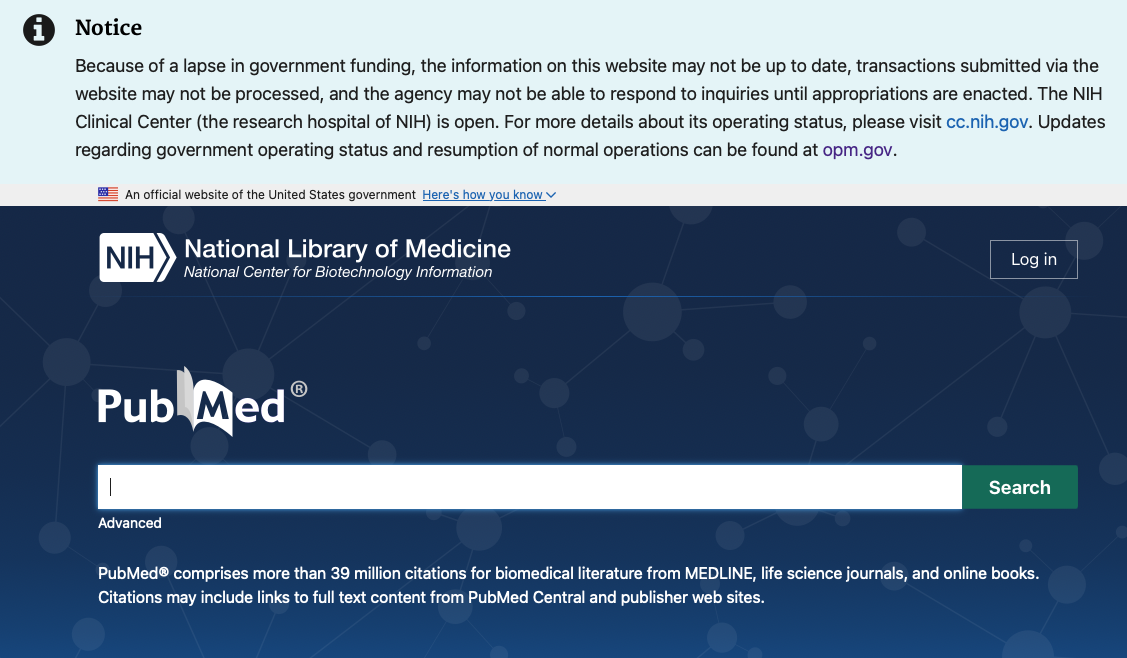
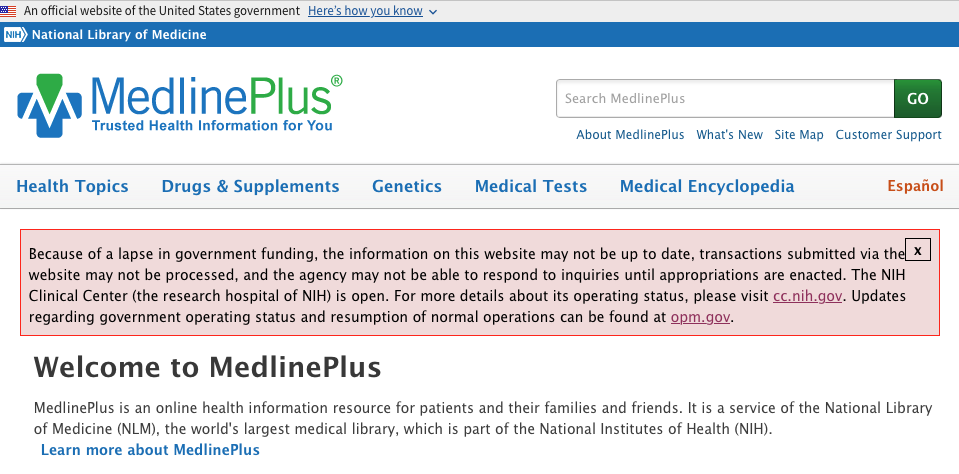
On October 1st 2025, when Congress reached a funding deadlock, disclaimers started popping up on many government websites, including health-related websites regularly used by librarians to support research needs. PubMed, the “National Library of Medicine’s free, searchable bibliographic database supporting scientific and medical research,”1 displayed this alarming banner:
The same banner can be seen on other websites, including MedlinePlus, an information hub for patient and their families, also maintained by the National Library of Medicine (NLM).
Because these tasks are mostly automated, citations are still being uploaded to PubMed, and articles are still being indexed. However, because the National Institutes of Health (NIH) has furloughed thousands of employees, according to Dyer (2025) the indexing of new journals has been suspended.2 But Dyer also notes that when the government resumes its normal activities, the Literature Selection Technical Review Committee – the group responsible for evaluating and approving journals for inclusion in PubMed – will no longer be operational. All 15 members of the committee were terminated by the Trump Administration earlier this fall.3
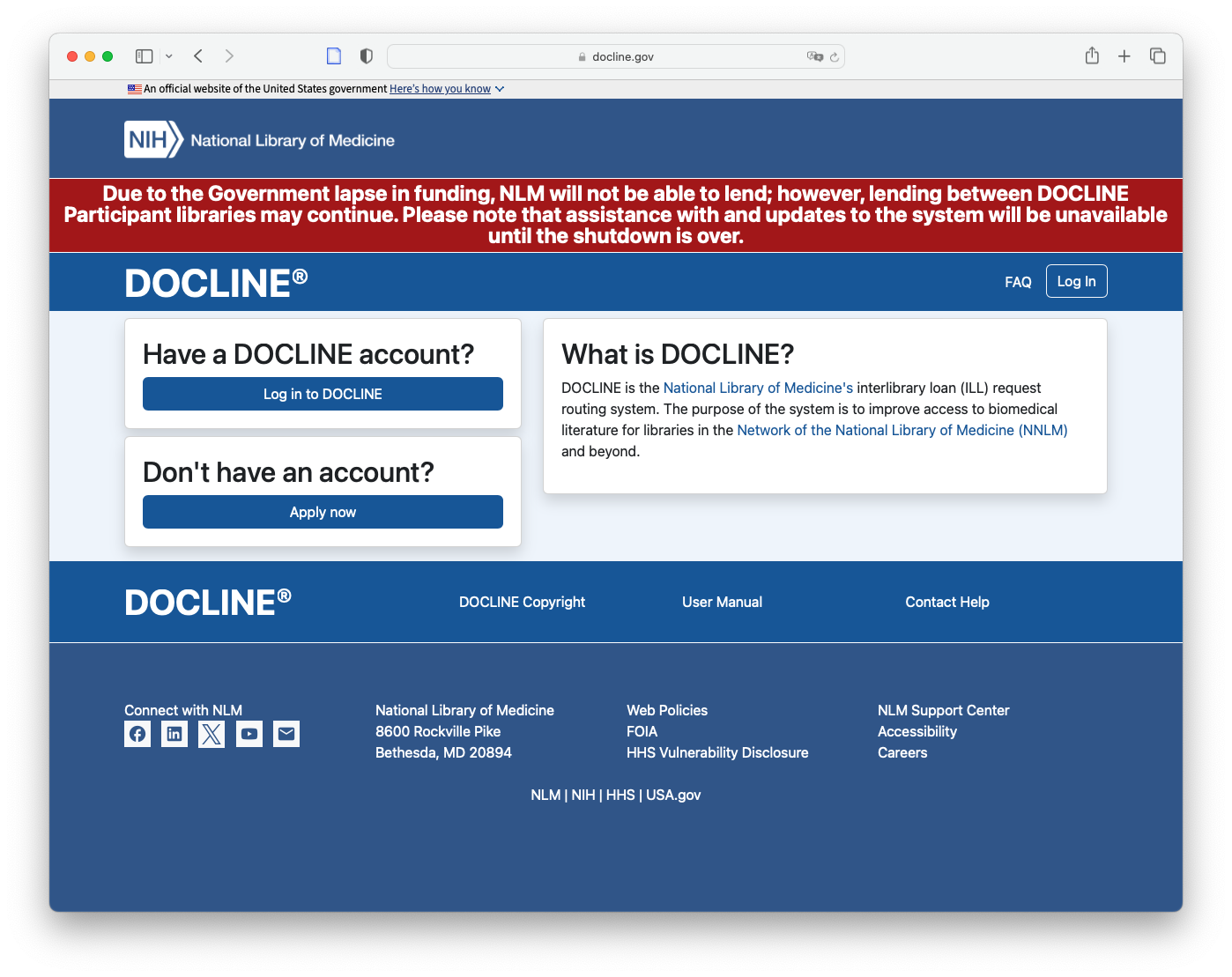
Another service that has been halted is document lending through DOCLINE, the National Library of Medicine’s official interlibrary loan request routing system. The banner on the DOCLINE homepage states that the NLM will not be fulfilling lending requests during the shutdown.4 Fortunately, participating institutions can still request and share materials among themselves. However, in the last few weeks, medical librarians have reported on the Medical Library Association’s listerserv that they are experiencing problems with DOCLINE, specifically that requests are not automatically rerouting as they normally would. As sometimes happens, when the NLM is the only library holding a particular article, requestors are left in the dark, unable to obtain material until government operations resume. For clinicians, researchers, and students who depend on rapid access to medical literature, even short interruptions like this can affect research progress, delay evidence-based decision making and disrupt patient care.
And just as librarians were beginning to adapt, finding solutions and supporting one another as we so often do, another challenge emerged. Last week we learned of the firing of all Centers for Disease Control and Prevention (CDC) library workers. In an earlier blog post on evidence-based medicine, we noted the importance of the CDC and their publication of the Morbidity and Mortality Weekly Report. In an interview the Washington Post, former CDC librarian Gail Bang, said: “It’s hard — almost impossible — for the researchers to do valid scientific research without the librarians.”5 Every Library, an non-profit organization that supports libraries and librarians in the United States, has started a petition calling on the government to reinstate CDC library workers. The petition has been shared numerous times among health librarians.
The current government shutdown highlights just how fragile the infrastructure supporting health information can be. From suspended updates to PubMed and MedlinePlus, to halted interlibrary loan services through DOCLINE, and the recent firing of CDC library staff, the consequences are far-reaching. Librarians work tirelessly behind the scenes to mitigate these disruptions, but even our ingenuity has limits when those responsible for governance fail to reach a compromise.
Dyer, O. (2025). PubMed is running on autopilot during shutdown, but key independent committee has been abolished. BMJ (Clinical Research Ed.), 391, r2158. https://doi.org/10.1136/bmj.r2158↩︎
This October, we join the McGill community in celebrating Queer History Month, a time to reflect on the contributions, histories, and ongoing advocacy of LGBTQ+ communities. During this time, we are reminded of the importance of visibility, inclusion and understanding across all areas of university life.
We are especially excited to highlight the Keynote Lecture, delivered by Kai Cheng Thom on Wednesday, October 22nd 2025. Registration is now open.
To complement this year’s events, the Schulich Library has curated a collection of books focused on LGBTQ+ health, from inclusive care practices and mental health, to intersectional approaches to wellness. The collection features a mix of scholarly titles for researchers and practitioners, as well as consumer health books written for the general public, reflecting the breadth of perspectives and experiences in LGBTQ+ Health. These titles are on display in the library throughout October and accessible online through our curated reading list.
You can continue to explore queer topics through our subject guides:
LGBTQ+ Health Guide: resources on inclusive clinical care, public health, research and consumer health.
LGBTQ+ Studies Guide: interdisciplinary resources on identity, activism and cultural representation.
LGBTQ+ Music Guide: explore the voices, sounds and histories of queer musicians and composers.
Whether you’re attending events, diving into our book collection, or exploring our guides, we invite you to celebrate Queer History Month with curiosity and reflection.
Science Literacy Week as a Canada wide event was paused in 2024 when the administration switched hands to the Canadian Association of Science Centres (CASC). We had a bit of a science literacy celebration this year, back in March, but we are happy to join in with CASC and other educators and organizations to ring in Science Literacy Week 2025, from October 6 – 12.
The theme for the week is From Sea to Space. Check out our Science Literacy guide to learn more.
We were one of the first universities to join the cross-country effort to celebrate science literacy, way back in 2015, so I thought that it would be fun to dig up the old blog posts and events of the past.
In addition to lectures (I attended Prof. Lovejoy’s talk, Why the warming can’t be natural: Harnessing butterflies for climate closure, and it was amazing), workshops and tours, there were fascinating exhibits at the Islamic Studies Library on the History of Science in Islam, and at the Osler Library on Sanitizing style: Germ theory and fashion at the turn of the century.
We also launched Arduino and Raspberry Pi lending at Schulich Library, that was pretty exciting!
Visits to the hives at Macdonald campus and on the roof of the Schulich Library! And that was in addition to workshops, a hands on session with the Oculus Rift, and a Wikipedia edit-a-thon on women in science. There was a Science of Star Trek exhibit at Schulich Library, and Knowing Blood, Medical Observations, Fluid Meanings, at Osler Library.
This year also marked our first lecture by Dr. Joe Schwarcz, a Science Literacy Week regular, on Eating Right: The Facts and the Myths.
Sadly, our movie nights were not that popular (lessons were learned!) but the same cannot be said for exhibits and events around the theme of From Lab to Life. Who wouldn’t want to knit a petri dish with Let’s Talk Science @ McGill or “drop in and bust myths” at Redpath Museum? We got really techie with augmented reality and Raspberry Pi workshops, and a learn to code session with HackMcGill.
There were 4 different library exhibits, and the Music Library joined in with Phonomenal! Rare sides from the history of sound recording. You can still read more about it from their post at the time.
There was a Doctor Who exhibition, Traveling through space and time, at Schulich Library, and The World That You Know Through the Eyes of Muslim Geographers, at Islamic Studies Library. Some really important Treasures from the History of Science in Rare Books and Special Collections were also on display.
The timing was perfect, coinciding with a Public Astronight talk, ORIGINS: How the Earth Shaped Human History, and the Cutting Edge Lecture in Science: Can we halt global amphibian declines?
There was an exhibit in the Redpath Library building on the theme of the week, Oceans, offering different cartographic views of the oceans of the world.
We learned all about the Data Rescue: Archives and Weather (DRAW) project, and The Art of Explaining Science to Non-Specialists with Dr. Diane Dechief. We also had De-Stress + Sketch Online, SLW edition, with the folks from Visual Arts Collection, and a book club meeting for the book, Data feminism, by Catherine D’Ignazio and Lauren F Klein.
Many of the 2020 offerings were back with the addition of some new workshops, like Chart Making in Excel: Going Further by Telling a Story with your Data. AstroMcGill also hosted an online event, Talking with Martians: A panel on red-planet research, and the Redpath Museum brought us an informative online Secret science spots of McGill.
The theme for the week was Mathematics and Prof. Rhonda Amsel did not disappoint with Stats-wise, a presentation on the ‘why’ of statistics. Dr Joe Schwarcz educated us on Analyzing Risk, and we had library workshops on Data Analysis in Excel, Charting numbers for understanding and communication, LaTeX, and Python.
I offered a workshop on spinning wool into yarn with spindles printed on library 3D printers, and it was a blast!
The theme in 2023 was Energy and we really brought it! There was fun with crochet, LaTeX, satellite and drone images, and repairing personal devices. We also learned what every Montrealer should know about earthquakes from Dr. Christie Rowe.
You can still visit the exhibits page to try out the Rare & Special Collections images digital jigsaw puzzles and colouring pages.
With Science Literacy Week on hold in 2024, we decided to have our own version in March of this year. Among other great activities, the Macdonald Campus Library launched their Seed Library that week and we had a fascinating tour of the Rutherford Museum and McPherson Collection with Curator, Prof. Barrette. This might sound wild, but we also learned about ancient Egyptian animal mummies from Prof. Reznikov!
The latest results from the WCOM 206 Excellence in Communication Award competition are in and we have two winners: Sophia Chen (Fall 2023 term) and Alan Fu (Winter/Summer 2023).
It has been such a pleasure to be part of the team that reads and ranks the undergraduate papers nominated by Communication in Engineering instructors each term. I have learned so much!
Now you can learn about the challenges of monitoring hormone levels for transgender and non-binary individuals, and about models to improve malignant brain tumour survival rates. These two were considered the best of their peer group and the full text of the papers have been added to the McGill Libraries’ repository, eScholarship.
Transgender and non-binary individuals may use Hormone Replacement Therapy as part of their gender transition. During this process, hormone levels are measured using immunoassays, which typically include estrogens, testosterones and progesterones. While commercial solutions can automate blood testing, the blood collection process itself is difficult., invasive, and prone to complications. Because hormone levels change throughout the day, a more robust testing solution needs to be developed. Lateral flow assays, a low cost detection device can be developed for quantitative readouts of hormone levels. However, low concentration of the hormones of interest present in the saliva means that this solution cannot currently be used as a diagnostic device. Future investigation is necessary on detection antibodies that are used for this solution. Intended audience: a biotechnical company considering research and development towards hormone monitoring.
Stagnant growth in malignant brain tumor survival rates indicates a need for more powerful models to advance tumor research and pharmaceutical testing. This paper comparatively analyzes three models: 3D cell line xenografts, genetically engineered mice models, and neoplastic cerebral organoids based on comprehensiveness, scalability, and accuracy criteria. 3D CLXs possess excellent scalability but are unappealing in all other aspects. GEMMs are favorable in the aspects of comprehensiveness and accuracy compared to 3D CLXs, but face issues regarding scalability. Finally, neoCORs outclass GEMMs in both comprehensiveness and accuracy while retaining modest scalability, leading this paper to conclude that neoCORs are the most viable model for future development. Future development of neoCORs, especially of assistive microfluidics devices, is strongly recommended.



/2025/Communications/Graphics/Digital%20screens/QHM%202025_Keynote_16x9.png?e=4%3ae64dcd6cd92b42c5a133de7f5ae1b824&web=1&sharingv2=true&fromShare=true&at=9&CID=8a881348-288f-4002-8eab-5d876ce80e82)
