
Peer review process: Confidential or not?

The peer review process is a method of assessing the quality of an individual (in the case of a grant application, for example) or evaluating the quality of a scholarly work (for instance, in the case of a journal article manuscript). It needs impartial reviewers who are experts in the research area for the process to work properly.

I used to think tanonymoushat the journal peer review process was always double-blinded, i.e., the authors did not know who the reviewers of their manuscripts were and the reviewers, in turn, did not know who the authors were. I learned that some journals have a double-blinded peer review process while others have one-sided blinding, i.e., the authors do not know the names of their reviewers but the reviewers know who the authors are. Blinding on one side should not be a problem if the reviewers perform their task objectively and critically.

What are the responsibilities of a peer reviewer and author towards each other? This was a topic discussed in a “CHEE 687: Research Skills and Ethics” class, the content of which is summarized below.

The peer reviewer should:

  • keep the contents of the grant application or manuscript confidential by not sharing it with others;
  • submit his/her comments to the funding agency or journal editor within the allotted time;
  • refuse the assignment if there are any conflicts of interest that can bias his/her assessment of the work;
  • not use any ideas or methods contained in the document (if relevant to his/her own research) until after the reviewed researcher’s work is published; and
  • conscientiously apply any evaluation criteria (supplied by the funding agency or journal editor) to the work being reviewed.

After receiving comments from the reviewers and being invited to resubmit the manuscript, the authors should:

  • respond to each of the comments made by the reviewers with diplomacy and respect;
  • do some further work if additional experiments are requested, since just altering the text in the manuscript will not be enough in most of these cases;
  • be prepared to rewrite sentences or entire sections if the reviewers did not understand the purpose of the research; and
  • consider the reviewers’ comments as an opportunity to improve the manuscript and make it the best it can be.

The peer review process is not infallible (see Nature article about peer review frauds as an example). However, when it is conducted correctly, I believe that peer review improves the quality of the submitted work before it is published.

This is the third in a series of weekly posts about topics relating to research skills and ethics. Stay tuned for the next post in the series, which will be about scientific misconduct and questionable authorship practices.

Image from the Laugh-Out-Loud Cats cartoon strip by Adam “Ape Lad” Koford (creative commons license)

Another puzzle completed

Sometimes we just need a little amusing distraction. We have a Puzzle Corner in the library to help individuals take a break from their work. It is located on the main floor of the Schulich Library of Science & Engineering, walk past the elevators and turn to your left. Below is the 1,000 piece puzzle that was just completed (minus a few pieces that went missing and which I will have fun recreating).

boat puzzleA new puzzle was set out today and is waiting to be assembled. Enjoy!

Being responsible for research work: Who should be a co-author?

I often see multiple individuals listed as authors for a single journal article in the sciences and engineering. While teamwork is expected in these fields, I wonder who did what for the research discussed in the article when the list of authors is long, e.g., exceeds five. Perhaps, some names were included on the paper for political reasons rather than intellectual contribution to the work. In the “CHEE 687 Research Skills and Ethics” graduate course that I am attending this semester, the class discussed criteria or guidelines to consider when determining who should be a co-author on a paper.

meet the authorsCo-authorship is not automatic; it is earned. An individual would be offered co-authorship on a journal article or would ask to be a co-author. To be a co-author, a person should have done the following:
1) made a significant intellectual contribution to the work by participating in the creation of the research question and plan, the data collection, and/or the analysis and interpretation of the results;
2) agree to be accountable for the entire content in the article (not just for his/her contribution), which means that all authors must communicate with each other so that everyone understands exactly what was done and said in the article;
3) participate in drafting the article; and
4) critically evaluate and double check the content of the final draft.

If someone does not do all of the above, one could successfully argue that the person should not be a co-author but, rather, can be listed in the acknowledgements section if he/she helped in some way. Just communicating ideas to the lead author, providing feedback, editing, or helping with a task does not automatically make a person a co-author.

thought experimentThis is the second in a series of weekly posts about topics relating to research skills and ethics. Stay tuned for the next post in the series, which will be about the peer-review process.

Images from the Laugh-Out-Loud Cats cartoon strip by Adam “Ape Lad” Koford (creative commons license)

Reading and writing research: What makes a good scientific paper?

I am fortunate this semester to be able to participate in a new graduate Chemical Engineering course called “CHEE 687 Research Skills and Ethics,” taught by Professor Nathalie Tufenkji. This course covers a wide range of topics dealing with how to conduct research as a graduate student and professional, such as best practices for keeping a lab notebook, how to recognize and manage conflicts of interest, what elements to include when writing a scientific paper, how to determine who should be a co-author on a paper, etc. I find the classes very engaging and practical, thereby inspiring me to write about some of the topics presented with the belief that it might be of interest to readers doing their own research.

The first topic I would like to discuss is about scientific writing. We may have a sense when we are reading a research article that it is difficult to read or that there is something quite not right with the article, but we may not always be able to articulate the reasons why.

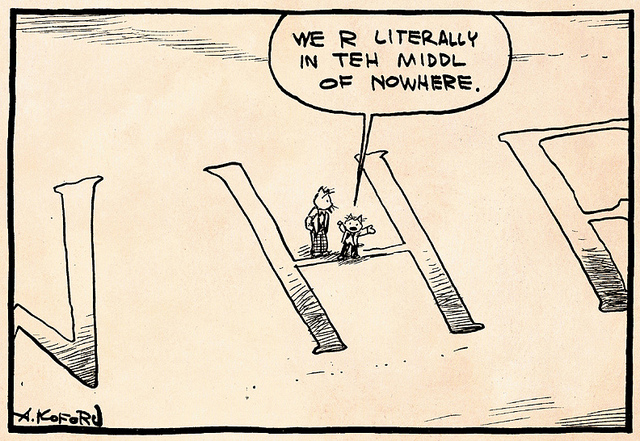
middle of nowhereWhat are the characteristics of a good scientific paper? What should we look for when reading a paper and what elements should we consider including when writing one? We tackled this topic in class by discussing what should be in each section of a research article, which is summarized in the points below:

  • Introduction/Background section: Publishing a journal article is a method of communicating research findings and helps build a researcher’s professional reputation. However, Professor Tufenkji also reminded us that one of the purposes of a research article is to educate readers. Imagine that one of the article’s readers is a beginning graduate student in this area. Therefore, the introduction/background section of the article is where the authors should explain the context of the research by summarizing and citing previous work in the area, describing how this study builds on previous publications or is different from them, stating the motivation of the study (the “why”), and presenting the research question/hypothesis (the “what”). This section usually starts from the general (the summary of previous work) and moves to the specific (the research question/hypothesis).
  • Methods section: Includes a detailed description of the steps the authors took to conduct the experiment/study (the “how”) so that readers can reproduce the study if they wish. The more details the authors can provide to help the reader understand and replicate what was done, the better (e.g., state the pH of a sample, the volume of the sample, how or where it was obtained, etc.).
  • Results section: Simply describes what was found. The results section should be presented in the same order as the methods section to make it easier for readers to follow. For example, if the authors conducted two experiments and described the steps for Experiment 1 first in the methods section, then the reader would also expect the results for Experiment 1 to appear first in the results section.
  • Discussion & conclusion sections: Interpret the results by explaining to the reader what the data means and comparing this data to previous published literature on the topic. This is also where the authors use the data to make appropriate and logical conclusions (without generalizing or over interpreting the results) and describe directions for future research.

The authors should write the paper in a way that makes the greatest impact on its readers, such as writing an article title that describes the major finding of the article and writing the article in a language that is as clear as possible (see a list of wordy phrases to avoid using when writing a manuscript).

lol titleRemember that while the article is written in the order that the authors went about conducting the experiment/study (i.e., Introduction/Background – Methods – Results – Discussion/Conclusion), this does not mean that you need to read the article in this order. I frequently skim a research article in the following order to quickly extract the main points: after reading the abstract, I jump to the discussion and conclusion sections to find out what the research all means, then back track to the introduction/background to get the context for the research, look at the results for more details of what was found, paying attention to any figures or tables that summarize the main findings of the article, and finally examine the details in the methods section. If the article is relevant for my own research or impacts my professional practice, I will read it thoroughly, otherwise I will put it aside.

This is the first in a series of weekly posts about topics relating to research skills and ethics. Stay tuned for the next post in the series, which will be about determining authorship for a scientific paper.

Images from the Laugh-Out-Loud Cats cartoon strip by Adam “Ape Lad” Koford (creative commons license)
CmapTools in the Cloud (yay!)

Have I been waiting for this to happen…I’ve been using the freely available desktop version of CmapTools for years, extolling the virtues of this classic concept mapping tool, and now the good folks at the Florida Institute of Human & Machine Cognition (IHMC) have unveiled Cmap Cloud.

Concept maps are graphical representations of knowledge – think brainstorming or mind mapping but a little more structured. They usually start with a focus question and run hierarchically, demonstrating the relationships between concepts. One of the great things about CmapTools is that when you connect two concepts together you are prompted to add a linking phrase to define the relationship. Rather than just typing [pie]–[cherry], you might specify [pie]-can be-[cherry]. It turns out that this is not the easiest thing to do. We can write reams of text on a topic but at the same time get rather stuck mapping it out. In this way, concept maps demonstrate our knowledge of a subject area and reveal misconceptions. When we add new information to maps, we build connections to what we already know and meaningful learning can occur. Concept maps can also be used in groups to reach a shared understanding of the tasks at hand, with the added bonus that concepts in CmapTools can have resources attached to them. If you haven’t yet taken the time to explore the software, I invite you to try today and get in touch with me if you have questions.

Back to the Cloud. The desktop version allows you to save concept maps on a public server and create a website for sharing – amazing – but with the advent of the Cmap Cloud, you can also save your maps there and edit them online. I have been using it for a couple of days now and it can be a little slow at times, but many of the features are there. The nice part is that you can make friends with other Cmappers and share folders to work on projects together.

IHMC also have a new CmapTools for iPad. It is free to download but there is an in-app purchase to be able to export maps and sync them with the Cmap Cloud. I’ll be spending some time with it so look for my review on our new mobile apps blog.

Welcome Aleiah!

aleiah closeup picture

I would like to introduce a new student blogger to the Turret. Her name is Aleiah and she is a student in “CCOM 206 – Communication in Engineering” at McGill this semester. The course gives students an opportunity to develop their writing skills through various types of writing including a research paper, a cover letter, and a business proposal. She is a 3rd year student in Mechanical Engineering who is interested in aerospace and wants to works in aircraft design. She is originally from Winnipeg. Welcome to the Turret Aleiah! We look forward to having your perspective as a McGill engineering student added to the blog!

3-Day Dissertation Writing Retreat

Nov 10, 11, and 12; 9am-4pm

Need to carve out dedicated time to stay on track with your dissertation?  Struggling with writing blocks?  Think you might benefit from consults with writing tutors, librarians and others to help you reflect on and strengthen your work?  Apply now for a 3-day dissertation writing retreat.  Limited spaces available!

Raspberry Pi’s and Arduinos come to Schulich

Launch of Raspberry Pi and Arduino lending program at Schulich - 21 Sept 2015We had a lot of fun this morning at Schulich launching our new Raspberry Pi and Arduino lending programme! These devices are two types of credit-card sized computer which are developing a rapidly growing following due to the ways they can be incorporated into a wide range of projects.

IMG_2108Schulich will start lending these items out later this week, for a loan period of two weeks, and will be monitoring the service over the next few weeks – the kits will be available on a first-come, first-served basis like all other library materials.  We’ll also be lending out a robotics unit and a wearable computing device.  Please come to the Schulich loans desk if you’d like to borrow a kit.

We’d love to hear about the creative ways these are used by the McGill community!  If you take out a kit, please spare us two minutes to give us your feedback using this form, and consider sending pictures of your project.

Get your knit on at Schulich!

Knit knacks

Feeling stressed? Now you can stitch away your cares at Schulich Library. The Schulich Knit Knacks bin of knitting supplies is located by the Wendy Patrick Collection on the main floor. Take yarn, leave yarn. Bring your own needles, donate old needles, or borrow ours.

Happy knitting!

Science Literacy Week: Register today

At Schulich Library we ♥ science and we have created an amazing lineup of events to share our love of science with you. This year we are participating in Science Literacy Week and it is only one week away: September 21st – 27th.

I invite you to visit our guide to Science Literacy Week @ McGill, where you will find info on exhibits and events organized by the Library and the Redpath Museum.

There are so many events scheduled that I will let the list speak for itself:

Register today!